

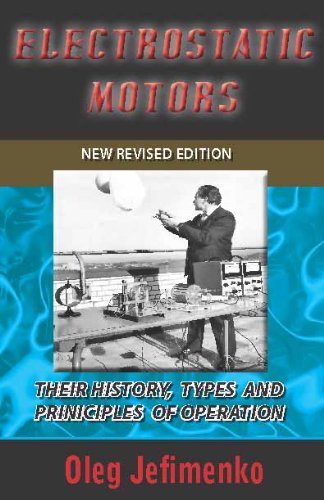
Ebook Info
- Published: 2011
- Number of pages: 159 pages
- Format: PDF
- File Size: 2.06 MB
- Authors: Oleg Jefimenko
Description
The most authoritative and comprehensive book on the subject of using high voltage electric charge to power a motor. The book shows the type of electrostatic motor that was first invented by Ben Franklin in 1748. It also reviews and illustrates electric pendulum motors, electric wind motors, Franklin’s spark motors, capacitor motors, inductance motors, corona motors, liquid immersed motors, electret motors and more. The last chapter shows how the electrostatic motor can be designed to be powered by atmospheric electricity, which Professor Jefimenko experimented with at the University of West Virginia. The author is very meticulous to give dates and references for the historical use of particularly unique electrostatic motors. Dr. Jefimenko’s articles from Popular Science magazine are reprinted in the Appendix for those who want to build their own electrostatic motor. He also reviews the atmospheric potential for generating energy, pointing out it is in the gigawatt range. The book also includes his review article on the earth’s electric field as a natural source of electrostatic energy.
User’s Reviews
Editorial Reviews: Review Dr. Oleg Dmitrovich Jefimenko (1922-2009) was among the most valued of contributors to the Electric Spacecraft Journal. He supplied ESJ with review copies of his books, including Electrostatic Motors: Their History, Types, and Principles of Operation; Electromagnetic Retardation and Theory of Relativity: New Chapters in the Classical Theory of Fields; Causality, Electromagnetic Induction, and Gravitation: A Different Approach to the Theory of Electromagnetic and Gravitational Fields; and Electricity and Magnetism: An Introduction to the Theory of Electric and Magnetic Fields. ESJ reviewed his ideas on retardation, current density, and various atomic clocks in previous journals. (See ESJ 6:37-38, 22:38-39, 31:6-9, and 40:25-27.) The following review of Electrostatic Motors is presented as a tribute in honor of the life work of a serious investigator in the physical sciences, who shared ESJ s passion for questioning assumptions, while never letting go of empiricism and reason. Undertaking investigations into electrostatics in the early 1970s, Jefimenko found the field largely abandoned. Toys had been created as curiosities in the 1700s, when the science was too primitive to take seriously. Jefimenko found the written record replete with colorful commentary, but devoid of quantitative analyses. His research into the topic included consulting ancient texts, forgotten journals, and museum closets where a lot of electrostatic machines had been stored for lack of understanding. The main reason electrostatic motors had not been taken seriously is that great voltages are required for their operation, and ESD is always working against the maintenance of high voltages. Nonetheless, some electrostatic motors have been built that run off input voltages in excess of 100 kV; others operate with currents on the order of nanoamps. One pendulum type electrostatic motor at the University of Innsbruck, Austria, operated nonstop off a Zamboni pile for eighty-six years. Another class of electrostatic motors would be the corona motors, developed by W. Holtz and J. C. Poggendorff. They consisted basically in the running of Wimshurst generators in reverse. A combination of fallacious appeals to authority and circular reasoning prevented the public s imagination from being captured to convert these machines into anything useful. A very different class of motors, known as capacitor motors, was invented by Karl Zipernowski. These motors consisted of a four-blade flat fan rotating between two brass cutouts of the same size and shape. Another unusual class of electrostatic motors is the electret motors. Electrets are permanently charged dielectrics, the electrical analogy of permanent magnets. A. N. Gubkin made the first electret motor. It consisted of diametrically situated electrets. The electret paddle was free to rotate through the dielectric spaces of two diametrically-situated capacitors. The polarity of the capacitors was regulated by commutators. Jefimenko had high hopes for a clean, renewable source of energy that would make electrostatic motors feasible. He invested a lot of effort attempting to harness appreciable horsepower from altitude induced potential differences in the atmosphere. –Electric Spacecraft Journal, Issue 47, March 30, 2011This is an outstanding book not to be missed by anyone who is interested in energy generation. It is the best source of information and history regarding atmospheric electricity powering a motor and the various types of electrostatic motors that are suitable for atmopheric conversion of energy. The author, Professor Oleg Jefimenko from West Virginia University, estimated the potential energy reserve of the atmospheric electricity to be 200 gigawatts. Therefore, this book provides the impetus for a new source of energy, especially in dry climates where it can be utilized throughout the year. –Thomas Valone, PhD, PE About the Author Professor Jefimenko (1922-2009) was hard-working, gifted, and lucky. He was born in the Ukraine. Caught in the buildup to World War II, he was forced into the Russian army and sent to Siberia for training. He was wounded at the Russian-German front, avoided capture and received medical treatment from a witch-doctor in a nearby village. Later he was apprehended and sent to a German work camp. His independent spirit attracted attention and extra beatings from guards. He managed to trade food rations with another prisoner for a book written in Russian about how to speak German. Guards stopped beating him once he began to speak their language. He improved his situation by learning to run a metal lathe and spent the rest of his time in the camp machining gun barrels. After the war he studied physics at the University of Goettingen, Germany (Vordiplom, 1950) where he attended lectures of famous scientists of those times. He married and came to the United States in search of new opportunity. His formal education was completed at Lewis and Clark College, Portland Oregon (BA, 1952), and University of Oregon (MA, 1954 and PhD, 1956). Oleg spent his entire career at West Virginia University Department of Physics. His lectures were enlivened by lecture room demonstrations. Most novel was his water stream loop-the-loop . Oleg s serious research work involved both theory and experimental aspects of spectroscopy, electricity and magnetism, and electrostatics. After retirement he had more time to explore new topics and wrote books on gravitation – cogravitational fields, electromagnetic retardation, and relativity.
Reviews from Amazon users which were colected at the time this book was published on the website:
⭐This is a small poorly organized book that provides brief potted descriptions of the numerous devices shown in line drawings, and in some not very clear photos. What really frustrates me is that although the working of most of the devices is obvious, there are a few that need a clear explanation, yet none is given. For example, all we are told about the electric racing ball is that “an excellent description {is} provided by M Guyot.”This is all very well if you can read French and track down an article written in 1786.Another problem is that no attempt is made to describe the technology of the materials used to build these ancient devices. I found that almost every question I had about the devices shown in the book required me to search outside it for the answers.
⭐Very good book on the subject!Most informative!
⭐This bok provided me with ideas for many electrostatic experiments for a middle school electrostatics class.
⭐Just great. Perfect new condition. Thanks.
⭐Old but good
⭐Satisfied
⭐Book is the summary of the history of the electrostatic motors with timeline extending to ~1970.A lot of historic illustrations.Numerical data on electrostatic motors performance is nearly absent.Comparison with the classical electromotors is biased in favor of the electrostatic motors.No data on newer developments of cold-emission cathode and MEMS electrostatic motors.
⭐good read
⭐good reprint…good overview of the electrostatic motors variety/experiments…good reading on the subject…
⭐Es handelt sich um den Neudruck der Originalversion von 1973.Die Information zu allen (?) elektrostatischen Motoren nach unterschiedlichen Prinzipien ist wirklich umfassend. Der Autor hat zu jeder Version eine kurze Beschreibung beigefügt.Aber: Es handelt sich um ein Reprint des Originals. Hierbei ist die Wiedergabe der SW-Fotografien unterirdisch schlecht. Im Buch sind genau 12 Fotos davon betroffen. Das Druckverfahren kommt mit einem sehr groben Druckraster daher (geschätzt 50 dpi). Es gibt keine Graustufen, diese werden nur mit unterschiedlichen Pixelmustern simuliert. Furchtbare Moiré-Effekte und schrecklich Unschärfe sind die Folge. Man fühlt sich 50 Jahre in die Vergangenheit der Xerokopien katapultiert.Eine Kopie der Originalversion gibt es im Netz von der Denver Campus Library der University von Colorado. Ich habe die schrecklichen Bilder mit den Kopien aus dieser Ausgabe ersetzt.Die zahlreichen SW-Skizzen im restlichen Buch sind davon natürlich nicht betroffen.In den Fotos (eigentlich muss man das nicht sagen)1. Bild: Reprint2. Bild: OriginalIt was fascinating to learn about electrostatic motors, a subject most people have never heard about. These high-voltage and low-current devices could have a number of revolutionary applications. I found particularly interesting the idea of harvesting atmospheric electricity.I would have liked to see more practical details, to be able to reproduce some of the mechanisms.
⭐Me gustó todo4 stars
Keywords
Free Download Electrostatic Motors: Their History, Types and Principles of Operation in PDF format
Electrostatic Motors: Their History, Types and Principles of Operation PDF Free Download
Download Electrostatic Motors: Their History, Types and Principles of Operation 2011 PDF Free
Electrostatic Motors: Their History, Types and Principles of Operation 2011 PDF Free Download
Download Electrostatic Motors: Their History, Types and Principles of Operation PDF
Free Download Ebook Electrostatic Motors: Their History, Types and Principles of Operation