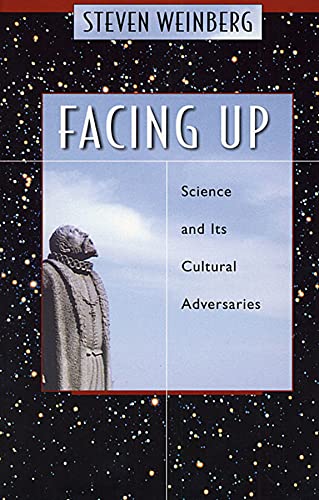
Ebook Info
- Published: 2003
- Number of pages: 306 pages
- Format: PDF
- File Size: 0.00 MB
- Authors: Steven Weinberg
Description
The New York Times’s James Glanz has called Steven Weinberg “perhaps the world’s most authoritative proponent of the idea that physics is hurtling toward a ‘final theory,’ a complete explanation of nature’s particles and forces that will endure as the bedrock of all science forevermore. He is also a powerful writer of prose that can illuminate―and sting… He recently received the Lewis Thomas Prize, awarded to the researcher who best embodies ‘the scientist as poet.’” Both the brilliant scientist and the provocative writer are fully present in this book as Weinberg pursues his principal passions, theoretical physics and a deeper understanding of the culture, philosophy, history, and politics of science. Each of these essays, which span fifteen years, struggles in one way or another with the necessity of facing up to the discovery that the laws of nature are impersonal, with no hint of a special status for human beings. Defending the spirit of science against its cultural adversaries, these essays express a viewpoint that is reductionist, realist, and devoutly secular. Each is preceded by a new introduction that explains its provenance and, if necessary, brings it up to date. Together, they afford the general reader the unique pleasure of experiencing the superb sense, understanding, and knowledge of one of the most interesting and forceful scientific minds of our era.
User’s Reviews
Editorial Reviews: Review “Steven Weinberg is a national treasure. Not only is he one of America’s greatest physicists, he is also a delightful essayist as well. In Facing Up, he addresses the issues of objectivity, reductionism, and the nature of science in rightful ways sure to outrage postmodernists.”―Eric J. Chaisson, author of Cosmic Evolution“In this wonderful and compelling collection of essays, Steven Weinberg–one of the greatest and most influential of physicists–convincingly argues that the more we discover about the laws governing the cosmos, the less it seems that we have any special status or role to play. While Weinberg may well be right regarding the absence of a divine plan for human beings, you cannot help leaving these finely written essays feeling uplifted by the boundless curiosity and ingenuity of the human spirit.”―Brian Greene, author of The Elegant Universe“In 23 previously published articles and miscellaneous speeches, which span 15 years, the Nobel Prize-winning particle physicist takes up arms against a sea of post-modernists, religionists, mystics, and even some liberal critics of modern science…However, interspersed with the arguments, counterarguments, and rebuttals of adversaries are two quieter gems: a tour-de-force summary of 20th-century physics’ accomplishments and a brief description of the moment of inspiration for his development of the theory unifying the weak and electromagnetic force.”―Kirkus Reviews“Winner of the Nobel Prize for physics in 1979, Weinberg will be well known to science buffs for his book The First Three Minutes and to a wider readership for his frequent essays in the New York Review of Books. He is one of the foremost proponents of reductionism, ‘the explanation of a wide range of scientific principles in terms of simpler, more universal ones.’ He has also been a major figure in the so-called science wars, arguing against writers like Derrida and Latour who question the objective character of scientific knowledge and maintain that cultural factors influence the nature of scientific discoveries…Yet he is quite adept at explaining complex concepts clearly to the general public.”―Publishers Weekly“Cogent and lucid, this collection of essays helps general readers understand both why the so-called science wars have aroused such passions within the academy and how these wars have affected sociopolitical events far beyond university campuses.”―Bryce Christensen, Booklist“The essays in Facing Up are illuminating and entertaining. They range across many subjects where Mr. Weinberg has points to make or turf to defend. There are excursions into quantum physics, cosmology, the history of science, and science’s relationships with politics and religion.”―The Economist“[Facing Up is] lucidly written as ever, with a gentle humor that does not hide [Weinberg’s] strong convictions on science, philosophy and religion. I unreservedly recommend it, not only to scientists but to all who share his beliefs in the contribution that science has made, and will continue to make, to the way we see ourselves and our world.”―Brian Pippard, Times Literary Supplement“Anyone who has read Weinberg’s essays in The New York Review of Books over the years knows that, in addition to being a superb popular expositor of science…the distinguished Nobel Prize physicist has not shied away from polemically treating more controversial matters as well…Weinberg’s writing is a joy. Difficult ideas are explained in a language that is learned, unpretentious, elegant, and persuasive all at once–it is the quality of the ideas that comes through, ideas needing no embellishing obfuscation of style. Much, much to be learned here…A valuable, important book. Highly recommended.”―M. Schiff, Choice“People interested in the role of science and technology in our culture and everyday life, and in its preservation and strengthening, will find stimulating arguments to compare to their viewpoints. I have found a reassuring confidence on the universal standing of science in the shaping of human culture and also an amusing unifying thread in the fortuitous fact that [these] books share the rejection of intellectual smokiness as enacted in the famous Sokal’s hoax, a must in any humanity and science curricula of university classes all over the world.”―Vittorio Sgaramella, History and Philosophy of the Life Sciences“Weinberg writes well and his clear style and strong opinions hold the reader’s attention. He says he has “a taste for controversy”, and this punchy and provocative writing certainly bears this out…This is an interesting book, with a lot to question and (I believe) disagree with, but is well worth reading.”―John Polkinghorne, Nature“Steven Weinberg inhabits a bleak world infested with adversaries that he is impelled to combat. He faces up to them with scientific rigour and lawyerly precision, as readers of this fascinating book of essays will discover with pleasure…Weinberg is a noble warrior in the science wars…Read this book.”―John Ellis, Physics World About the Author Steven Weinberg won the Nobel Prize in Physics for his theory unifying two forces of nature, laying the foundation for the Standard Model of subatomic physics. His other awards included the National Medal of Science and eighteen honorary degrees. Among Weinberg’s books are the classic The First Three Minutes and To Explain the World. He was a frequent contributor to the New York Review of Books and taught at the University of Texas.
Reviews from Amazon users which were colected at the time this book was published on the website:
⭐One probably cannot but be impressed by the honors received by the author, and they appear well deserved. In connection perhaps with science’s “cultural adversaries” of the book’s subtitle, I share the author’s dissatisfaction with much of philosophy as he indicated in his last paragraph (p.270).But I don’t agree with his sentiment in that paragraph that it is not “actually possible to prove anything about most of the things (apart from mathematical logic) that they [philosophers] argue about”. Aristotle’s syllogisms, also complained about in that paragraph, are an achievement in logic independent of mathematics, and occasionally thinkers like Descartes (
⭐) or the British empiricists contributed insights into epistemology, into how knowledge is acquired. Modern philosophers, I agree, contribute no insights outside those of science (to which they are subservient, if not its “adversaries”), notwithstanding their voluminous writings.However, this doesn’t mean it isn’t possible to logically demonstrate facts about the world without the aid of science, and without contradicting most of its tenets. Although it appears quite bold, I do just that in
⭐. The title may suggest some of the areas in which I question the contentions of the book reviewed. The author often states such as: “no biologist today would be content with an axiom about biological behavior that could not…have an explanation at a more fundamental level of physics and chemistry…” (pp.22-3); “the forces that act within atoms…produce all the rich variety of chemical behavior which…produced the phenomenon of life” (p.31); “If we ask any question about nature…and keep asking why…we will get a series of answers that generally takes us down to the very small” (p.40); “life emerges from biochemistry; biochemistry emerges from atomic physics; and atomic physics emerges from the properties of elementary particles…” (p.58); “and vitalism, the belief in autonomous biological laws is safely dead” (p.59).The author here engages in the classical “not seeing the forest for the trees”. As a particle physicist he is intensely involved in the reductionist efforts of finding the elementary building blocks of matter, the “final theory” as he puts it, simultaneously assuming that with that finding there can be no other basic principle producing worldly events.One can only consider human volition, which utilizes those elementary physical forces for its own purposes, not for purposes of those forces, understood to be purposeless. But this goes much farther. Animal volition is only part of the property in all organisms to function purposely, in general toward their survival. There is accordingly indeed more that determines physical events than their microscopic functions. This leads to other, macroscopic, issues, in particular to theistic ones, also dealt with by the author.He argues variously against theism, one of his points being: “Either you mean something definite by God, a designer, or you don’t. If you don’t, then what are we talking about?” (p.234), he seeking a meaning like “a deity more or less like those of traditional monotheistic religions” (p.232). His complaint about meaning “something definite by ‘God’ or ‘design'” doesn’t accord with his views on meaning elsewhere, saying (p.206) that though “it is terribly hard to say precisely what we mean [by] words like ‘real’ and ‘true'”, and he respects “the efforts of philosophers to clarify these concepts, [he is] sure that even [they] have used words like ‘truth’ and ‘reality’ in everyday life, and had no trouble with them”.While a deity meant by traditional religions may be easier to dispute, it is more justified to consider a supreme being in a universal sense of indeed basic attributes like of a designer. Design can be equated with purpose, which is the crux of the recent disputes between Darwinism and its opponents: Is there a God of purpose? Specifically, is there a higher power with purpose for the living?An answer has been given by the preceding observation of purpose in all organisms.
⭐excellent!
⭐This book is a collection of essays that to a large extent share the theme in the title: Science and Its Cultural Adversaries. Of course, the title begins with the words “Facing Up” which to Weinberg has three meanings: looking upwards as an astronomer, facing up to the conclusions one derives, and looking upwards rather than downwards as if in prayer.Well, who are the cultural adversaries of Science? Creationists? Certainly. But there are others. Weinberg agrees with most of the Creationists about truth being a value. The disagreement with them is about which side possesses it. There are others who attack the value of truth, including many multiculturalists. We Westerners say that the Milky Way is a Galaxy, our home Galaxy. That works for us. Mayan culture had the Milky Way as a river in the sky. That may have worked for them. Can Weinberg say that one belief is better than the other? He sure can. As he says, “Western astronomers got it right.”Weinberg criticizes some political attacks on truth as well. That’s the point of his very short (about one page) article on Zionism. His point is not that anti-Zionists may tell specific lies as a means to some goal (such as winning a war). It is that, especially when he deals with fellow Western liberals, anti-Zionism is an attack on Western civilization and the culture of science in general, so that defeating truth as a whole becomes an anti-Zionist goal. It is also the point of his article about utopias, some of which idealize a world in which the cultural adversaries of Science are either right or victorious or both.Still, the most interesting articles are on Reductionism. This is a philosophy of trying to explain phenomena in terms of a finite set of laws, describing something complex in terms of the less complex, and describing large numbers of obervations with just a few simple rules. It is not simply an act of trying to describe objects in terms of their components. For Weinberg, reductionism is an important part of scientific culture.It’s an intriguing and informative book, and I recommend it.
⭐It is indeed about science and scientists.About Newtoanism, Reductionism, Zionism, Galileo, Thomas Kuhn, …Written by a great scientist
⭐good price for a good book
Keywords
Free Download Facing Up: Science and Its Cultural Adversaries in PDF format
Facing Up: Science and Its Cultural Adversaries PDF Free Download
Download Facing Up: Science and Its Cultural Adversaries 2003 PDF Free
Facing Up: Science and Its Cultural Adversaries 2003 PDF Free Download
Download Facing Up: Science and Its Cultural Adversaries PDF
Free Download Ebook Facing Up: Science and Its Cultural Adversaries