

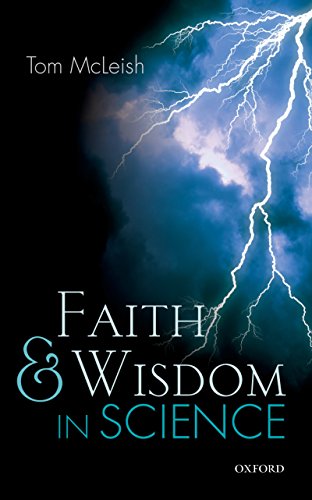
Ebook Info
- Published: 2014
- Number of pages: 302 pages
- Format: PDF
- File Size: 2.30 MB
- Authors: Tom McLeish
Description
“Can you Count the Clouds?” asks the voice of God from the whirlwind in the stunningly beautiful catalogue of nature-questions from the Old Testament Book of Job. Tom McLeish takes a scientist’s reading of this ancient text as a centrepiece to make the case for science as a deeply human and ancient activity, embedded in some of the oldest stories told about human desire to understand the natural world. Drawing on stories from the modern science of chaos anduncertainty alongside medieval, patristic, classical and Biblical sources, Faith and Wisdom in Science challenges much of the current ‘science and religion’ debate as operating with the wrong assumptions and in the wrong space. Its narrative approach develops a natural critique of the cultural separation ofsciences and humanities, suggesting an approach to science, or in its more ancient form natural philosophy – the ‘love of wisdom of natural things’ – that can draw on theological and cultural roots. Following the theme of pain in human confrontation with nature, it develops a ‘Theology of Science’, recognising that both scientific and theological worldviews must be ‘of’ each other, not holding separate domains. Science finds its place within an old story of participative reconciliation with anature, of which we start ignorant and fearful, but learn to perceive and work with in wisdom. Surprisingly, science becomes a deeply religious activity. There are urgent lessons for education, the political process of decision-making on science and technology, our relationship with the globalenvironment, and the way that both religious and secular communities alike celebrate and govern science.
User’s Reviews
Reviews from Amazon users which were colected at the time this book was published on the website:
⭐Well written, by a very intelligent man.
⭐A good book that has framed new investigation and theological reflection. Will read again in next while to reinforce my thinking.
⭐The most original discussion of science and faith since Polkinghorne in the 1990s. I thoroughly enjoyed the balanced treatment of both science and theology
⭐Brilliant, superb!Every scholar/believer in our line of work (science) should read and enjoy Prof. McLeish’s grand tour through most of what we know and believe.
⭐Must reading for those who are tired of listening and reading about entrenched views of this issue.
⭐Splendid!
⭐Do you wonder about the divide between science and faith? Are puzzled by when and how this chasm came about and if it permanent? If so, Prof. Tom McLeish of Durham University (UK) has some news for you. He sees the divide as more a issue of perception rather than fact.Prof. McLeish opens the book with an examination of the “Clamour of Voices” that arise when trying to discover a working definition of “science.” He then guides the reader on a journey through the past looking at specific cases of “natural philosophy” beginning with a strange jelly, then Brownian motion, then a 13th century bishop studying the properties of light, Bede on the water cycle, and ending with a discussion on the reality of the mind conducted by a brother and sister in the 4th century A.D. In the rest of the book the author looks at how questions of creation, nature, chaos an order are discussed in the Old and New Testament of the Bible while also looking at how science tries to explain storms, comets, chaos and naturally arising order. The climax of the book is a delving into the book of Job with an examination of questions raised about science. The author finishes with a chapter on how to bring faith and science back together.Tom McLeish has not written a polemic condemning those who hold differing beliefs. Instead, if the reader is willing to listen to arguments from different viewpoints, he or she will find plenty of fodder for thought in Faith & Wisdom in Science.
⭐The publisher, Oxford University Press, should be shot at dawn. This paperback has a miniscule border at the centre of the page which means the reader is unable to read it at all without bending the book back on itself, a physical irritation throughout. After such vast experience they should know by now that the one space that must be large enough is the centre. The outer space of the page is unimportant.The book itself, I read entirely. The science was badly explained, unclear. In mathematical-physics 1 at theTait Institute I remember doing the simple pendulum at the start and the compound, I think. It is essential to be complete and clear. This was not. I defy anyone to understand why the compound pendulum produces chaotic results.The section on Job, I found nauseatingly uninteresting. But I did read all of it. The effort to interpret this by Tom, I thought a failure. What annoyed me very much was the interpretation given to the famous opening on John 1. I read it six times in all and learned nothing except that an ‘ordering principle’ was involved in the meaning of ‘logos.’ What principle? What ordering? What is its role, if true? I am appalled to think that this was supposed to be helpful. There was no clarity and it was therefore off putting. Of course I have been at this before many times but Tom’s book did nothing for me on this.I thought the later chapters were very tedious, full of citations and surveys of other folks’ ideas. There was far too much of this. There was no originality and no clarity.Only one thing was useful.. My recognition that Sir Karl Popper’s ‘Objective Knowledge’ (1972) which I read three times with immense enthusiasm once I accepted the lack of structure (I had just come from Kant’s Ethics) had not been the full story, that others had moved it on. And I remembered a suspicion that things were not quite as Popper had conveyed. Tom revealed this, but not clearly. As I once taught Philosophy of Science that was worthwhile.I dined in Tom’s company at a Theology conference recently, attended his talk and also his lecture at Heriott-Watt which I judged very clear, professional and even unusual in the apparent science going on long before Newton et al: Grosseteste etc.The idea that the two cultures divide of CP Snow et al is unnecessary. I do not agree. There is belief in both, I concede, but I see no reason to join up science and religious belief. Whenever I hear the Nicene Creed in a church and am encouraged to assent to it, I cringe. To me, it seems impossible that anyone could believe such things. I always come out raging at the foolishness of those who do assent. This after 8 Theology Conferences and a near twenty year pilgrimage in search of the Big G as I call ‘him.’
⭐What a delight to read! This book deals with science and theology in an original way, relevant to, but quite different in substance and tone from “God delusion / conclusion” debates. McLeish tells the story of science from within, a story of hard-won understanding, humility, and perseverance. This is story rather different from that told by science journalists who present something more like a triumphal march from darkness to light. Importantly McLeish tells this story as one which has a much longer history than the modern “scientific revolution” of history textbooks. Completely central to his thesis is the gentle recovery of the idea of “natural philosophy” (love of wisdom of natural things) replacing or at least complementing “science” (based on the root idea of “to know”). This immediately makes science an enterprise more human, more humble, and more accessible. As a science educator, no longer a working scientist, I see this as a real game-changer leading to an emphasis on questions, inquiry, fascination, and no little sense of wonder. As regards theology, McLeish spends very little time on Genesis texts, but includes an extensive study of ideas about nature in the book of Job, culminating in the great questions at the end of that book. McLeish sees here at least a hint of a challenge to explore these questions. For those within the Christian church, perhaps the most thought-provoking idea is that science is an integral part the “ministry of reconciliation” to which the church is called. In a world where the local church is often indifferent to science, ignorant of science, afraid of science, or even at war with science, I earnestly hope church members, pastors, and youth leaders hear this. This is an inspiring, intelligent and important book. I hope it is widely read.
⭐This book is amazing in its breadth subjects brought together. The science is sound and up to-date with modern developments. The history of science selects key individuals from Grecian times and includes one woman. As a chemist I appreciated the use of research in this field. What was a strong theme was the consideration of the relationship between creation and science. The author did not start with the Genesis account but examined a wide range of biblical material. He paid particular attention to the book of Job. Without becoming side-tracked with the so-called New Atheism the paucity of the argument of Dawkins and his ilk was exposed.The relationship between science and education and with the public perception received consideration germane to the future of science in society.I recommend the book to any with an interest in science and the bible.
⭐I thoroughly enjoyed reading this book. It goes beyond the tired and profoundly unsatisfactory “science vs religion” debate to offer a grand encompassing alternative vision. In this account of things, science has ancient roots in the human desire to understand and be reconciled with the natural world. Science is best understood and practiced when done with faith and wisdom. Without the mainstays and foundations of faith and wisdom science is at the whim of policy makers and commercial interest. A grander deeper vision of science is needed that grounds it in our humanity and spirituality.
⭐Excellent, accessible book with illuminating and sometimes challenging insights in all three sections. My only quibble is that the three sections didn’t mesh together perfectly.I was tempted to title this “the peer reviewed trials of Job”…
Keywords
Free Download Faith and Wisdom in Science in PDF format
Faith and Wisdom in Science PDF Free Download
Download Faith and Wisdom in Science 2014 PDF Free
Faith and Wisdom in Science 2014 PDF Free Download
Download Faith and Wisdom in Science PDF
Free Download Ebook Faith and Wisdom in Science