Ebook Info
- Published: 2014
- Number of pages: 318 pages
- Format: PDF
- File Size: 2.38 MB
- Authors: Alan Sokal
Description
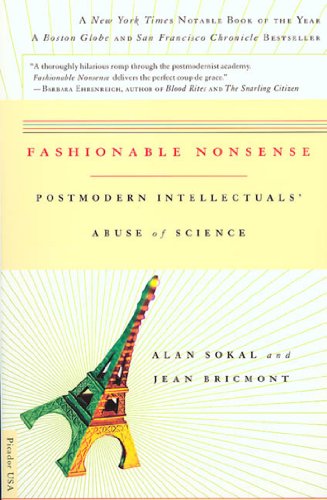
In 1996 physicist Alan Sokal published an essay in Social Text–an influential academic journal of cultural studies–touting the deep similarities between quantum gravitational theory and postmodern philosophy. Soon thereafter, the essay was revealed as a brilliant parody, a catalog of nonsense written in the cutting-edge but impenetrable lingo of postmodern theorists. The event sparked a furious debate in academic circles and made the headlines of newspapers in the U.S. and abroad.In Fashionable Nonsense: Postmodern Intellectuals’ Abuse of Science, Sokal and his fellow physicist Jean Bricmont expand from where the hoax left off. In a delightfully witty and clear voice, the two thoughtfully and thoroughly dismantle the pseudo-scientific writings of some of the most fashionable French and American intellectuals. More generally, they challenge the widespread notion that scientific theories are mere “narrations” or social constructions.
User’s Reviews
Reviews from Amazon users which were colected at the time this book was published on the website:
⭐The book is a follow up the the authors’ famous hoax that highlighted the problem of postmodern philosophy works referring to concepts from mathematics or physics, without actually understanding them or in a completely nonsensical way. The book is a collection of such quotes and their analysis. It is sometimes challenging to follow as some of the analyzed works have been translated from French and the subject of philosophy is not an easy one to start with. The first third of the book is hilarious, but as you progress it gets grimmer and grimmer. You start realizing that the quotes the authors refer to have actually been published, their authors are well established in their field and they keep on spreading their ideas up to this day. Admittedly, some of the criticised authors only briefly ventured into the field of abuse of mathematics and/or physics and the rest of their works are of much higher quality. But the book does a good job of highlighting the problem with how far you can get in non-quantitative subjects using completely made up notions.
⭐It’s 20 years too late for me to have been saved from all the malarke I put up with in graduate school, but better late than never. I just wish I’d known about this book when it came out.
⭐I have a lot of books I’m trying to get to, but when I got a copy of this I started looking at it and I haven’t been able to put it down. It is just too interesting and well-written. Most people probably come to this book with some opinion already on the Sokal Affair and postmodernism. That’s all right, either way. Whether you agree with Sokal and Bricmont’s conclusions or not, they have done an admirable job in this book of laying out what exactly it is they are saying and not saying, what their goals are, and what are the standards they are applying, as well as detailed, specific critiques in plain language. Agree with them or not, I think you must agree that this is a fair and honest critique in good faith and is very up front about its goals and limitations.They also delve into their own views on epistemology and philosophy of science, which is very interesting to hear from two theoretical physicists. I appreciate how clearly this book is written, and I think it makes a strong argument in favor of clear communication and using concepts honestly. And it’s just fun to read- It moves at just the right pace.
⭐This volume should be required reading at university. But the use of rhetoric to obfuscate in “theory” texts isn’t new. It goes back at least to Heidegger and Nietzsche, who together with Foucault form what I call “The Iron Triangle of Postmodern Irony”. Read Theodore Adorno’s “The Jargon of Authenticity” for a critique of the nonsense found in “Being and Time”. Read any number of critiques on the hyperbolic bombast of Nietzsche, or the coquettish mandarin pirouettes of Foucault.
⭐A necessary read for anyone trying to understand post-modernism. Using Ockham’s Razor as a guide as any scientist should, this book clearly in concise clear wording brings out the contradictions of post-modernism including an analysis of its need to reject the principle of non-contradiction.
⭐Humorous and tragic, illuminating and infuriating. A guide for our “post-truth” times and the masturbation fantasies that neutered the left. Or, why a feminist critique of quantum gravity isn’t worth reading, or writing.
⭐The basic thrust of the book is: the social scientists have decided to jazz up their papers with a bunch of mathematical jargon to make it sound complex and profound, and it’s all just noise.
⭐Although this is an important book it is not a very enjoyable one to read for the simple fact that the authors felt compelled to quote at length from some of the most disfigured and meaningless jumbles of words that I have ever seen sewn together in the guise of sentences.A major portion of the book is given over to reproductions of original ‘postmodernist’ sources that ramble for pages on end, with trifling comments by the authors on how the different scientific concepts have been misinterpreted or misused. However, the long barrage of academic verbiage is such manifest nonsense to begin with that there is little left for the sagacity of Sokal and Bricmont to say.There are only so many ways to call a fraud a fraud, so many ways to point to a syntactic confusion of adjectives and say, ‘this is gibberish.’The reason for the extensive quantity of quoted material, the authors explain, is that they do not want to be accused of misrepresenting the sources, or cherry-picking their quotations. This may be an admirable intention but it does not make the situation any less painful for the reader who is forced to slog his way through the sentences.If a reader is not convinced of the absurdity of the postmodern examples within the first two sentences of a quotation, they probably so completely lack the discriminating facility that another twenty pages will not do them any more good.Much more instructive were the sections between the criticisms of the individual postmodern authors, that dealt more broadly with the roles of science and reason in the humanities and politics. Despite what other reviewers have said, there is nothing in these parts which does not seem to me to be thoroughly reasonable and correct.Most incomprehensible is how anyone could have ever taken these postmodernist authors seriously in the first place – how entire segments of the academic world could have so completely taken leave of their senses as to give even one of these imposters an academic post – let alone legions of them spanning several generations.By sheer chance, I recently ran into this comment by Jonathan Swift which seems to have some bearing on the situation:”There are certain common Privileges of a Writer,the Benefit whereof, I hope, there will be no Reason to doubt;Particularly, that where I am not understood, it shall be concluded,that something very useful and profound is coucht underneath.” (1704)
⭐Great critique of postmodern philosophy. The segments where they break down postmodernists arguments and expose their shoddy arguments are a bit dry and I skipped through them. However, the intermezzos and intro/outro are great, as is the opportunity to read the hoax text itself. Some lovely touches of wit from time to time too.
⭐For example, the chapter on Deleuze and Guattari includes a bunch of out-of-context passages from their books, with small passages in-between the quotes. If the authors have a problem with the scientific terminology D&G are using, they should focus on the used words rather than quoting passages, as in the current form it also seems like they also disagree with the contents. I think what the authors could’ve done is show the terms in the works they’re discussing, demonstrate their meaning in given context, and help us understand the “real” meaning, while proving that their usage was not metaphoric.
⭐When I was going to art school, in many of the academic classes, I was constantly being fed ideas that seemed very over-my-head and difficult to grasp as they were being presented. But when I really buckled down and worked hard to decipher what the writers were saying, much of it sounded trivially obvious, ridiculous, overblown, or downright nonsensical. But very few of my classmates shared my opinion, so I thought it was just me, lacking the high-level mathematical knowledge to truly get what “the intellectuals” were saying.Then I got this book, and it instantly felt like a breath of fresh air blowing through the stale academic world. It put the mathematical concepts into simpler terms that can be understood by the laymen, and compares these math concepts with the arguments made by “the intellectuals”, and explains in great detail exactly why these academics are just stating trivially obvious, making claims that are ridiculous, overblown, and downright nonsensical.Since reading this book, I’ve lent some of my Foucault and Baudrillard texts to mathematician friends of mine, and they quickly reach the same conclusions as Alan Sokal – the so-called intellectuals aren’t revealing the deep mysteries of human cultural conditioning, they are intellectual imposters using some very big words to dress up their small ideas to deliver some very fashionable nonsense.
⭐Das Buch “Fashionable Nonsense” enstand aus der sog. Sokal-Affäre und dem darauffolgenden Streit. Im Jahr 1996 veröffentlichte der US-Physiker Alan Sokal einen Text in der amerikanischen Fachzeitschrift Social Text, der im Duktus postmodernistischer Denker verfaßt ist und ein Parodie darstellt. In dem Artikel, der bewußt zahlreiche Fehlschlüsse enthält, wurde ein Vielzahl Unsinnszitate bekannter amerikanischer und französischer Intellektueller verarbeitet. Für seine Recherchen zu den in seinem Artikel verwendeten Zitaten ist Sokal auf eine Fülle von mißbräuchlicher Analogiebildung, Pseudowissenschaft und sprachlichem Blendwerk gestoßen, das in diesem Buch verarbeitet wird.Die Einleitung rekapituliert die Sokal-Affäre inklusive Antworten auf seinen Zeitschriftenbeitrag und seine Auswirkungen.Im Hauptteil des Buches untersuchen Sokal und Bricmont verschiedene ausgewählte Texte u.a. von Jacques Lacan, Julia Kristeva, Bruno Latour und Luce Irigaray. Dabei werden die mißbrauchten wissenschaftlichen Konzepte in ihren Grundzügen erläutert, zudem verweisen die Autoren auf weiterführende wissenschaftliche Literatur. In Zwischenkapiteln gehen die Autoren auf bestimmte wissenschaftliche und philosophische Konzepte des Postmodernismus ein und werfen Licht ein einige Mißverständnisse, die im Umgang mit wissenschaftliche Konzepten, die zu Schlagwörter geworden sind, existieren.Obwohl die Autoren die Grundzüge der mißbrauchten (natur-)wissenschaftliche oder mathematischen wie oben angemerkt Konzepte erläutern, ist ein tieferes Verständnis dieser Konzepte, die teilweise weit über den Schulstoff hinausgehend, durchaus hilfreich. Dieser Teil des Buches ist für die flüssige Nebenbei-Lektüre wenig geeignet, ein Durchackern und sei es einzelner Kapitel ist jedoch in jedem Fall lohnenswert.Im Anhang befindet sich u.a. der vollständige Text des Artikels (“Transgressing the Boundaries: Towards a Transformative Hermeneutics of Quantum Gravity”), den Sokal 1996 in der Zeitschrift Social Text veröffentlicht hat sowie eine vollständige Bibliographie.Das Buch sollte Pflichtlektüre für jeden sein, der sich auch nur entfernt mit Wissenschaftstheorie auseinandersetzt, also eigentlich jeden Studenten.
⭐
⭐Lettura istruttiva assai, benché triste. Libro di buona fattura
⭐
Keywords
Free Download Fashionable Nonsense: Postmodern Intellectuals’ Abuse of Science 1st Edition in PDF format
Fashionable Nonsense: Postmodern Intellectuals’ Abuse of Science 1st Edition PDF Free Download
Download Fashionable Nonsense: Postmodern Intellectuals’ Abuse of Science 1st Edition 2014 PDF Free
Fashionable Nonsense: Postmodern Intellectuals’ Abuse of Science 1st Edition 2014 PDF Free Download
Download Fashionable Nonsense: Postmodern Intellectuals’ Abuse of Science 1st Edition PDF
Free Download Ebook Fashionable Nonsense: Postmodern Intellectuals’ Abuse of Science 1st Edition