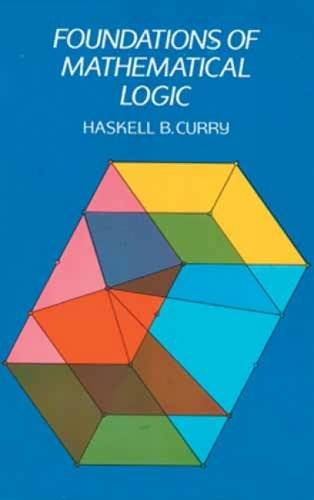
Ebook Info
- Published: 2010
- Number of pages: 416 pages
- Format: PDF
- File Size: 8.50 MB
- Authors: Haskell B. Curry
Description
This book is a thoroughly documented and comprehensive account of the constructive theory of the first-order predicate calculus. This is a calculus that is central to modern mathematical logic and important for mathematicians, philosophers, and scientists whose work impinges upon logic.Professor Curry begins by asking a simple question: What is mathematical logic? If we can define logic as “the analysis and criticism of thought” (W. E. Johnson), then mathematical logic is, according to Curry, “a branch of mathematics which has much the same relation to the analysis and criticism of thought as geometry does to the science of space.”The first half of the book gives the basic principles and outlines of the field. After a general introduction to the subject, the author discusses formal methods including algorithms and epitheory. A brief treatment of the Markov treatment of algorithms is included here. The elementary facts about lattices and similar algebraic systems are then covered. In the second half of the book Curry investigates the possibility for a formulation that expresses the meaning to be attached to the logical connectives and to develop the properties that follow from the assumptions so motivated. The author covers positive connectives: implication, conjunction, and alternation. He then goes on to negation and quantification, and concludes with modal operations. Extensive use is made in these latter chapters of the work of Gentzen. Lists of exercises are included.Haskell B. Curry, Evan Pugh Research Professor, Emeritus, at Pennsylvania State University, was a member of the Institute for Advanced Study, Princeton; a former Director of the Institute for Foundational Research, the University of Amsterdam; and President of the Association for Symbolic Logic. His book avoids a doctrinaire stance, presenting various interpretations of logical systems, and offers philosophical and reflective as well as mathematical perspectives.
User’s Reviews
Editorial Reviews: About the Author Haskell B. Curry was Evan Pugh Research Professor Emeritus at Pennsylvania State University. He was also a member of the Institute for Advanced Study, Princeton; a Director of the Institute for Foundational Research at the University of Amsterdam; and President of the Association for Symbolic Logic.
Reviews from Amazon users which were colected at the time this book was published on the website:
⭐Some other logic books attempt to summarize the broad sweep of mathematical logic systems, but this book by Curry is encyclopedic in breadth and virtuosic in depth. It should not be allowed to go out of print! It is not only historically important, but also an invaluable reference work for current working mathematicians and logicians.This Dover book,
⭐, by Haskell Brooks Curry, originally published in 1963, summarizes pretty much every approach to logic up to that time. Although there is a chapter at the end on modal logic, it’s mostly concerned with the kinds of logics which are directly applicable to real-world mathematics.At first, I found this book pointlessly abstruse, but the more I study and refer to it, the more I find it fills many gaps in the literature that the other 45 mathematical logical books on my shelf do not fill. For example, Curry presents a wide range of propositional and predicate calculus systems, classified by his very terse abbreviations, like TA for an absolute propositional algebra which uses introduction and elimination rules, and TC for a classical positive propositional algebra with similar rules, but HA for a propositional version of TA whose only rule is modus ponens, and HC for the propositional version of TC, and so forth. The axioms and rules are also systematically named, like Pe for implication elimination (i.e. modus ponens) and Pi for implication introduction (i.e. the “deduction theorem”). After a while, the dozens of such notations start to make sense.One oddity of this book, compared to others, is how late in the book negation appears. Out of 8 chapters, it is only in chapter 6 that negation appears, and then many different kinds of negation are considered, including intuitionistic styles.The references to the literature are truly copious. This book would be of great value if only for the thousands of references, covering every point and every point of view. The historical notes are also very valuable. Every chapter has a “supplementary topics” section of several pages where the subject and its history are surveyed, and choices of approach are explained in comparison to other possible approaches.The eight chapter titles give an idea of the systematic progression of ideas in this book. Chapter 4 on relational logical algebra presents lattices as an underlying concept layer. Then Chapter 5 presents “the theory of implication”, which deals with “systems which are assertional in character”. (In other words, not all logical systems are assertional, which is somewhat different to the way many other books present logic.) Following Chapter 6 on negation is Chapter 7 on quantification, which extends the propositional systems to various forms of predicate calculus. Although most serious logic books of the 1950s and 1960s seem to have preferred to use only one a-priori rule (modus ponens) for inference, Curry describes a “T formulation of quantification” (page 342) which includes Rule G and Rule C amongst the inference rules. (These rules were given their names by
⭐in 1953, but Curry does not use these names.)In conclusion, Curry’s book is encyclopedic in character despite its small size, it has great historical importance (because it is cited so much by later authors as a standard text), and it synthesizes a very broad range of logics into a single unified analytical framework. So I hope very much that it will not go out of print.
⭐Those interested in mathematical logic will appreciate this book written by one of the main contributors to the field in the twentieth century. The technique of “currying” in higher order logic is named after the author, wherein unary functions can be used to emulate functions with many parameters. The book was first published in 1963, reprinted in 1977, and so is not a up-to-date treatment of mathematical logic, but it could still be used as an historical supplement to a course in this subject. The reader should be aware though the terminology employed by the author is very idiosyncratic and therefore it may not reflect what is currently used in the literature. The first chapter of the book could be considered an introduction to the philosophy of logic and mathematics. The author though views “philosophical logic” as the study of the principles of valid reasoning, and this is to be distinguished from “mathematical logic”, wherein mathematical systems are constructed to study (formally) the principles of valid reasoning. One can also according to the author view logic as a theory in itself, and many “models” of it can be studied, in much the same way as many different models of geometry can be considered. The author also discusses very succinctly the logical paradoxes, and the different schools of thought in mathematics, such as Platonism, intuitionism, and formalism. The author clearly advocates the formalist school of thought in this book. In chapter 2, the author gets more into the details of formal reasoning, the field of semiotics is outlined, and the author first begins defining the grammar and symbols for the upcoming discussion. A theory is defined as a class of statements, and consistency and decidability of theories is defined. The idea of a deductive theory is also defined, and the author defines the notion of such a theory being complete. The notions of consistency, decidability, and completeness are the familiar ones now entrenched in current textbooks on mathematical logic. A formal system, according to the author, is a theory in which the parameters of the statements of the theory are introduced as unspecified objects, and the statements of the theory make assertions on the properties of the parameters and their relations. The author considers syntactical systems, wherein the formal objects are taken from some object language, and what he calls Ob systems, which are essentially the systems considered in modern mathematical logic.The author employs the familiar Godel numbering scheme to numerically represent formal objects. The notion of algorithm is brought in here as an effective procedure to manipulate the formal objects of a system. The next chapter is basically an introduction to the analysis of what would now be called the metalanguage of a formal system. This analysis is done in terms of what the author calls epistatements and epitheorems. Examples of these epitheorems include the Godel incompleteness theorem and the Skolem-Lowenheim theorem. The author introduces and classifies variables, and defines free and bound variables. A brief introduction to the lambda calculus and combinatory logic is given. Then in chapter 4, the author discusses logical systems which are relational but with no bound variables. These are called logical algebras by the author, and the reader will encounter the famous truth tables and lattices in this chapter. A discussion of the Heyting algebra is given in the notes to the chapter. The reader interested in the more exotic types of algebraic logic, such as quantum logic, could benefit greatly from the reading of this chapter. The logic of propositional calculus in terms of algebraic logic is discussed in chapter 5. Called propositional algebras by the author, the author proves the deduction theorem for such systems in this chapter. Interestingly, the L systems introduced by Gentzen are also discussed in this chapter. Although there are much better overviews of Gentzen’s work in the current literature, a reader may still profit from a perusing of this chapter. L-systems where negation is added is then the subject of the next chapter. Quantification in formal systems is taken up in chapter 7, considered both in the usual predicate calculus and in L systems. Prenex normal forms, the Herbrand-Gentzen theorem, and the completeness theorem are discussed in fairly good detail, albeit with old-fashioned notation. The last chapter covers the interesting concept of modal logic. First considered by Aristotle, the author discusses it in the context of L systems, with the presentation being the shortest in the book.
Keywords
Free Download Foundations of Mathematical Logic (Dover Books on Mathematics) in PDF format
Foundations of Mathematical Logic (Dover Books on Mathematics) PDF Free Download
Download Foundations of Mathematical Logic (Dover Books on Mathematics) 2010 PDF Free
Foundations of Mathematical Logic (Dover Books on Mathematics) 2010 PDF Free Download
Download Foundations of Mathematical Logic (Dover Books on Mathematics) PDF
Free Download Ebook Foundations of Mathematical Logic (Dover Books on Mathematics)