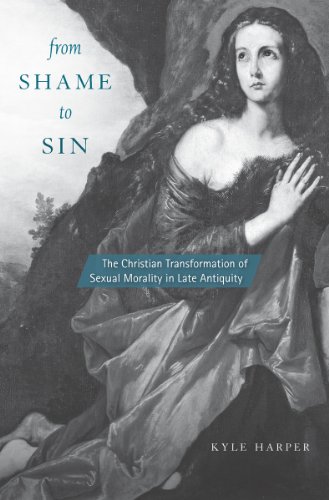
Ebook Info
- Published: 2013
- Number of pages: 318 pages
- Format: PDF
- File Size: 1.69 MB
- Authors: Kyle Harper
Description
The transformation of the Roman world from polytheistic to Christian is one of the most sweeping ideological changes of premodern history. At the center was sex. Kyle Harper examines how Christianity changed the ethics of sexual behavior from shame to sin, and shows how the roots of modern sexuality are grounded in an ancient religious revolution.
User’s Reviews
Reviews from Amazon users which were colected at the time this book was published on the website:
⭐I was drawn to this book because for some time I’ve been intrigued by the parallels between the period of late antiquity (roughly the fourth to the sixth centuries) and our own time, which used to be called “postmodern” – though in many ways it might be better called “late modernity.” As the Roman Empire tottered on toward extinction there was similar chaos in the social institutions making up daily life as we can see around us now with increasing frequency. Christians and pagans alike today find themselves struggling to make their way through strange territory without familiar landmarks in household and community.It was Robert Jenson, in his prescient essay in First Things (October 1993) who first called my attention to these parallels:One of many analogies between postmodernity and dying antiquity – in which the church lived for her most creative period – is that the late antique world also insisted on being a meaningless chaos, and that the church had to save her converts by offering herself as the narratable world within which life could be lived with dramatic coherence.Kyle Harper, in his monumental study of sex in ancient Rome, contrasts the sexual habits and proclivities of the “High Empire” with the sexual standards and mores of the early Christian church. More importantly, he shows how the church deliberately engaged its culture pastorally and catechetically. In so doing he provides contemporary Christians much food for thought – and, I would say, a way forward through the sexual quagmire that seems to engulf us increasingly with every passing year. The picture of Greco-Roman sexual culture documented by Harper from his study of ancient literature, art, and jurisprudence is – as you can imagine – complex. Yet the following broad-brush characteristics emerge:• Roman girls of status were expected to marry shortly after puberty.• Men, however, generally didn’t marry until their late 20s or early 30s (middle age in the age spans of the time)• Men who violated married women suffered severe penalties socially – and in many cases, legally.• The male sexual drive was expected to be freely indulged within available social parameters. (unmarried women, concubines, male and female slaves)• Married men had fewer social or legal penalties than women for extramarital sexual liaisons (with their concubines or slaves). Sex trafficking, prostitution, and pederasty was rampant – to which society turned a blind eye.• The ancient world had no categories for sexual identity or sexual preference –freeborn males routinely penetrated people of either sex – unmarried women and both female or male slaves. (usually boys ca 15 – 19 years of age)This is the sexual climate in which Christianity took root, and Harper shows how in the space of several centuries the Church moved from a scorned cult to cultural hegemony in matters of sex and marriage. Hence his title “From Shame to Sin.” Here he means social shame, not spiritual shame. His book demonstrates that what the pagan world sought to do to the human sexual drive using social and political pressure, the church accomplished by pastoral care.Yet, as Prof. Harper notes, this was not achieved overnight. Christians then, as today, were strongly influenced by the sexual mores of their pagan culture; what their neighbors accepted, many argued, should also be acceptable within the fellowship of believers. The apostles had their work cut out for them in preserving and fostering sexual purity:Some of the Corinthians were claiming that the emancipatory message of the gospel freed the body from petty moral demands: ‘All things are lawful for me.’ Paul’s response was both sharp and ranging. The body, he insisted, was not made for fornication. The believer’s body was a ‘member of Christ,’ and the member of Christ could not be made ‘a member of a prostitute.’ Paul’s libertine interlocutors espoused a traditional upper-class attitude toward the male body, whose desires were to be balanced by vigilant control but not self-denial. Paul’s response betrays an acute sensitivity to bodily purity. The sexual machinery of the body was something to be protected from contamination, not simply kept in proper balance. Coition was anything but a vacuous physical act without effects beyond the circulation of heat and moisture. ‘He who joins himself to a prostitute becomes one body with her.’ Paul’s demand was simple: ‘flee fornication.’ The stakes were pitched deliberately high, and in an idiom of Mediterranean piety that gentile converts would immediately understand. ‘The fornicator sins into his own body. Do you not know that your body is a temple of the Holy Spirit within you?’ Fornication was an act of pollution in the sacred space of the Christian body. (91)This book is not an easy read by any means. Yet I commend it to you because it sheds light on how a countercultural movement can have a significant impact within a culture with antithetical sexual values. Professor Harper’s claims are well documented with citations from ancient historical, artistic, and literary sources.Full disclosure: I am a Lutheran pastor. Thus for me the greatest value of Dr. Harper’s work lies in showing how the proper distinction and application of Law and Gospel should be brought to bear individually and corporately on humans who find themselves floundering in a sea of sexual decadence and indulgence. Harper’s third chapter, “Church, Society, and Sex in the Age of Triumph,” I found the most enlightening (and well written – his vocabulary in chapters one and two was excessively obtuse, in my opinion). Here he outlines how the radical teachings of Jesus, Paul, and the other apostles were applied to a populace that had come to expect that women were to be held to stricter standards than men and that the normal human sexual impulse was to be indulged indiscriminately. In contrast, Christianity held that sex was to be constrained within the marriage bed for the procreation and nurture of children and the comfort and aid of the wife, not just the husband. Harper documents that by patient and compassionate, yet persistent and uncompromising pastoral care the early church sought to cleanse men (and women) who had defiled themselves with sexual immorality – and then welcome them (or restore them) into full membership within the body of Christ.Two conclusions can be drawn. First, that Christianity revolutionized the understanding of sexual integrity. Whereas in the old pagan world female sexual virtue had a narrow definition, within the church it encompassed the penitent prostitute. Christianity prized male virginity just as much as female virginity, and although virginity once lost can never be restored, chastity can always be regained by absolution and spiritual cleansing.Do not be deceived: neither the sexually immoral, nor idolaters, nor adulterers, nor men who practice homosexuality, nor thieves, nor the greedy, nor drunkards, nor revilers, nor swindlers will inherit the kingdom of God. And such were some of you. But you were washed, you were sanctified, you were justified in the name of the Lord Jesus Christ and by the Spirit of our God. (1 Corinthians 6:9-11)Secondly, the book shows how early Christians valiantly contended for sexual virtue despite the monolithic force of widespread approval for sexual indulgence and decadence. Promiscuity was the norm, and sexual continence was viewed as aberrant. Those who uphold Christian sexual standards today find themselves in a parallel position to our early church cousins: on the outside looking in. To quote Justice Antonin Scalia’s dissent from the Supreme Court’s decision overturning the federal Defense of Marriage Act (United States v Windsor, 2013), those who hold to sexual standards contrary to the majority view are often treated as hostes humani generis, “enemies of the human race.”Whether our society is coming to its senses in acknowledging the sexual disaster we have experienced in the wake of the sexual revolution is anybody’s guess. One can applaud the recent rush to call out sexual predation by men in power positions. Yet sexual schizophrenia is evident even there. Hollywood women at the 2018 Golden Globe awards, for example, were dressed in black to protest sexual harassment in their industry. Yet men were evidently expected to ignore the titillation of many dresses that openly flaunted female sexuality. The message seems to be “indulge yourself, but only when I say so.”Christianity has a different message – for both men and women: “you were bought with a price; therefore glorify God in your body.” (1 Corinthians 6:20)In short, I found the book encouraging. This is no time for despair. Like the church in late antiquity, the church in late modernity has an eternal gospel to proclaim. We, like them, live in a world of sexual chaos, abuse, and disaster. It is our joyous privilege, like the ancient church, to welcome refugees from a world of hurt to find rest and respite in our midst. Men and women freed from the sins of their past find in Christ cleansing and renewal to live sexual lives in honor and freedom – if unmarried, in abstinent chastity and if married, in faithful conjugal chastity.Rev. Harold L. Senkbeil, Executive DirectorDOXOLOGY: The Lutheran Center for Spiritual Care and Counsel
⭐Foucault, Langlands, Williams, Verstraete and Provencal, along with an army of others, have spilt gallons of ink to chronicle and choreograph the tricky and intricate sexual mores of ancient Rome into the Christian era. Kyle Harper, Professor of Classics and Letters at the University of Oklahoma and Executive Director of the Institute for the American Constitutional Heritage, has added his voice to the discordant chorus in his 316 page hardback, “From Shame to Sin: The Christian Transformation of Sexual Morality in Late Antiquity.” It is a work written for both the lettered and the thoughtful learner alike. The author is clinical in his approach, analytical in his reading, and fairly impartial in his objective.“From Shame to Sin” seeks to track the change in Roman sexuality over a roughly 600 year period as Roman society met, and became absorbed into, Christianity. Harper does this by “exploring the late classical world out of which Christianity emerged and following the story of the religion’s expansion down to the age of the emperor Justinian” (preface). Since the author is a classicist, it is no surprise that he accomplishes his task by following romantic novels of the high imperial roman society to the late antiquity of Christian Hagiographa. It provides not only an interesting excursion into the romantic genre of the period, but also a contextual glance into the rules of virtue and shame prevalent at the time. As the author observes, “The Christian transformation of sex can be retraced in the history of literature, which mirrors quite sensitively the passage from a public sexual ideology organized around the imperatives of social reproduction to a mentality founded in ecclesiastical norms. In short, the history of literature recapitulates the passage from shame to sin” (16). He follows this transition through the second century work of Achilles Tatius’s Leucippe and Clitophon to the seventh century composition of John Moschus’s The Spiritual Meadow.Harper takes the reader by the hand and weaves them across the erotic ethics of Rome, showing how the surplus of slave bodies provided a venue for plentiful outlets to gratify the male libido. The author also chronicles the placement of homoeroticism, whether pederasty, consenting adults, prostitutes and kinaidos, etc., that was widely permitted for the freeman to engage in with both slaves and non-slaves; and how same-sex marriage, which was not unknown, “had no legal standing or consequence in public law” (36). He similarly recounts how the moral code for honorable women was pudicitia (modesty), to possess sexual honor. In the end, the author’s recitation shows how “the symphony of sexual values, in all its various movements and complex harmonies, was set to the rhythms of the material world: early marriages for women, jealous guarding of honorable female sexuality, an expansive slave system, late marriage for men, and basically relaxed attitudes toward male sexual potential, so long as it was consonant with masculine protocols and social hierarchies” (78).“From Shame to Sin” then tackles some New Testament passages as well as the writings of Clement, and Tertullian, that address sexual behaviors showing how “the novelty of Christian language mirrored the transformative logic of a distinctive sexual morality” (98). Though several aspects of Christian sexual morality are addressed, the author capitalizes on homoeroticism, showing how from “Paul onward, Christian sexual ideology collapsed all forms of same-sex contact, whether pederastic or companionate, into one category” (99), and that category was porneia. Fornication went from “being a cipher for sexual sin in general to a sign of all sex beyond the marriage bed, and it came to mark the great divide between Christians and the world. Same-sex love, regardless of age, status, or role, was forbidden without qualification and without remorse” (85). Harper next maps out the direction this new moral code took as Christianity became predominant in late Roman antiquity, with the rigorous laws on the one hand, and the rigid asceticism on the other; “The reign of Justinian marks a terminal point where sin and salvation, rather than shame and reputation, have come to form the dominant axis of public regulation” (158).Since one “proof of moral freedom was the ability of individuals to change” (127), Harper spends much of the final portions of “From Shame to Sin” presenting one area of change that became prominent in the literary works of late Rome. Novelists and story-tellers maintained the format of the earlier romances, but changed the tension-resolving conclusion from legitimate, honorable marriage to absorption of the “gospel of virginity” (212). Another direction taken up by the storywriters was the recounting and glamorizing of penitent prostitutes. “The impresarios of the Christian imagination realized that in the figure of the penitent prostitute they had not only the raw material for a Christian allegory but a plot that could express the brave new world of sexual morality. The lives of the penitent prostitutes were worked into antiromances, inverting the rich fictional tradition to express an entirely new logic of sexual morality, a new relationship between the sexual self and society” (222).“From Shame to Sin” is a scholarly read, looking through the lens of literature, to see the social and sexual conversion of latter Rome. It’s richly informative, rigorous, and reasoned. This would not only make an ideal addition to a University and Seminary library, but it would be a worthy supplement to a pastors’ book collection. Harper does a masterful job unpacking the social and sexual mores of the Roman world at the time of the writing of the New Testament, which deepens our understanding both the pressures warned against and the resistances prescribed in the Christian Scriptures. I highly recommend the book.
⭐One of the best summaries of the dramatic change that Christianity made to sexual morality in late antiquity available.Kyle shows that before Christianity influenced the Roman world the boundaries of sex were formed not by absolutes (sin) but by social mores (shame).So a married Roman man could have sex with many other people apart from his wife and yet not be guilty of adultery because of the way the boudaries of adultery were defined – socially, not absolutely. So he could have sex with a female slave (because he was socially above her and she was nothing), a male slave (provided he was the active partner – that was the social protocol in homosexual relationships), a prostitute (because she again was a zero and the state allowed prostitutes because they prevented “adultery” – defined in Roman terms solely as sex with a woman already married) and he could have sex with a boy (provided he was younger and, again, provided the man was the active partner). This married man could even have sex with a homosexual adult male provided he was the active partner, again.This Roman man could engage in all of this extra-marital sex without being in the least an adulterer!Along comes the Gospel and especially the writings of the Apostle Paul, and the sexual landscape changes forever. For a start, Paul in Romans focusses on gender as the deterimining factor in the propriety of a sexual act. If the act is same-gender-to-same-gender it is wrong, ipso facto, it is sin. Secondly, if it is with anyone apart from your wife it is wrong. The boundaries of sexual propriety suddenly shrink.Of course the reason the Roman world’s boundaries were set so wide was because it was assumed that a man could not control his lusts or confine his sexual appetite to his wife. This is is the axiomatic premise of a pagan culture: self-control is actually impossible, let’s not pretend otherwise.There were of course unpleasant aspects of this revolution from SHAME to SIN, caused by that terrible marriage between Christianity and Power. Whenever these two get together the latter totally corrupts the former. And so all sorts of draconian measures were taken against sexual deviants in the name of Christ. This, of course, is never the true Christian way. Jesus told Peter to put away his sword; he taught his disciples that his kingdom was not of this world. The Kingdom of Jesus, unlike other kingdoms, does not advance by the sword.The importance of this book lies in the debate taking place in some parts of the modern “church” – some people are trying to argue that the Bible does not stand against same-sex relationships. This book shows that Christianity has from the very beginning recognised same-sex realtionships not only as sinful, but “same-sex attraction symbolised the estrangement of men and women, at the very level of their inmost desires, from the creator.” (p.12).(Note to author: It would be more accurate to say, last sentence above, that to Paul, same-sex sexual “activity”, not same-sex “attraction” symbolised…. etc.)I only hope the academic language used doesn’t limit the usefulness of this excellent study.
⭐Well researched, well written book, not for the faint hearted nor closed minded. there is a wealth of historical information and interpretation that challenges our assumptions and preconceived notions. Highly recommended.
⭐excellent book and delivered in pristine condition
Keywords
Free Download From Shame to Sin: The Christian Transformation of Sexual Morality in Late Antiquity (Revealing Antiquity Book 20) in PDF format
From Shame to Sin: The Christian Transformation of Sexual Morality in Late Antiquity (Revealing Antiquity Book 20) PDF Free Download
Download From Shame to Sin: The Christian Transformation of Sexual Morality in Late Antiquity (Revealing Antiquity Book 20) 2013 PDF Free
From Shame to Sin: The Christian Transformation of Sexual Morality in Late Antiquity (Revealing Antiquity Book 20) 2013 PDF Free Download
Download From Shame to Sin: The Christian Transformation of Sexual Morality in Late Antiquity (Revealing Antiquity Book 20) PDF
Free Download Ebook From Shame to Sin: The Christian Transformation of Sexual Morality in Late Antiquity (Revealing Antiquity Book 20)