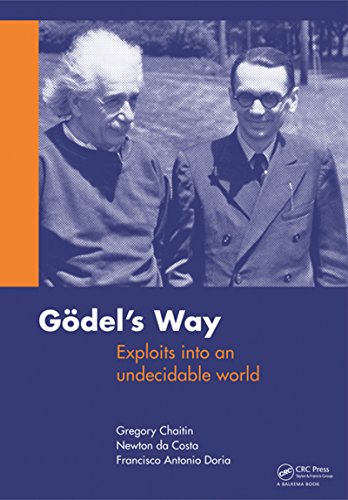
Ebook Info
- Published: 2011
- Number of pages: 161 pages
- Format: PDF
- File Size: 1.09 MB
- Authors: Gregory Chaitin
Description
Kurt Gödel (1906-1978) was an Austrian-American mathematician, who is best known for his incompleteness theorems. He was the greatest mathematical logician of the 20th century, with his contributions extending to Einstein’s general relativity, as he proved that Einstein’s theory allows for time machines. The Gödel incompleteness theorem – the usual formal mathematical systems cannot prove nor disprove all true mathematical sentences – is frequently presented in textbooks as something that happens in the rarefied realms of mathematical logic, and that has nothing to do with the real world. Practice shows the contrary though; one can demonstrate the validity of the phenomenon in various areas, ranging from chaos theory and physics to economics and even ecology. In this lively treatise, based on Chaitin’s groundbreaking work and on the da Costa-Doria results in physics, ecology, economics and computer science, the authors show that the Gödel incompleteness phenomenon can directly bear on the practice of science and perhaps on our everyday life.This accessible book gives a new, detailed and elementary explanation of the Gödel incompleteness theorems and presents the Chaitin results and their relation to the da Costa-Doria results, which are given in full, but with no technicalities. Besides theory, the historical report and personal stories about the main character and on this book’s writing process, make it appealing leisure reading for those interested in mathematics, logic, physics, philosophy and computer sciences.
User’s Reviews
Reviews from Amazon users which were colected at the time this book was published on the website:
⭐In spite of its failings—really a series of notes rather than a finished book—this is a unique source of the work of these three famous scholars who have been working at the bleeding edges of physics, math and philosophy for over half a century. Da Costa and Doria are cited by Wolpert (see below or my articles on Wolpert and my review of Yanofsky’s ‘The Outer Limits of Reason’) since they wrote on universal computation and among his many accomplishments, Da Costa is a pioneer in paraconsistency. The articles, and especially the group discussion with Chaitin, Fredkin, Wolfram et al at the end of Zenil H. (ed.) ‘Randomness through computation’ (2011) is a stimulating continuation of many of the topics here, but again lacking awareness of the philosophical issues, and so often missing the point. Chaitin also contributes to ‘Causality, Meaningful Complexity and Embodied Cognition’ (2010), replete with articles having the usual mixture of scientific insight and philosophical incoherence, and as usual nobody is aware that Ludwig Wittgenstein (W) provided deep and unsurpassed insights into the issues over half a century ago, including Embodied Cognition (Enactivism).Chaitin’s proof of the algorithmic randomness of math (of which Godel’s results are a corollary) and the Omega number are some of the most famous mathematical results in the last 50 years and he has documented them in many books and articles. His coauthors from Brazil are less well known in spite of their many important contributions. For all the topics here, the best way to get free articles on the cutting edge is to visit ArXiv.org ,viXra.org, academia.edu, citeseerx.ist.psu.edu or philpapers.org where there are tens of thousands of preprints on every topic (be warned this may use up all your spare time for the rest of your life!).As readers of my reviews and articles are aware, in my view there are two basic issues running throughout philosophy and science which have completely different solutions. There are the scientific or empirical issues, which are facts about the world that need to be investigated observationally, and philosophical issues as to how language can be used intelligibly, which need to be decided by looking at how we actually use certain words in particular contexts and how these are extended to new uses in new contexts. Unfortunately there is almost no awareness that these are two different tasks and so this work, like all scientific writing that has a ‘philosophical’ aspect, mixes the two with unfortunate results. And then there is scientism, which we can here take as the attempt to treat all issues as scientific ones and reductionism which tries to treat them as physics and/or mathematics. Since I have noted in my reviews of books by Wittgenstein (W), Searle and others, how an understanding of the language used in what Searle calls the Logical Structure of Reality (LSR) and I call the Descriptive Psychology of Higher Order Thought (DPHOT), along with the Dual Process Description (the Two Systems of Thought) helps to clarify philosophical problems, I will not repeat the reasons for that view here.Since Godel’s theorems are corollaries of Chaitin’s theorem showing algorithmic randomness (incompleteness) throughout math (which is just another of our symbolic systems that may result in public testable actions-i.e., if meaningful it has COS), it seems inescapable that thinking (dispositional behavior having COS) is full of impossible, random or incomplete statements and situations. Since we can view each of these domains as symbolic systems evolved by chance to make our psychology work, perhaps it should be regarded as unsurprising that they are not “complete”. For math, Chaitin says this ‘randomness’ (another group of language games) shows there are limitless theorems that are ‘true’ but unprovable—i.e., ‘true’ for no ‘reason’. One should then be able to say that there are limitless statements that make perfect “grammatical” sense that do not describe actual situations attainable in that domain. I suggest these puzzles go away if one considers W’s views. He wrote many notes on the issue of Godel’s Theorems, and the whole of his work concerns the plasticity, “incompleteness” and extreme context sensitivity of language, math and logic, and the recent papers of Rodych, Floyd and Berto are the best introduction I know of to W’s remarks on the foundations of mathematics and so to philosophy.Regarding Godel and “incompleteness”, since our psychology as expressed in symbolic systems such as math and language is “random” or “incomplete” and full of tasks or situations (“problems”) that have been proven impossible (i.e., they have no solution-see below) or whose nature is unclear, it seems unavoidable that everything derived from it by using higher order thought (system 2 or S2) to extend our innate axiomatic psychology (system 1 or S1) into complex social interactions such as games, economics, physics and math, will be “incomplete” also. In these cases a proof shows that what looks like a simple choice stated in plain English has no solution. A mountain of literature exists on Godel’s two “incompleteness” theorems and Chaitin’s more recent work, but I think that W’s writings in the 30’s and 40’s are definitive. Although Shanker, Mancosu, Floyd, Marion, Rodych, Gefwert, Wright and others have done insightful work in explaining W, it is only recently that W’s uniquely penetrating analysis of the language games being played in mathematics and logic have been clarified by Floyd (e.g., ‘Wittgenstein’s Diagonal Argument-a Variation on Cantor and Turing’), Berto (e.g., ‘Godel’s Paradox and Wittgenstein’s Reasons’ , and ‘Wittgenstein on Incompleteness makes Paraconsistent Sense’ , and Rodych ( e.g., ‘Wittgenstein and Godel: the Newly Published Remarks’ and ‘Misunderstanding Gödel :New Arguments about Wittgenstein and New Remarks by Wittgenstein’). Berto is one of the best recent philosophers, and those with time might wish to consult his many other articles and books including the volume he co-edited on paraconsistency. Rodych’s work is indispensable, but only two of a dozen or so papers are free online (but see also his Stanford Encyclopedia of Philosophy articles).Berto notes that W also denied the coherence of metamathematics-i.e., the use by Godel of a metatheorem to prove his theorem, likely accounting for W’s “notorious” interpretation of Godel’s theorem as a paradox, and if we accept W’s argument, I think we are forced to deny the intelligibility of metalanguages, metatheories and meta anything else. How can it be that such concepts (words) as metamathematics, undecidability and incompleteness, accepted by millions ( and even claimed by no less than Penrose, Hawking, Dyson et al to reveal fundamental truths about our mind or the universe) are just simple misunderstandings about how language works? Isn’t the proof in this pudding that, like so many “revelatory” philosophical notions (e.g., mind and will as illusions a la Dennett, Carruthers, the Churchland’s etc.), they have no practical impact whatsoever? Berto sums it up nicely: “Within this framework, it is not possible that the very same sentence…turns out to be expressible, but undecidable, in a formal system… and demonstrably true (under the aforementioned consistency hypothesis) in a different system (the meta-system). If, as Wittgenstein maintained, the proof establishes the very meaning of the proved sentence, then it is not possible for the same sentence (that is, for a sentence with the same meaning) to be undecidable in a formal system, but decided in a different system (the meta-system)… Wittgenstein had to reject both the idea that a formal system can be syntactically incomplete, and the Platonic consequence that no formal system proving only arithmetical truths can prove all arithmetical truths. If proofs establish the meaning of arithmetical sentences, then there cannot be incomplete systems, just as there cannot be incomplete meanings.” And further “Inconsistent arithmetics, i.e., nonclassical arithmetics based on a paraconsistent logic, are nowadays a reality. What is more important,the theoretical features of such theories match precisely with some of the aforementioned Wittgensteinian intuitions…Their inconsistency allows them also to escape from Godel’s First Theorem, and from Church’s undecidability result: they are, that is, demonstrably complete and decidable. They therefore fulfil precisely Wittgenstein’s request, according to which there cannot be mathematical problems that can be meaningfully formulated within the system, but which the rules of the system cannot decide. Hence, the decidability of paraconsistent arithmetics harmonizes with an opinion Wittgenstein maintained thoughout his philosophical career.”W also demonstrated the fatal error in regarding mathematics or language or our behavior in general as a unitary coherent logical ‘system,’ rather than as a motley of pieces assembled by the random processes of natural selection. “Godel shows us an unclarity in the concept of ‘mathematics’, which is indicated by the fact that mathematics is taken to be a system” and we can say (contra nearly everyone) that is all that Godel and Chaitin show. W commented many times that ‘truth’ in math means axioms or the theorems derived from axioms, and ‘false’ means that one made a mistake in using the definitions (from which results follow necessarily and algorithmically), and this is utterly different from empirical matters where one applies a test (the results of which are unpredictable and debateable). W often noted that to be acceptable as mathematics in the usual sense, it must be useable in other proofs and it must have real world applications, but neither is the case with Godel’s Incompleteness. Since it cannot be proved in a consistent system (here Peano Arithmetic but a much wider arena for Chaitin), it cannot be used in proofs and, unlike all the ‘rest’ of Peano Arithmetic, it cannot be used in the real world either. As Rodych notes “…Wittgenstein holds that a formal calculus is only a mathematical calculus (i.e., a mathematical language-game) if it has an extra-systemic application in a system of contingent propositions (e.g., in ordinary counting and measuring or in physics)…” Another way to say this is that one needs a warrant to apply our normal use of words like ‘proof’, ‘proposition’, ‘true’, ‘incomplete’, ‘number’, and ‘mathematics’ to a result in the tangle of games created with ‘numbers’ and ‘plus’ and ‘minus’ signs etc., and with ‘Incompleteness’ this warrant is lacking. Rodych sums it up admirably. “On Wittgenstein’s account, there is no such thing as an incomplete mathematical calculus because ‘in mathematics, everything is algorithm [and syntax] and nothing is meaning[semantics]…”W has much the same to say of Cantor’s diagonalization and set theory. “Consideration of the diagonal procedure shews you that the concept of ‘real number’ has much less analogy with the concept ‘cardinal number’ than we, being misled by certain analogies, are inclined to believe” and makes many other penetrating comments (see Rodych and Floyd). Of course the same remarks apply to all forms of logic and any other symbolic system.As Rodych, Berto and Priest (another pioneer in paraconsistency) have noted, W was the first (by several decades) to insist on the unavoidability and utility of inconsistency (and debated this issue with Turing during his classes on the Foundations of Mathematics). We now see that the disparaging comments about W’s remarks on math made by Godel, Kreisel, Dummett and many others were misconceived. As usual, it is a very bad idea to bet against W. Some may feel we have strayed off the path here—after all in ‘Godel’s Way’ we only want to understand ‘science’ and ‘mathematics’ (in quotes because part of the problem is regarding them as ‘systems’) and why these ‘paradoxes’ and ‘inconsistencies’ arise and how to dispose of them. But I claim that is exactly what I have done by pointing to the work of W . Our symbolic systems (language, math, logic, computation) have a clear use in the narrow confines of everyday life, in what we can loosely call the mesoscopic realm–the space and time of normal events we can observe unaided and with certainty (the innate axiomatic bedrock or background as W and later Searle call it ). But we leave coherence behind when we enter the realms of particle physics or the cosmos, relativity, math beyond simple addition and subtraction with whole numbers, and language used out of the immediate context of everyday events. The words or whole sentences may be the same, but the meaning is lost (i.e, to use Searle’s preferred term, their Conditions of Satisfaction (COS) are changed or opaque). It looks to me like the best way to understand philosophy is to enter it via Berto , Rodych and Floyd’s work on W, so as to understand the subtleties of language as it is used in math and thereafter “metaphysical” issues of all kinds may be dissolved. As Floyd notes “In a sense, Wittgenstein is literalizing Turing’s model, bringing it back down to the everyday and drawing out the anthropomorphic command-aspect of Turing’s metaphors.”W pointed out how in math, we are caught in more LG’s (Language Games) where it is not clear what “true”, “complete”, “follows from”, “provable”, “number”, ”infinite”, etc. mean (i.e., what are their COS or truthmakers in THIS context), and hence what significance to attach to ‘incompleteness’ and likewise for Chaitin’s “algorithmic randomness”. As W noted frequently, do the “inconsistencies” of math or the counterintuitive results of metaphysics cause any real problems in math, physics or life? The apparently more serious cases of contradictory statements –e.g., in set theory—have long been known but math goes on anyway. Likewise for the countless liar (self-referencing) paradoxes in language and in the ”incompleteness” and “inconsistency” (groups of complex LG’s) of mathematics as well.It is a constant struggle to keep in mind that different contexts mean different LG’s (meanings, COS) for “time”, “space”, “particle” “object” , ”inside”, etc, and even (in some contexts) “and”, “or”, “also”, “add” , “divide”, “if…then”, “follows” etc.A major overlap that now exists (and is expanding rapidly) between game theorists, physicists, economists, mathematicians, philosophers, decision theorists and others, all of whom have been publishing for decades closely related proofs of undecidability, impossibility, uncomputability, and incompleteness. One of the more bizarre is the recent proof by Armando Assis that in the relative state formulation of quantum mechanics one can setup a zero sum game between the universe and an observer using the Nash Equilibrium, from which follow the Born rule and the collapse of the wave function. Godel was first to demonstrate an impossibility result and (until Wolpert) it is the most far reaching (or just trivial/incoherent) but there have been an avalanche of others.Another recent famous impossibility result is that of Brandenburger and Keisler (2006) for two person games (but of course not limited to “games” and like all these impossibility results it applies broadly to decisions of any kind), which shows that any belief model of a certain kind leads to contradictions. One interpretation of the result is that if the decision analyst’s tools (basically just logic) are available to the players in a game, then there are statements or beliefs that the players can write down or ‘think about’ but cannot actually hold. But note W’s characterization of ‘thinking’ as a potential action with COS, which says they don’t really have a meaning (use), like Chaitin’s infinity of apparently well-formed formulas that do not actually belong to our system of mathematics. “Ann believes that Bob assumes that Ann believes that Bob’s assumption is wrong” seems unexceptionable and multiple layers of ‘recursion’ (another LG) have been assumed in argumentation, linguistics, philosophy etc., for a century at least, but B&K showed that it is impossible for Ann and Bob to assume these beliefs. And there is a rapidly growing body of such impossibility results for one person or multiplayer decision situations (e.g., they grade into Arrow, Wolpert, Koppel and Rosser etc.). For a good technical paper from among the avalanche on the B&K paradox, get Abramsky and Zvesper’s paper from arXiv which takes us back to the liar paradox and Cantor’s infinity (as its title notes it is about “interactive forms of diagonalization and self-reference”) and thus to Floyd, Rodych, Berto, W and Godel. Many of these papers quote Yanofsky’s (Y’s) paper “A universal approach to self-referential paradoxes and fixed points. Bulletin of Symbolic Logic, 9(3):362–386, 2003. Abramsky (a polymath who is among other things a pioneer in quantum computing) is a friend of Y’s and so Y contributes a paper to the recent Festschrift to him ‘Computation, Logic, Games and Quantum Foundations’ (2013). For maybe the best recent(2013) commentary on the BK and related paradoxes see the 165p powerpoint lecture free on the net by Wes Holliday and Eric Pacuit ’Ten Puzzles and Paradoxes about Knowledge and Belief’. For a good multi-author survey see ’Collective Decision Making(2010).One of the major omissions from all such books is the amazing work of polymath physicist and decision theorist David Wolpert, who proved some stunning impossibility or incompleteness theorems (1992 to 2008-see arxiv.org) on the limits to inference (computation) that are so general they are independent of the device doing the computation, and even independent of the laws of physics, so they apply across computers, physics, and human behavior, which he summarized thusly: “One cannot build a physical computer that can be assured of correctly processing information faster than the universe does. The results also mean that there cannot exist an infallible, general-purpose observation apparatus, and that there cannot be an infallible, general-purpose control apparatus. These results do not rely on systems that are infinite, and/or non-classical, and/or obey chaotic dynamics. They also hold even if one uses an infinitely fast, infinitely dense computer, with computational powers greater than that of a Turing Machine.” He also published what seems to be the first serious work on team or collective intelligence (COIN) which he says puts this subject on a sound scientific footing. Although he has published various versions of these proofs over two decades in some of the most prestigious peer reviewed physics journals (e.g., Physica D 237: 257-81(2008)) as well as in NASA journals and has gotten news items in major science journals, few seem to have noticed and I have looked in dozens of recent books on physics, math, decision theory and computation without finding a reference.W’s prescient grasp of these issues, including his embrace of strict finitism and paraconsistency, is finally spreading through math, logic and computer science (though rarely with any acknowledgement). Bremer has recently suggested the necessity of a Paraconsistent Lowenheim-Skolem Theorem. “Any mathematical theory presented in first order logic has a finite paraconsistent model.” Berto continues: “Of course strict finitism and the insistence on the decidability of any meaningful mathematical question go hand in hand. As Rodych has remarked, the intermediate Wittgenstein’s view is dominated by his ‘finitism and his view […] of mathematical meaningfulness as algorithmic decidability’ according to which ‘[only] finite logical sums and products (containing only decidable arithmetic predicates) are meaningful because they are algorithmically decidable.’”. In modern terms this means they have public conditions of satisfaction (COS)-i.e., can be stated as a proposition that is true or false. And this brings us to W’s view that ultimately everything in math and logic rests on our innate (though of course extensible) ability to recognize a valid proof. Berto again: “Wittgenstein believed that the naïve (i.e., the working mathematician’s) notion of proof had to be decidable, for lack of decidability meant to him simply lack of mathematical meaning: Wittgenstein believed that everything had to be decidable in mathematics…Of course one can speak against the decidability of the naïve notion of truth on the basis of Godel’s results themselves. But one may argue that, in the context, this would beg the question against paraconsistentists– and against Wittgenstein too. Both Wittgenstein and the paraconsistentists on one side, and the followers of the standard view on the other, agree on the following thesis: the decidability of the notion of proof and its inconsistency are incompatible. But to infer from this that the naïve notion of proof is not decidable invokes the indispensability of consistency, which is exactly what Wittgenstein and the paraconsistent argument call into question…for as Victor Rodych has forcefully argued, the consistency of the relevant system is precisely what is called into question by Wittgenstein’s reasoning.” And so: “Therefore the Inconsistent arithmetic avoids Godel’s First Incompleteness Theorem. It also avoids the Second Theorem in the sense that its non-triviality can be established within the theory: and Tarski’s Theorem too—including its own predicate is not a problem for an inconsistent theory” [As Graham Priest noted over 20 years ago].In any event, paraconsistency is now a common feature and a major research program in geometry, set theory, arithmetic, analysis, logic and computer science. Y on p346 says reason must be free of contradictions, but it is clear that “free of” has different uses and they arise frequently in everyday life but we have innate mechanisms to contain them. This is true because it was the case in our everyday life long before math and science. Until very recently only W saw that it was unavoidable that our life and all our symbolic systems are paraconsistent and that we get along just fine as we have mechanisms for encapsulating or avoiding it. W tried to explain this to Turing in his lectures on the foundations of mathematics, given at Cambridge at the same time as Turing’s course on the same topic.And again, ‘decidability’ comes down to the ability to recognize a valid proof, which rests on our innate axiomatic psychology, which math and logic have in common with language. And this is not just a remote historical issue but is totally current. I have read much of Chaitin and never seen a hint that he has considered these matters.Once again note that “infinite”, “compute”, “information” etc., only have meaning in specific human contexts—that is, as Searle has emphasized, they are all observer relative or ascribed vs intrinsically intentional. The universe apart from our psychology is neither finite nor infinite and cannot compute nor process anything. Only in our language games do our laptop or the universe compute.W noted that when we reach the end of scientific commentary, the problem becomes a philosophical one-i.e., one of how language can be used intelligibly. Virtually all scientists and most philosophers, do not get that there are two distinct kinds of “questions” or “assertions” (both families of Language Games). There are those that are matters of fact about how the world is—that is, they are publicly observable propositional (True or False ) states of affairs having clear meanings (COS)—i.e., scientific statements, and then there are those that are issues about how language can coherently be used to describe these states of affairs, and these can be answered by any sane, intelligent, literate person with little or no resort to the facts of science, though of course there are borderline cases where we have to decide.Now I will make a few comments on specific items in the book. As noted on p13, Rice’s Theorem shows the impossibility of a universal antivirus for computers (and perhaps for living organisms as well) and so is, like Turing’s Halting theorem, another alternative statement of Godel’s Theorems, but unlike Turing’s, it is rarely mentioned.On p33 the discussion of the relation of compressibility, structure, randomness etc. is much better stated in Chaitin’s many other books and papers. Also of fundamental importance is the comment by Weyl on the fact that one can ‘prove’ or ‘derive’ anything from anything else if one permits arbitrarily ‘complex’ ‘equations’ (with arbitrary ‘constants’) but there is little awareness of this among scientists or philosophers. As W said we need to look at the role which any statement, equation, logical or mathematical proof plays in our life in order to discern its meaning since there is no limit on what we can write, say or ‘prove’, but only a tiny subset of these has a use. ‘Chaos’, ‘complexity’, ‘law’, ‘structure’, ‘theorem’, ‘equation’, ‘proof’, ‘result’, ‘randomness’, ‘compressibility’ etc. are all families of language games with meanings (COS) that vary greatly, and one must look at their precise role in the given context. This is rarely done in any systematic deliberate way, with disastrous results. As Searle notes repeatedly, these words have intrinsic intentionality only relevant to human action and quite different (ascribed) meanings otherwise. It is only ascribed intentionality derived from our psychology when we say that a thermometer ‘tells’ the temperature or a computer is ‘computing’ or an equation is a ‘proof’.As is typical in scientific discussion of these topics, the comments on p36 (on omega and quasi-empirical mathematics) and in much of the book cross the line between science and philosophy. Although there is a large literature on the philosophy of mathematics, so far as I know, there is still no better analysis than that of W’s, not only in his comments published as ‘Remarks on the Foundations of Mathematics’ and ‘Lectures on the Foundations of Mathematics’, but throughout the 20,000 pages of his nachlass (awaiting a new edition on CDROM). Math, like logic, language, art, artefacts and music only have a meaning (use or COS in a context) when connected to life by words or practices.Likewise on p54 et seq. it was W who has given us the first and best rationale for paraconsistency, long before anyone actually worked out a paraconsistent logic. Again it is critical to be aware that not everything is a ‘problem’ , ‘question’, ‘answer’, ‘proof’ or a ‘solution’ in the same sense and accepting something as one or the other commits one to an often confused point of view.In the discussion of physics on p108-9 we must remind ourselves that ‘point’, ‘energy’, ‘space’, ‘time’, ‘infinite’, ‘beginning’, ‘end’, ‘particle’, ’wave’, ‘quantum’ etc. are all typical language games that seduce us into incoherent views of how things are by applying meanings (COS) from one game to a quite different one.So this book is a flawed diamond with much value and I hope the authors are able to revise and enlarge it. It makes the nearly universal and fatal mistake of regarding science, especially mathematics, logic and physics, as though they were systems—i.e., domains where “number”, “space”, “time”, “proof”, “event”, “point”, “occurs”, “force”, “formula” etc. can be used throughout its “processes” and “states” without changes in meaning—i.e., without altering the Conditions of Satisfaction, which are publicly observable tests of truth or falsity. And when it’s an almost insuperable problem for such truly clever and experienced people as the authors, what chance do the rest of us have? Let us recall W’s comment on this fatal mistake.“The first step is the one that altogether escapes notice. We talk of processes and states and leave their nature undecided. Sometime perhaps we shall know more about them—we think. But that is just what commits us to a particular way of looking at the matter. For we have a definite concept of what it means to learn to know a process better. (The decisive movement in the conjuring trick has been made, and it was the very one that we thought quite innocent.)” PI p308While writing this article I came upon Dennett’s infamous ‘damning with faint praise’ summary of W’s importance, which he was asked to write when Time Magazine, with amazing perspicacity, choose Wittgenstein as one of the 100 most important people of the 20th century. As with his other writings, it shows his complete failure to grasp the nature of W’s work (i.e., of philosophy) and reminds me of another famous W comment that is pertinent here.“Here we come up against a remarkable and characteristic phenomenon in philosophical investigation: the difficulty—I might say—is not that of finding the solution but rather that of recognizing as the solution something that looks as if it were only a preliminary to it. We have already said everything.—Not anything that follows from this, no this itself is the solution!….This is connected, I believe, with our wrongly expecting an explanation, whereas the solution of the difficulty is a description, if we give it the right place in our considerations. If we dwell upon it, and do not try to get beyond it.” Zettel p312-314The best collections if work by da Costa and Doria are in Chaos, Computers, Games and Time: A quarter century of joint work with Newton da Costa by F. Doria 132p(2011),On the Foundations of Science by da Costa and Doria 294p(2008), and Metamathematics of science by da Costa and Doria 216p(1997), but they were published in Brazil and almost impossible to find. You will likely have to get them through interlibrary loan.My collected writings are now available on the web and on Amazon as paperbacks and Kindleshttps://www.amazon.com/dp/B071P1RP1Bhttps://www.amazon.com/dp/B0711R5LGXhttps://www.amazon.com/dp/B071HVC7YP
⭐It takes some mathematical fluency to enjoy. But if you have got it done its a unique trip al over our modern world and the many ways in which things fundamentally misbehave.
⭐I can report the feelings of our hard science book group, whose seven members include engineers, physicists and a physician. We did NOT find that this book showed how Godel’s Theorem relates to everyday life. We found it far from elementary, and the least accessible book we have read in over five years. We did enjoy the human interest histories, but that was not what the description promised.
⭐Kurt Gödel is one of the most important personalities that most people have never heard of. He is known for his incompleteness theorems, of which much of mathematical logic of the last 80 years is built on.Gödel become somewhat of a household word in 1979 with the publication of Gödel, Escher, Bach: An Eternal Golden Braid, which went on to win the 1980 Pulitzer Prize.With that, Goedel’s Way: Exploits into an undecidable world, is a fascinating book. Authors Gregory Chaitin, Newton da Costa and Francisco Antônio Dória cover a huge amount in but 130 pages.All three of the authors are world-class mathematics and it worth noting that Dória and Da Costa have published papers with conditional proofs of the consistency of the P versus NP problem.When it comes to Gödel, Chaitin also has his own interpretation of the incompleteness theorem (Gödel-Chaitin), and is also the discoverer of the Chaitin constant, of which the book terms and references as the omega number.Gödel’s incompleteness theorem has traditionally been used in the realm of mathematical logic. The author’s premise is that Gödel can be extended into nearly every field; from biology, ecology, to economics, computer science and more. In fact, their hypothesis is that undecidability and incompleteness is everywhere in mathematics.Goedel’s Way: Exploits into an undecidable world is a hard book to classify. Part of it includes numerous vignettes into the life of Gödel, part of it a detailed explanation of the incompleteness theorems, and a lot more.What piqued my interest in the title is that the book is described as an accessible book gives a new, detailed and elementary explanation of the Gödel incompleteness theorems and presents the Chaitin results and their relation to the da Costa-Doria results, which are given in full, but with no technicalities.The truth is that about 40% of the book requires the reader to have a much more sophisticated understanding of higher mathematics (including 4th-year calculus, advanced number theory, set theory and more), something I don’t have. It is likely that the authors understanding of accessible and no technicalities means something quite different to them than to the average reader.For those that don’t mind reading a book where almost half of it is beyond their comprehension, then Goedel’s Way is a book worth reading.The books 6 chapters touch upon an array of fascinating topics including: Turing machines, complexity and randomness, halting functions, entropy and more. When not engaging in mind-numbing mathematics, the authors throw in snippets about mathematical personalities such as Leibniz, Shannon, Hilbert and others. The authors note that this is not a standard textbook, and they add these stories as a human interest feature. The authors write in the prologue that this book discusses a piece of their idea, but is certainly not the entire picture.Goedel’s Way: Exploits into an undecidable world is a fascinating, albeit challenging book. Those with a degree in mathematics will likely find more enjoyment out of the book. For the rest of us, the book gives them a glimpse into one of the most important logicians in recent memory and the remarkable work he did, which is still extremely relevant today.
⭐This book puts together quite different aspects of knowledge in a fascinating manner. Very insightful, though it was a challenge reading it. It was a great appetizer to the authors’ earlier and subsequent works as well. I’ve lost my first copy on the train, so now I’m just going to buy a second one…
⭐I both loved and hated this book. It drove me to the brink and yet brought me back out by the very end.
Keywords
Free Download Goedel’s Way: Exploits into an undecidable world 1st Edition in PDF format
Goedel’s Way: Exploits into an undecidable world 1st Edition PDF Free Download
Download Goedel’s Way: Exploits into an undecidable world 1st Edition 2011 PDF Free
Goedel’s Way: Exploits into an undecidable world 1st Edition 2011 PDF Free Download
Download Goedel’s Way: Exploits into an undecidable world 1st Edition PDF
Free Download Ebook Goedel’s Way: Exploits into an undecidable world 1st Edition