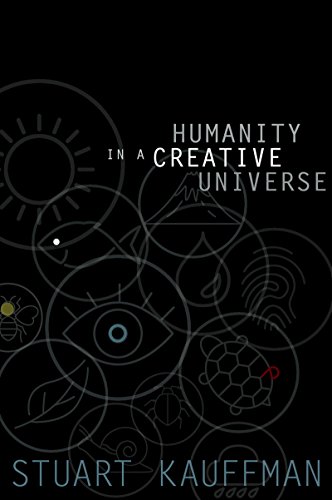
Ebook Info
- Published: 2016
- Number of pages: 312 pages
- Format: PDF
- File Size: 1.93 MB
- Authors: Stuart A. Kauffman
Description
In the hard sciences, which can often feel out of grasp for many lay readers, there are “great thinkers” who go far beyond the equations, formulas, and research. Minds such as Stephen Hawking philosophize about the functions and nature of the universe, the implications of our existence, and other impossibly fascinating, yet difficult questions. Stuart A. Kauffman is one of those great thinkers. He has dedicated his lifetime to researching “complex systems” at prestigious institutions and now writes his treatise on the most complex system of all: our universe.A recent Scientific American article claims that “philosophy begins where physics ends, and physics begins where philosophy ends,” and perhaps no better quote sums up what Kauffman’s latest book offers. Grounded in his rigorous training and research background, Kauffman is inter-disciplinary in every sense of the word, sorting through the major questions and theories in biology, physics, and philosophy. Best known for his philosophy of evolutionary biology, Kauffman coined the term “prestatability” to call into question whether science can ever accurately and precisely predict the future development of biological features in organisms. As evidenced by the title’s mention of creativity, the book refreshingly argues that our preoccupation to explain all things with scientific law has deadened our creative natures. In this fascinating read, Kauffman concludes that the development of life on earth is not entirely predictable, because no theory could ever fully account for the limitless variations of evolution. Sure to cause a stir, this book will be discussed for years to come and may even set the tone for the next “great thinker.”
User’s Reviews
Reviews from Amazon users which were colected at the time this book was published on the website:
⭐Stuart Kauffman, one of our greatest scientists, is a passionate humanist. “Humanity in a Creative Universe” expands on and elaborates his long-held view of the universe as a wonderfullly unpredictable system that creates novelty and complexity at a furious pace. Kauffman’s universe is not a lot of empty space with a little bit of stuff scattered through it, as some physicists argue it is. Nor are human beings insignificant fragments of that stuff, but exceptional and fascinating products of the its creativity. For Kauffman this is a joyous realization, and he makes no effort to conceal his delight in this view of life and the world.Kauffman knows that we are all aware of our thinking, feeling and choosing selves, despite what the physicists may say. He wants to eliminate the gap between what we know and feel intuitively and the scientific dogmas that tell us everything that happens was already determined when the Big Bang was so mysteriously initiated, driven by just a few simple physical laws. Kauffman explains that the laws of physics alone cannot account for the biological universe, just as the laws of biology cannot account for what we think and feel. The laws must evolve along with the phenomena they govern. Each individual E. coli of the millions in the physicist’s gut is more complex, more interconnected, more interactive and more energy efficient than the entire non-biotic universe.A good place to begin in understanding Kauffman’s thinking, is with the concept of “the adjacent possible”. In earlier books, describing the evolutionary process, Kauffman has referred to the set of all the possible evolutionary outcomes from a single mutation in any one of the thousands of genes an organism possesses, as “the adjacent possible” into which the organism can evolve. Natural selection winnows these possibilities to a very few that can be actualized in a viable organism. But the number of the adjacent possibilities is so vast, and the circumstances that might favor one over the others so complex. that the outcome of the evolutionary process cannot be known in advance. He illustrates this idea with the homely example of a screwdriver. He asks the reader to specify all the possible uses for a screwdriver. It can’t be done. Someone will always be able to come up with a new one.In “Humanity”, Kauffman draws out the implications of the idea of the adjacent possible, beginning with its undermining of the scientific dogmas of reductionism and determinism. This project leads Kauffman and “Humanity” in many directions, which I can’t begin to describe here, although quantum mechanics and consciousness, and the possible links between them appear prominently. Some of his explorations lead to conclusions that seem both brilliant and obvious, all are imaginative and fascinating, a few perhaps too far a stretch to be completely convincing. Each reader will have his own assessment of this mix. But the process of sorting out Kauffman’s ideas for oneself is an exciting adventure I can recommend to everyone.Kauffman’s writing is not always easy to follow. “Humanity” is not written in a linear style, like a textbook. Kauffman keeps returning to old material in new contexts, making new connections, seeing more deeply into the issues. Sometimes it seems as if a whirlwind has just passed through. But you don’t have to worry. There’s no examination. “Humanity in a Creative Universe”, as enlightening as it may be, is a pleasure trip.
⭐Kauffman clearly has the ability to think both broadly and deeply which is a rare talent.I strongly recommend reading his book “At Home In the Universe” first if you are not familiar with Kauffman’s core theory of collectively autocatalytic sets as the basis for the emergence of life, the biosphere and the economy.This essentially is a deep dive into how subjective experience and free will could be coupled with these autocatalytic sets via ontologically indeterminate quantum mechanics.In addition he touches upon some themes raised in “Reinventing the Sacred” to push for a new “mythic structure” that points behind the current paradigm of Newton, Darwin, Locke, and Smith.I think Kauffman is largely successful in making his case for at least considering the significance of ontologically indeterminate quantum mechanics for life and consciousness. I was somewhat surprised given that I had recently read “Incomplete Nature” by Terrence Deacon and find his classical “emergent dynamics” to be just as much if not more persuading.I think that’s the most important thing in the end, to read many different opinions on the deep questions of the day and realize that as Donna Meadows stressed, to be free from holding on to any particular paradigm and surrender into the not knowing that is demanded by the staggering complexity we are part of.
⭐This book is the most interesting and profound exploration I know of the intellectual revolution underway in a host of disciplines though still resisted by much of the academic establishment. Briefly, it acknowledges emergence. You might read this book together with
⭐,
⭐,
⭐, and
⭐.
⭐Stuart Kauffman’s ideas are interesting. But this is perhaps the worst-written of all his books. It was actually a chore to read it, which is a shame since his plea for a new understanding of reality that departs from the errors of scientism needs to be heard. This book needed a good editor and it doesn’t look like it got much editing at all (or even proofreading). There are several instances of ungrammatical sentences throughout the book. And Kauffman’s constructions are often difficult to figure out. A very difficult read.
⭐I don’t mind reading difficult books, but the author really should take more time to explain terms and background. I got about 45 pages into the book and simply lost interest in struggling through the material. I found myself googling too many terms to understand the backdrop. It felt like he was writing to a very narrow erudite audience. I have a layman’s background with quantum and Newtonian physics, but this book was a bit much for me. It’s unfortunate because I think he was making some interesting points.
⭐Stuart Kauffman is perhaps the most intriguing author of our age. Each book is a part of the same one book about complexity, but each one brings at least one new important aspect. There are quite some of them in this one, but for me the most important is a conclusion that not only matter and spirit evelve, but basic laws as well (perhaps). Such solution would make multiverse theory obsolete and would fill some gaps in big bang theory.But then: you should read it and not read my comments.
⭐I recommend you skip the first 13 chapters: very repetitive
Keywords
Free Download Humanity in a Creative Universe 1st Edition in PDF format
Humanity in a Creative Universe 1st Edition PDF Free Download
Download Humanity in a Creative Universe 1st Edition 2016 PDF Free
Humanity in a Creative Universe 1st Edition 2016 PDF Free Download
Download Humanity in a Creative Universe 1st Edition PDF
Free Download Ebook Humanity in a Creative Universe 1st Edition