Ebook Info
- Published: 2011
- Number of pages: 304 pages
- Format: PDF
- File Size: 2.59 MB
- Authors: Jean Bricmont
Description
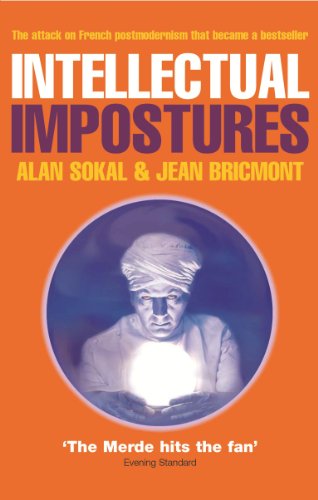
When Intellectual Impostures was published in France, it sent shock waves through the Left Bank establishment. When it was published in Britain, it provoked impassioned debate. Sokal and Bricmont examine the canon of French postmodernists – Lacan, Kristeva, Baudrillard, Irigaray, Latour, Virilio, Deleuze and Guattari – and systematically expose their abuse of science. This edition contains a new preface analysing the reactions to the book and answering some of the attacks.
User’s Reviews
Reviews from Amazon users which were colected at the time this book was published on the website:
⭐I read Lacan, Kristeva, Gilles Deleuz, Jean Baudrillard, and Godel’s theorem when I was younger and questioned, first, my intelligence, then the quality of the English translations. This book by Sokal and Brichmont helps confirm my more recent suspicion that it was not me, but the authors of those dense, turgid books filled with jargon and incomprehensible statements. Just checking out against the contents page will save readers a great deal of angst from attempting to make sense of ‘impostures’ of the worst kind.
⭐Anyone who has had the misfortune to purchase a book that is an offense to reason, or to have to listen to a talk full of pretense and pseudo-scientific subterfuge; anyone who is rightly scornful of woolly thinking, half-baked ideas and downright intellectual dishonesty backed up by specious reasoning, will delight in this expose by its two authors. They systematically take apart and pulverize the work of many perpetrators of the art of literary and pseudo-academic deception, exposing its dishonesty and impure motives. The authors do a great job as exposers of falsehood and upholders of objective truth.This book is recommended reading for those whose grasp of objectivity is weak or faltering, or who wish to find champions of an approach to reality that is, to man’s great peril, increasingly ignored today – an approach which relies on facts, not on fantasy; on painstaking research and meticulous reasoning, not on mere subjectivity and a plunge into an abyss of subjective fantasy and madness.
⭐The many hours I spent reading French philosophy in school while trying to glean something comprehensible were far too many. This book reinforced my earlier convictions that the writing was verbose and just plain terrible. I should add that it wasn’t lost in translation. The fact that they still use French philosophy in Universities is unnerving to say the least. I recommend this book for anyone who wants to ‘deprogram’ the post-modern out of someone they know and love.
⭐The book was great. It was a little old and gave me allergies although I attempted to air it out and put it in the microwave to try to kill some of the microorganisms. But I did purchase a used book so…
⭐I find the book extremely interesting and well written, and the subject is very relevant. It was surprising to learn how renowned philosophers wrote sentences completely meaningless. It is a depressing social phenomenon, but it also teaches us a lot about the role of prestige and authority in the judgement of some intellectual works.
⭐Unfortunately, the truths of the postmodern movement, as obscured by the common trash as they are, have equally been lost on Mr. Sokal and Mr. Bricmont.In a word…”hermeneutics.”What the authors fail to realize is that philosophy is indeed not science, and should not be read as such…even when it uses the ideas and words of science in new contexts for which they, the scientists, are wholly unfamiliar, and unqualified to judge.The meaning of any text is a function of the interface between reader and writer; i.e. hermeneutics. The authors don’t UNDERSTAND the text and they fail to understand the limitations of their own personal, and in this case, failed, reading. Certainly it is not true that all readings are created equal, as the extreme post-modernists would have us believe, but by this token it is by no means clear in these cases that a failure to make sense of a text is the correct reading either.Is a failure to interpret, an interpretation of failure?I have read Mr. Sokal and Bricmont’s previous book “Fashionable Nonsense: Postmodern Intellectuals’ Abuse of Science” and found it enlightening. They found some of the most brilliant post-modernist prose out there, but in most cases they entirely missed the point of the “nonsense” which they attempted to criticize. This new book seems more of the same. A case in point. They cite Deleuze and Guattari, clearly unable to understand the prose, and then leave it to their common reader to follow suit, naturally adopting the easy and comfortable collective belief that a failure to interpret is an interpretation of failure.The authors have adopted, and indeed adapted the words of science for their own specialized use. To interpret those same words in the original scientific meaning is indeed to throw a wrench into the gears, to disrupt the “multi-dimensional machinic catalysis” of the non-linear meaning. This is the root of the failure of Mr. Sokal and Bricmont to understand not only the texts they criticize, but the distinction between science and philosophy itself. Philosophy is not science and it should not be addressed as such. Philosophy is a meta-science and indeed, at the edges of empirical knowledge, every bit as much, and necessarily so, an art; a function critically of intuition as much as erudition, logic and knowledge. Philosophy attempts to synthesize and analyze all forms of knowledge together and apart, and is not limited to the resources of any one of them, such as the limits of their own specialized vocabularies. Science has a fertile ground of concepts for philosophy to adapt, and often radically, for its own meta-scientific and creative uses. Any scientist attempting to make sense of this adaptation—especially in the case of the fertile imaginations (and this in the good way stated by Einstein, “imagination is more important than knowledge”) of Deleuze and Guatarri—will fall flat when he takes those words, which in his scientific context are all-to-familiar, at face value in this radically new context. The authors have stripped these passages from their “multireferential, multi-dimensional” context and then naturally failed to make sense of the adapted meanings of their own words and concepts. They then impose this failed hermeneutic as if it were pregiven and absolute, expecting their unwitting, and equally unqualified readers, to follow suit.They have failed to learn from their enemy the value of context and hermeneutics. This is not to excuse the occasional errors that will occur in all human endeavors, philosophy not being an exception, but merely to expose the limitations of a “scientific” reading of philosophy. Scientists should know, especially if they have any knowledge of the philosophy of their discipline, that one must follow the injunctions of the “paradigm” if one is to find its meaning. In this case, one must understand the context and adapted meanings of the words in use before one can first understand, and then pass judgment on the text. Essentially the judgment being cast-when the failure to interpret is taken at face value-is that the postmodernist authors have simply played with the meaning in a radically new context for which the scientists are no longer truly competent to judge. Not having followed the injunctions of the “paradigm” (scare-quotes indicate a loose adaptation of the term) to learn from the context the new, adapted meanings of their beloved vocabulary, the “experiments in hermeneutics” by these scientists venturing into this new terrain of philosophy, have naturally failed. Philosophy is not science, and is neither inferior nor derived from, or reducible to it. Scientists would be wise to learn this and to suspend judgment over what they are often not qualified to understand.If, on the other hand, a philosopher attempts to describe a scientific theory, and bungles it in the context of the science itself, that is another issue entirely. The philosophers, in this new case, have wandered into the scientist’s domain and in this case the scientists are doing us a favor by pointing out the flaws. This is not the case here, however, with these quotes, stripped of their context and meaning, or “disrobed” as the authors so poetically put it. In these cases, the post-modernists have taken the science into their own world to be trans-adapted for new meanings, a typical evolutionary strategy, as good scientists should be aware. And in this case of meta-criticism the scientists have wandered into a new and unfamiliar space, that of post-modernist philosophy, in which they are incompetent to judge. They are attempting to reclaim the old meanings of their terms, but this is as futile and meaningless as attempting to reclaim the pre-mammalian jaw-bones that have been functionally adapted into the delicate sensorial operations of the mammalian ear. To reclaim those words, concepts and ideas for science-as if science had an ownership and hold on the evolution of even its own language-is analogous to ripping out the angular, articular and the prearticular bones so critical to mammalian hearing. It is equally as mal-directed and violent, and equally a step back down the “ladder” of evolution, at least in a particular domain.
⭐Thank you!
⭐The authors are even handed but there is no conclusion other than that post modernism is full of impostures, created we therefore infer by impostors. How much time has been wasted and confusion has been sown by the likes of Lacan and Kristeva? Surely this is phenomenon that will merit analysis in the future, cf. the witch craze in early modern Europe. Innocent concepts are taken out and burnt on a pyre of ego. I watch and I feel disgusted. In the future we should give mathematics the respect it deserves.
⭐Good book. Thank you
⭐Delivery conform to expectations
⭐Sokal and Bricmont acheive their aim of critisizing some postmodernists for their perceived abuse of science. The professors point out some of the blatent abuse of scientific terms and concepts used by the postmodernist authors to augment their own theses. To this end they are entertaining, and to my mind valid.The professors also enter the arena of philosophy of science in chapter 4 ” intermezzo”. They offer some critisism of Popper, Quine, Kuhn, Feyerabend and others in a concise form. What’s more they also indicate their own philosophy which is based on the verification of facts in a scientific context, along with the possibility of allowing inductive inferences to made from these verifications.All this is well and good, however it may be that there is another interpretation possible, if one where to act as devil’s advocate for the postmodernists :Sokal ands Bricmont’s own philosophy relies on verification, which ultimately relies on tautologies. As such it gives the reader no meaning that may be applied outside a very constrained set of conditions. The postmodernist author may have taken the scientific concepts and language onboard as a metaphor, in order to enrich his own work and allow the reader to interpret meaning through their text.”It is a great thing indeed for the poet to be able to make a proper use of these poetical forms, as also of compounds and strange words. But the greatest thing by far is to be a master of metaphor. Metaphor consists of giving a thing a name that belongs to something else. ” Aristotle cited in Polnayi Meaning 1975.In this context the postmodernist author may be an accomplished poet, yet a poor scientist.In his parody Alan Sokal used all possible means available to imitate a piece of postmodernist text. In fact his imitation was so good it was indistinguishable from the ‘real’ thing.So was the parody real chocolate or fake merde, or fake chocolate or real merde ? As always the reader must decide.
⭐This is one of the best book that I came across this year. The one by one study of some of the “postmordern” thinkers works is extremely precise and very “scientific”. But what I found more interesting were the two extra chapters, one of epistemology of sciences and other, the Epilogue, on the social and political impact it has. Highly recommitted for anyone even slightly interested in sciences (natural and social, both.)
Keywords
Free Download Intellectual Impostures in PDF format
Intellectual Impostures PDF Free Download
Download Intellectual Impostures 2011 PDF Free
Intellectual Impostures 2011 PDF Free Download
Download Intellectual Impostures PDF
Free Download Ebook Intellectual Impostures