Ebook Info
- Published: 2014
- Number of pages: 139 pages
- Format: PDF
- File Size: 8.79 MB
- Authors: Michael Atiyah
Description
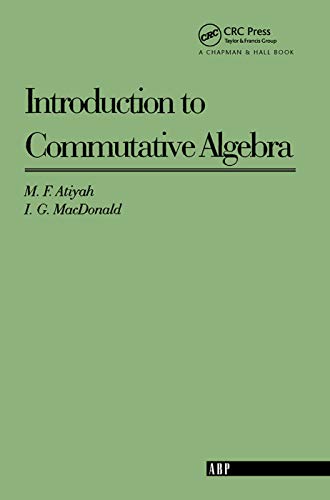
This book grew out of a course of lectures given to third year undergraduates at Oxford University and it has the modest aim of producing a rapid introduction to the subject. It is designed to be read by students who have had a first elementary course in general algebra. On the other hand, it is not intended as a substitute for the more voluminous tracts such as Zariski-Samuel or Bourbaki. We have concentrated on certain central topics, and large areas, such as field theory, are not touched. In content we cover rather more ground than Northcott and our treatment is substantially different in that, following the modern trend, we put more emphasis on modules and localization.
User’s Reviews
Editorial Reviews: About the Author Michael Atiyah
Reviews from Amazon users which were colected at the time this book was published on the website:
⭐Now this is clearly *the* best mathematics text I’ve come upon. It was the syllabus in my first course in commutative algebra. Taking the course and readig the book was a real pain, but I’ve never learned so much from so few pages.In addition to introducing “all” necessary subjects in commutative algebra, the book is stuffed with really good exercises. I always come back to this book – looking up terms and definitions and proofs. And of course, taking it with me on holidays so I can work on the exercises :).
⭐I was foolish enough to buy the book used (given other reviews on how bad the printing is) thinking I might get an older edition but no. Printing looks like a cheap copy and at times not even readable. Do not buy!
⭐Love the exercises. They supplement the exposition so well that together they produce magic.
⭐Prompt shipping. Product as described
⭐good
⭐This is a very good, short and useful account of basic commutative algebra, by two famous algebraic geometers (one a Fields medalist) that has long been recommended as unusually accessible to students. Unfortunately such books have been shamelessly inflated in price in recent years, and I for one agree that this book’s price has now exceeded its value. It is after all, an outline of material explained in more detail elsewhere, and it would be an unusually well off student who can be recommended to choose this book at this price. For about the same money one can buy both of Miles Reid’s books, Undergraduate commutative algebra, and Undergraduate algebraic geometry, and probably be better off, or the very well regarded second attempt at explaining the topic by Matsumura, Commutative ring theory. Eisenbud’s massive tome at over 5 times the length is now about half as expensive, at around $35. Even Hartshorne’s standard algebraic geometry book, which at least states all the commutative algebra results needed, is cheaper. I regret to say this since the book really is a good one, but the authors are being embarrassed and their students are being exploited here by this pricing policy. One should not encourage this kind of blackmail by publishers. In fact I just noticed the classic work by Zariski and Samuel is available used for $50 or less for both volumes! Last time I taught the course I found myself preferring that fuller version to the one under review. I suggest going there instead.
⭐The strongest aspects of Atiyah & MacDonald’s book are its brevity, accessibility to undergraduates, and subtle introduction of more advanced material.Audience: I think an undergraduate with a solid understanding of material from a first course in abstract algebra (i.e., the chapter on rings–the modules chapter would help, but isn’t necessary–from M. Artin’s book ‘Algebra’ is more than sufficient) and some basic point-set topology from an intro real analysis course (or ch1-4 of Munkres) would be sufficient for fully appreciating the material. I think having experience in PS Topology is important for understanding parts of this book well; doing the exercises is possible if you learn it “on the fly,” but I hadn’t seen Urysohn’s Lemma before, and even that caused me some “intuition” hangups; to fully appreciate the material, I would recommend doing a healthy number of problems in topology first.Material: The material uses concepts from homological algebra, though in a disguised form; students with experience in category theory will find offhanded comments that recast some of the material in that language, but CT is absolutely not essential to understand the material well. It also provides exercises that lead naturally into topics from Algebraic Geometry and Algebraic Number Theory quite readily; a nice set of problems in CH1 walk a student through construction of the Zariski topology, prime spectrum, etc., and some functional properties of morphisms between spectra. Algebraic Number Theory starts showing up after chapter 4 in greater detail, and would lead comfortably into Lang’s GTM on ALNT by CH9 (though I only read a bit of Lang, the first chapter felt natural).The “details left to the reader” are usually reasonably tackled with the tools made available so far, and the book is short enough that one can cover a lot of ideas in a reasonable amount of time; the commentary made by the authors is brief, to the point, and never redundant as far as I can recall, so I consider this a highly efficient book (but not too efficient, it’s self contained enough and not uncompromisingly terse).Exercises: They are quite good, I think. Very few of them follow from “symbol-pushing” or “robotic theorem proving,” and usually require some constructive argument. The exercises are mostly chosen to introduce more advanced material, and do a good job in that regard. The longer chapters have 25-30 exercises, and shorter chapters (a few pages) have maybe 10, so there are plenty of problems to do.Hazards: The material on modules is brisk, the propositions in the first three sections on modules are mostly left without proof; however, the proofs follow from their analogues for rings, and aren’t that hard, just be sure to actually do them because they are mentioned only briefly. Also, the book is not typo-free, but this only caused me one major hangup during the semester. After Chapter 3, the proofs are mostly complete, with a spattering of “left to the reader” exercises, which I usually found helpful.Companion Material: I think Lang’s ‘Algebra’ GTM would make a nice reference for the material on Homological Algebra and other miscellaneous things that come up in the proofs; I remember once a proof in the book required the notion of the adjoint of a matrix over a ring, and so I had to look it up in Lang, and also the basic category theory covered in CH1 of Lang would at least introduce (though in a very rapid way) the “abstract nonsense” mentioned offhandedly here and there. If you have a lot of money, or access to a good library, ‘Categories for the Working Mathematician’ is a slower and more thorough introduction to that language, and I would recommend at least having a look, though this isn’t really central to the material from Commutative Algebra.
⭐This book is a classic of outstanding clarity and there is nothing that needs to be said about the content of this book that has not already been said elsewhere.I am reviewing this book because of the printing quality of this edition. I am outraged. The cost of the printing is clearly below 2 pounds and the book is barely readable. Yet it is being sold for 40 pounds. This is an insult to both the reader and the authors.What annoys me most is that I realised too late that I could return it even though it arrived undamaged. I want my money back. This is a disgrace.
⭐I am honestly outraged about the printing quality of the copy I received. I knew the book from a hardback copy I had gotten from the library. The printing in this cheap print paperback version is barely readable. I paid 40 pounds for this when the printing cost is below 5 pounds. (Since this book is a standard work it is not necessary to mention that the contents of the book are excellent)
⭐As others have rightly said probably the best book on the subject. But £58.72 for 128 pages so badly printed as to be hardly readable is just theft.
⭐I loved it. It is a really short book so if you know just a little about rings, it guides you in the way of learning some advanced facts
⭐This sounds like a hyperbole, but it is one of the best math book I have ever read. You cannot find an extra word anywhere, it is a book to keep in one’s library if the subject interests you. The main defect is that some of the exercises are very difficult and they deserve much more space, therefore there are few basic examples which would be very useful the first time reading about these topics.
Keywords
Free Download Introduction To Commutative Algebra (Addison-Wesley Series in Mathematics) in PDF format
Introduction To Commutative Algebra (Addison-Wesley Series in Mathematics) PDF Free Download
Download Introduction To Commutative Algebra (Addison-Wesley Series in Mathematics) 2014 PDF Free
Introduction To Commutative Algebra (Addison-Wesley Series in Mathematics) 2014 PDF Free Download
Download Introduction To Commutative Algebra (Addison-Wesley Series in Mathematics) PDF
Free Download Ebook Introduction To Commutative Algebra (Addison-Wesley Series in Mathematics)