Ebook Info
- Published: 2002
- Number of pages: 574 pages
- Format: PDF
- File Size: 2.38 MB
- Authors: William F. Trench
Description
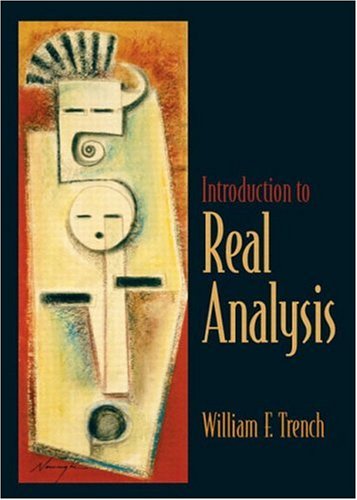
Using an extremely clear and informal approach, this book introduces readers to a rigorous understanding of mathematical analysis and presents challenging math concepts as clearly as possible. The real number system. Differential calculus of functions of one variable. Riemann integral functions of one variable. Integral calculus of real-valued functions. Metric Spaces. For those who want to gain an understanding of mathematical analysis and challenging mathematical concepts.
User’s Reviews
Editorial Reviews: From the Back Cover Using an extremely clear and informal approach, this book introduces readers to a rigorous understanding of mathematical analysis and presents challenging math concepts as clearly as possible. The real number system. Differential calculus of functions of one variable. Riemann integral functions of one variable. Integral calculus of real-valued functions. Metric Spaces. For those who want to gain an understanding of mathematical analysis and challenging mathematical concepts. Excerpt. © Reprinted by permission. All rights reserved. This is a text for a two-term course in introductory real analysis for junior or senior mathematics majors and engineering and science students with a serious interest in mathematics. Prospective educators of mathematically gifted high school students can also benefit from the mathematical maturity that can be gained from an introductory real analysis course. The book is designed to fill the gaps left in the development of calculus as it is usually presented in an elementary course, and to provide the background required for insight into more advanced courses in pure and applied mathematics. The standard elementary calculus sequence is the only specific prerequisite for Chapters 1-5, which deal with real-valued functions. (However, other analysis oriented courses, such as elementary differential equations, provide useful preparatory experience.) Chapters 6 and 7 require a working knowledge of determinants, matrices, and linear transformations, typically available from a first course in linear algebra. Chapter 8 is accessible after completion of Chapters 1-5. Without taking a position for or against current reforms in mathematics teaching, I think it is fair to say that the transition from elementary courses such as calculus, linear algebra, and differential equations to a rigorous real analysis course is a bigger step today than it was just a few years ago. To make this step, today’s students need more help than their predecessors did, and must be coached and encouraged more. Therefore, while striving throughout to maintain a high level of rigor, I have tried to write as clearly and informally as possible. In this connection, I find it useful to address the student in the second person. I have included 295 completely worked out examples to illustrate and clarify all major theorems and definitions. I have emphasized careful statements of definitions and theorems and have tried to be complete and detailed in proofs, except for omissions left to the exercises. I give a thorough treatment of real-valued functions before considering vector-valued functions. In making the transition from one to several variables and from real-valued to vector-valued functions, I have left to the student some proofs that are essentially repetitions of proofs of earlier theorems. I believe that working through the details of straightforward generalizations of more elementary results is good practice for the student. Great care has gone into the preparation of the 760 numbered exercises, many with multiple parts. These range from routine to very difficult. Hints are provided for the more difficult parts of the exercises. ORGANIZATION Chapter 1 is concerned with the real number system. Section 1.1 begins with a brief discussion of the axioms for a complete ordered field, but no attempt is made to develop the reals from them; rather, it is assumed that the student is familiar with the consequences of these axioms, except for one: the completeness axiom. Since the difference between a rigorous and a nonrigorous treatment of calculus can be described largely in terms of the attitude taken toward completeness, I have expended considerable effort in developing its consequences. Section 1.2 is about mathematical induction. Although this may seem out of place in a real analysis course, I have found that the typical beginning real analysis student simply cannot do an induction proof without reviewing the method. Section 1.3 is devoted to elementary set theory and the topology of the real line, ending with the Heine-Borel and Bolzano-Weierstrass theorems. Chapter 2 covers the differential calculus of functions of one variable: limits, continuity, differentiability, 1’Hospital’s rule, and Taylor’s theorem. The emphasis is on rigorous presentation of principles; no attempt is made to develop the properties of specific elementary functions. Even though this may not be done rigorously in most contemporary calculus courses, I believe that the student’s time is better spent on principles, rather than on reestablishing familiar formulas and relationships. Chapter 3 is devoted to the Riemann integral of functions of one variable. The integral is defined in the standard way in terms of Riemann sums. Upper and lower integrals are also defined there and used in Section 3.2 to study the existence of the integral. Section 3.3 is devoted to properties of the integral. Improper integrals are studied in Section 3.4. I believe that my treatment of improper integrals is more detailed than in most comparable .textbooks. A more advanced look at the existence of the proper Riemann integral is given in Section 3.5, which concludes with Lebesgue’s existence criterion. This section can be omitted without compromising the student’s preparedness for subsequent sections. Chapter 4 treats sequences and series. Sequences of constants are discussed in Section 4.1. I have chosen to make the concepts of limit inferior and limit superior parts of this development, mainly because this permits greater flexibility and generality, with little extra effort, in the study of infinite series. Section 4.2 provides a brief introduction to the way in which continuity and differentiability can be studied by means of sequences. Sections 4.3-4.5 treat infinite series of constants, sequences and infinite series of functions, and power series, again in more detail than in most comparable textbooks. The instructor who chooses not to cover these sections completely can omit the less standard topics without loss in subsequent sections. Chapter 5 is devoted to real-valued function of several variables. It begins with a discussion of the topology of R n in Section 5.1. Continuity and differentiability are discussed in Sections 5.2 and 5.3. The chain rule and Taylor’s theorem are discussed in Section 5.4. Chapter 6 covers the differential calculus of vector valued-functions of several variables. Section 6.1 reviews matrices, determinants, and linear transformations, which are integral parts of the differential calculus as presented here. In Section 6.2 the differential of a vector-valued function is defined as a certain linear transformation, and the chain rule is discussed in terms of composition of such functions. The inverse function theorem is the subject of Section 6.3, where the notion of branches of an inverse is introduced. In Section 6.4 the implicit function theorem is motivated by first considering linear transformations and then stated and proved in general. Chapter 7 covers the integral calculus of real-valued functions of several variables. Multiple integrals are defined in Section 7.1, first over rectangular parallelepipeds and then over more general sets. The discussion deals with the multiple integral of a function whose discontinuities form a set of Jordan content zero, over a set whose boundary has Jordan content zero. Section 7.2 deals with evaluation of multiple integrals by means of iterated integrals. Section 7.3 begins with the definition of Jordan measurability, followed by a derivation of the rule for change of content under a linear transformation, an intuitive formulation of the rule for change of variables in multiple integrals, and finally a careful statement and proof of the rule. The proof is complicated, but this is unavoidable. Chapter 8 deals with metric spaces. The concept and basic properties of a metric space are introduced in Section 8.1. Section 8.1 discusses compactness in a metric space, and Section 8.3 covers continuous functions on metric spaces.
Reviews from Amazon users which were colected at the time this book was published on the website:
⭐Professor Trench has made the online version of this text that is absolutely free. I think this is a very traditional real analysis book appropriate for advanced undergraduate mathematics students. My experience with real analysis is the old classics by Walter Rudin,Thomas Apostol and Halsey Royden. Unlike those tests which can be used for advanced undergraduate or graduate level texts, this book has two chapters covering introductory calculus which can serve as a refresher for undergraduates who have not seen this material for three years. The material is well-established and with Professor Trench’s long experience as a teacher it is inconceivable that the text would be filled with errors. The online version was made available in late 2009 and is essentially the same as the hard cover 2002 text except that it has corrected some errors and misprints from the 2002 version which is now out of print. So new copies of the 2002 hard cover issue may be hard to come by. The online issue looks just as professional as the hardcover version.The content is typical for a first course in real analysis and is certainly worth considering for a class text. Each chapter contains an ample number of problems to give as homework problemns to reinforce what is covered in lecture.I would also like to add that the review by “A customer” is written by a student who would not necessarily have a good insight into what constitutes a good text on real analysis. Also there is no content to support his remarks which are purely sarcastic. I am skeptical about the remark that his professor did not like the book and only used it becuase he is a friend of French. Being that there are so many texts that could be used for this type of course in real analysis it is inconceivable to me that a professor who seriously wants his students to learn the subject would pick a text that he thought was not the most helpful for his students and that he would feel comfortable teaching from. If this were really the case then I wouldn’t be surprised to know that the instructor was a poor teacher who didn’t care much about teaching the subject. In that case the student could easily be disguntled because he did poorly in the course and chose to blame the text rather than the instructor. But students rarely depend on the text to learn the course and the instructor plays a crucial role in courses that are taught in a traditional manner.I took my courses in real analysis many years ago and so I am not sure exactly what constitutes an indergraduate course in real analysis in 2010. However, from my experience much of what is covered in the book was covered in first and second year calculus when I was an undergraduate and chapters 1 and 8 are most like the material in texts like Rudin’s.
⭐One of the best books on calculus
⭐This was part of the curriculum…no way around this one.
⭐Vielen Dank
⭐I’ve been reading the online version of this book and I am unsure why the original reviewer is so unhappy with it. I’m only on Chapter 3 so far, so I cannot fully judge its contents, but from what I’ve read it’s been very readable and I have learned from it. Is it my favorite book ever? No, but it has not once struck me to be categorized as one of the worst.Read it for yourself:[…]
⭐Lots of typos.
Keywords
Free Download Introduction to Real Analysis in PDF format
Introduction to Real Analysis PDF Free Download
Download Introduction to Real Analysis 2002 PDF Free
Introduction to Real Analysis 2002 PDF Free Download
Download Introduction to Real Analysis PDF
Free Download Ebook Introduction to Real Analysis