Ebook Info
- Published: 2012
- Number of pages: 582 pages
- Format: PDF
- File Size: 52.98 MB
- Authors: Cornelius Lanczos
Description
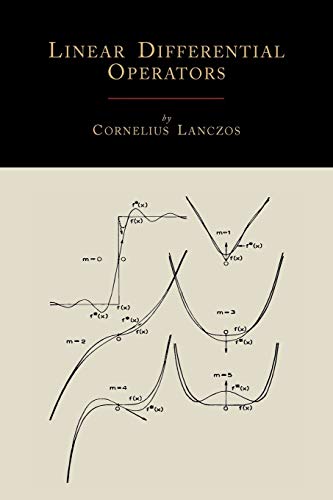
2012 Reprint of 1961 Edition. Exact facsimile of the original edition, not reproduced with Optical Recognition Software. Don’t let the title fool you! If you are interested in numerical analysis, applied mathematics, or the solution procedures for differential equations, you will find this book useful. Because of Lanczos’ unique style of describing mathematical facts in nonmathematical language, “Linear Differential Operators” also will be helpful to non-mathematicians interested in applying the methods and techniques described. Originally published in 1961, this Classics edition continues to be appealing because it describes a large number of techniques still useful today. Although the primary focus is on the analytical theory, concrete cases are cited to forge the link between theory and practice. Considerable manipulative skill in the practice of differential equations is to be developed by solving the 350 problems in the text. The problems are intended as stimulating corollaries linking theory with application and providing the reader with the foundation for tackling more difficult problems.
User’s Reviews
Reviews from Amazon users which were colected at the time this book was published on the website:
⭐It is a masterpiece, as somebody else said, for which it would deserve 5 stars. Unfortunately, the phenomenal number of typographical errors in the matrix equations degrades its value, particularly for those uninitiated on the matter.
⭐Cornelius Lanczos was a brilliant expositor of math and physics, and it shines in this book. I’ve only read through the first 5 chapters so far, but every page I’ve read has been beautifully motivated and seems to tie into a few unifying themes of this book. I couldn’t even wait to finish the book before writing the review.What I especially enjoy about Lanczos’s writing is that he excels at providing unforgettable mental pictures that provide immediate intuition. His Chapter 3 on Matrix Calculus offers a presentation of spectral decomposition and the SVD that was new to me even after having been exposed to linear algebra from both the abstract algebra (Axler, Friedberg/Insel/Spence) and numerical (Trefethen, Demmel) perspectives. Especially useful in Chapter 4 is his emphasis on the idea that differential operators are naturally undetermined without appropriate boundary conditions, which we can see by analogy with discrete differential matrix operators. Overall, I have seen many of the subjects before; however, Lanczos provides his own unique perspective, and he connects dots in ways that are often not obvious.If you’re relatively new to Lanczos, be warned that he often skips over quite a few calculations to be filled in by the reader. These omissions can usually be resolved in a few lines of scratch work (assuming some mathematical maturity), and they are nowhere near the gaps one must hurdle to read Rudin or Spivak.
⭐As the other reviewers have said, this is a master piece for various reasons. Lanczos is famous for his work on linear operators (and efficient algorithms to find a subset of eigenvalues). Moreover, he has an “atomistic” (his words) view of differential equations, very close to the founding father’s one (Euler, Lagrange,…).A modern book on linear operators begins with the abstract concept of function space as a vector space, of scalar product as integrals,… The approach is powerful but somehow we loose our good intuition about differential operators.Lanczos begins with the simplest of differential equations and use a discretization scheme (very natural to anybody who has used a computer to solve differential equations) to show how a differential equation transforms into a system a linear algebraic equation. It is then obvious that this system is undetermined and has to be supplemented by enough boundary condition to be solvable. From here, during the third chapters, Lanczos develops the concept of linear systems and general (n x m) matrices, the case of over and under determination, the compatibility conditions, …It is only after these discussions that he returns (chapter 4) to the function space and develops the operator approach and the role of boundary conditions in over and under-determination of solutions and the place of the adjoint operators. The remaining of the book develops these concepts : chp5 is devoted to Green’s function and hermitian problems, chap7 to Sturm-Liouville,… The last chapter is devoted to numerical techniques, amazing if one think that the book was written at the very beginning of computers, which is a gem by itself.
⭐Lanczos is a master of insightful presentation and, I think, his ability reached its climax in this book. Pure mathematicians may object to the presentation given in this book and even to its title as “Linear Differential Operators”. But who minds? He already declares that “the present book is written from the applied angle..” (Section 4.2, page 165).I had run into this book more than 35 years ago, when I was a graduate research assistant in applied mathematics. I was literally struggling with the technicalities of Lebesgue’s Integration Theory and Functional Analysis, through the books of authors like McShane, Dunford &Schwartz . It had immediately captivated me as if somebody had unexpectedly pulled me out of a bog into the light. The essentials of the realm of function spaces, differential and integral operators, Green functions and integral transformations had appeared to a young mind almost in a flash after a painless and self-flowing reading. Today a professional engineer in his sixty, I steel remember that emotion and feel the same captivation when I collect this book from my Library and page through it. It is my sincere belief, and wish at the same time, that no young graduate of mathematics,physics and even engineering should miss the chance of reading this masterpiece.
⭐Somebody writen:”Some mathematics and physics writers stand head and shoulders above the rest. Goldstein…Liboff…Morrison…Morse and Feshbach…and Lanczos. A joy to read, if you are both mathematically and verbally inclined.”I think some mathematics and physics writers stand head and shoulders above even Goldstein…Liboff…Morrison…Morse and Feshbach. It is the case of Lanczos and Dirac.
⭐Very good book – excellent topics and text presentation. Consider to purchase and read…
Keywords
Free Download Linear Differential Operators in PDF format
Linear Differential Operators PDF Free Download
Download Linear Differential Operators 2012 PDF Free
Linear Differential Operators 2012 PDF Free Download
Download Linear Differential Operators PDF
Free Download Ebook Linear Differential Operators