Ebook Info
- Published: 2012
- Number of pages: 134 pages
- Format: PDF
- File Size: 0.00 MB
- Authors: Bernardo Kastrup
Description
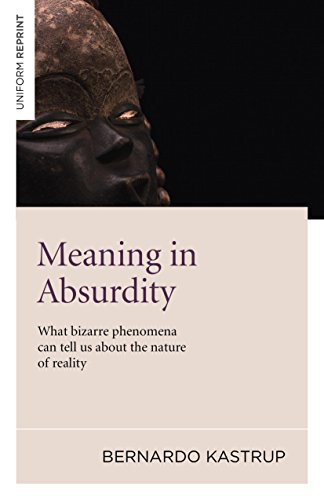
This book is an experiment. Inspired by the bizarre and uncanny, it is an attempt to use science and rationality to lift the veil off the irrational. Its ways are unconventional: weaving along its path one finds UFOs and fairies, quantum mechanics, analytic philosophy, history, mathematics, and depth psychology. The enterprise of constructing a coherent story out of these incommensurable disciplines is exploratory. But if the experiment works, at the end these disparate threads will come together to unveil a startling scenario about the nature of reality. The payoff is handsome: a reason for hope, a boost for the imagination, and the promise of a meaningful future. Yet this book may confront some of your dearest notions about truth and reason. Its conclusions cannot be dismissed lightly, because the evidence this book compiles and the philosophy it leverages are solid in the orthodox, academic sense.
User’s Reviews
Editorial Reviews: About the Author Bernardo Kastrup has a Ph.D. in philosophy and another in computer engineering. He has been a scientist in some of the world’s foremost scientific laboratories. His main interests are metaphysics and philosophy of mind.
Reviews from Amazon users which were colected at the time this book was published on the website:
⭐Kastrup synthesizes depth psychology, quantum mechanics, idealism, and constructivism in this short but powerful treatise which ultimately accomplishes his goal: revealing the meaning in absurdity. His interpretation of Jung’s work, specifically the image of the “red sun” at our core, has provided me with new fuel for my own personal myth. This is not my favorite of Kastrup’s paradigm-shifting work, but I am still very grateful to have read it. For new readers of Kastrup’s philosophy, I would recommend first reading More Than Allegory or Brief Peeks Beyond. They are the path to the light for intellectual seekers.”An idealist world, as it turns out, is a world of potential paradox and contradiction; a world amenable to the absurd. It is, in fact, a world of ‘strange loops,’ perpetually cycling through self-negating metaphors of themselves, like an Escher drawing, from fantasy to seeming literalism and ultimately back to fantasy.”“Your life is a patchwork of projected concepts; a thin conceptual crust around an unfathomable core of the amorphous substance of existence.”
⭐As a beginning, the problem with this differentiation between weak and strong objectivity is that it’s artificial, because there is always a kind of observation toward the object; it surely can be direct or indirect, but is always an observation, since it depends on a registration of the phenomenon. Even the measurement of a seismograph or the account of a tradition, is still an observation. The approach of this book have a few misconceptions due to fake facts, like the direct contradiction between Idealism and Realism; which are not only complimentary ways to understand reality, each one with its own set of references, but they are even one the basis of the other.As a result of all that misconceptions, the author fails to set the intermediate status of knowledge, which participates of both natures: The objectivity of reality and the subjectivity of its comprehension, as an objective (conventional) comprehension, settled by the organic sum of traditions, scientific and actual facts. Is in that realm where the so called “calls of the absurd” takes place with its ambiguity; and the inability to understand it (by now) could be only because we still lacks enough references and knowledge skills for that. The attribution of epistemological value to a lack of skill is for sure a call for the absurd.This book just retracts the discussion to the (fake) problem between Objective and Subjective Idealism, taken the so called Objective as what it sees as Realism; but that (fake) problem ignores that the Objective tradition of Idealism surged at a moment were Idealism were so absolute it was prompted to its own excesses.
⭐In his latest book, Kastrup puts forward the view that we only have a “weakly objective” understanding of the world rather then a “strongly objective” understanding of the world. In other words, we can only understand the world in regards to how it relates to ourselves and others and cannot truly grasp a reality independent of our minds. Kastrup argues that the world we know is a “consensus reality” or more like a “shared dream” and that our usual bivalence logic of true and false dichotomies can be seen to often breakdown in the face of seeming paradoxes thus creating in us a sense of the absurd. He uses the example of quantum mechanical entanglement as example where our usual true or false logic can break down and the observer dependent nature of the world can be seen. He also sites the work of Carl Jung and his notion of Archetypes to argue that nature is fundamentally a construct of the Psyche, all be it a Collective Unconscious Psyche. Kastrup argues that the world appears coherent to us rather then a chaotic mess because we construct an internally consistent story. He borrows from a philosophical view of Mathematics called “Intuitionism” to support his idea. Intuitionism says that Mathematics does not entail the discovery of mind-independent mathematical objects but rather, involves the building of a logical series of statements that mutually constrains the kind of Mathematical statements one can make. Yet these statements themselves, when given enough complexity, can break down into paradoxes and absurdity. Kastrup argues, however, that this is where meaning begins, rather then ends – perhaps by transcending itself? What does one make of Kastrup’s views? Many of us have heard of dinosaurs and dragons. Both seem very similar – they are both large reptile like or even birdlike creatures which may evoke fascination and fear in us. Yet, we take dinosaurs to have really existed and dragon to be nothing more then creations of our imagination. Hundreds of years ago human-kind may have debated if dragons existed, yet the question if dinosaurs existed would have been seen as meaningless and hence absurd. Hundreds of years later we believe the opposite: Whether a fossilised Triceratops died of a T-Rex attack 35 millions years ago seems to have a straight up true/false answer. In contrast, whether the St George Dragon had a sibling is meaningless and possesses no meaningful true or false answer. Is Kastrup telling us that we should see dragons as belonging to a kind of transcendent “reality” where there are true and false statements about dragons just as there are true or false statements about dinosaurs in our current consensus reality? If so, whose reality is “dragon reality” anyway? Kastrup may say it is the reality of the Jungian Archetype and if we respond that this is absurd, he may in turn say: “yes, indeed.”
⭐I’ve recently been turned on to Bernardo Kastrup after hearing him speak about Brief Peeks Beyond on an interview on Legalize Freedom. I bought that book, and after reading it, every other Kastrup book. This one is the last one I’ve read and it is amazing like the others. I was a lifelong materialist atheist until I had an experience like one of those mentioned in the book that completely and radically changed my worldview. I was so excited to discover Kastrup and found myself saying “Yes, Yes!” so many times when reading his books. I’ve finally found (and I have been looking a while) someone who articulates perfectly many of my beliefs (or the things I now know), which I’ve had such a hard time trying to explain to others. I can’t recommend Kastrup highly enough.
⭐Dr. Bernardo Kastrup is the leading metaphysicist in the world today, and I enjoy his thoughts often when I listen to them or read them.But this book is disappointing. It’s certainly a good or decent book, but it lacks rigor and content that would make it an amazing work.
⭐Bernardo’s books are all superbly clearly written. His thinking is crystal clear and sharp as a razor. His way of breaking down a concept and presenting it re-formed is unparalleled in modern writers in philosophy of mind. The ideas are very exciting, too. I came from a background in theoretical physics and previously considered thinkers exploring consciousness to be without exception delving to some degree into ‘woo-woo’ nonsense. Bernardo shows it’s completely philosophically sound to regard the entirety of existence as being composed of mind, in a formulation without contradiction and with the minimum of assumptions – just one. In fact, as a result of visiting these ideas through Bernardo’s sharply-focussing lens, monistic idealism is now my preferred ontology.
⭐The argument presented in the book is the standard of this author. True or false (I have not decided yet) this book could use some structure in its delivery. Anectodal evidence are mixed with theory and the negation of materialism in a way that does not make for an easy read. Not that the author is trying to be obscure, on the contrary, he tries hard, and succeeds at least in part, to deliver a complicated message and I am certain that other books might be a better starting point.
⭐In Meaning in Absurdity, Kastrup shows us the limits of our logical and rational worldview. Starting with a series of documented experiences of events and quantum effects that defy our understanding, we are rapidly shown that our models of reality carry the seed of their own falsification. What stroke me is Kastrup’s lucidity as regards the fact that not only paradoxes arise from self-reference, but also our reality is fundamentally self-referential, leading to a vulnerability of reality to paradox. From here Kastrup constructs an idealist alternative to the ruling paradigm of reductive materialism, from which our experienced consensus meta-reality emerges.A joy to read.
⭐Bernado Kastrup is such an important thinker!This book is relatively brief at 128 pages or so but has tremendous power and is a terrific read, even if Kastrup has updated some of his metaphors in more recent books like “Why Materialism is Baloney”.Beautifully written and incredibly insightful.
⭐This is the 3rd book by Bernardo Kastrup I have read. As usual, educating, entertaining, thought provoking and helping to connect the dots across different layers and aspects of my life. I like how despite the philosophical nature of the subject the book manages to add meaning and weight on a very practical level.
Keywords
Free Download Meaning in Absurdity: What bizarre phenomena can tell us about the nature of reality in PDF format
Meaning in Absurdity: What bizarre phenomena can tell us about the nature of reality PDF Free Download
Download Meaning in Absurdity: What bizarre phenomena can tell us about the nature of reality 2012 PDF Free
Meaning in Absurdity: What bizarre phenomena can tell us about the nature of reality 2012 PDF Free Download
Download Meaning in Absurdity: What bizarre phenomena can tell us about the nature of reality PDF
Free Download Ebook Meaning in Absurdity: What bizarre phenomena can tell us about the nature of reality