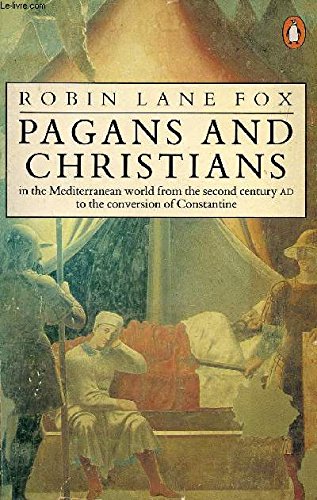
Ebook Info
- Published: 1988
- Number of pages: 800 pages
- Format: PDF
- File Size: 4.44 MB
- Authors: Robin Lane Fox
Description
Explores the character of early Christianity, with details on religious life, secular daily life, and the condition of paganism at the time of its defeat
User’s Reviews
Editorial Reviews: From the Publisher Re-creates the world from the second to the fourth century AD, when the Graeco-Roman gods lost their dominion and Christianity, with the conversion of Constantine, triumphed in the Mediterranean world.
Reviews from Amazon users which were colected at the time this book was published on the website:
⭐There is much to recommend in Fox’s exegesis of the rise of the early Church – but it is difficult reading. The first 250-odd pages go into tremendous detail of what it meant to “be a practicing pagan” in the Greco-Roman world. The second section – just under 300 pages explores the appeal and spread of Christianity in the first – third centuries CE. Much of this is well-trod ground, Fox offering little new here (although, to be fair, the first publication of this book was in 1989, so perhaps my perspective is skewed by time). The final 120 pages are worth the price of the book (and the investment of time it takes to get there), as Fox closely discusses how Christianity “won” the fight for survivial (or, conversely, how the pagans “lost”).Because of the depth, detail and density of the book I don’t recommend reading it cover-to-cover unless you are deeply committed to an understanding of the time period (or the history of the early Church.) Rather, this is the sort of text whose index and table of contents will serve most readers best, allowing them to “dip in” to sections of which they are interested and skip over parts that are of less important.The scholarship and analysis are outstanding, and the volume of information is almost overwhelming. As some other reviewers have mentioned, the writing style is a bit difficult, but there is so much information here, it is worthy of attention.
⭐I have long wanted to understand how – and why, from a secular perspective – Christianity spread throughout the Roman Empire, eventually coming to dominate it in a way that paganism never did. Though this book does not offer a satisfying (or even clear) explanation for all that, it is a brilliant exposition of the natures of both forms of religion, polytheism and monotheism, highlighting their similarities and differences. That makes it a must-read for anyone interested in late antiquity. If sometimes overly detailed, this book consistently fascinates.Before Christianity, paganism was defined as things “rustic” rather than a religion. Then, it came to be assigned to people who were not committed through baptism to be a “soldier of Christ”. So far as pagan “religion” went, according to Fox, it was an extremely eclectic collection of rituals, cult acts, supernatural beliefs, magic, and philosophies (which had argued themselves into a “stalemate”); they were as varied as local languages and cultures. Its adherents did not subscribe to revealed beliefs, made no exhortations to faith, and were unaccustomed to notions of heresy. Instead, it was simply something that people did, a combination of festivals, gestures to appease (or demand favor from) incomprehensible gods, even dream states that explained occurrences or personal luck. In addition, it was syncretic, absorbing gods and practices no matter what their origin into a polytheistic pantheon and ritual, each temple or shrine offering a multiplicity of possibilities for worship or action. Even the Roman Emperor became a God – his behavior as an agent of unpredictable power or beneficence reflected that of the Olympian gods.In a political sense, the local notables were responsible for bankrolling festivals, buildings, etc. As such, participating in the local religion was a sign of fealty to them, to the city, and more largely, to the empire. All they required was a gesture of belief – it mattered little what people really thought or felt, they just needed to swear allegiance or even simply partake of the food and drink on offer at a festival – that reinforced the notables’ control, prestige, and support. (It was here that the Christians, who refused to make these gestures of fealty, first ran awry of the pagan state, setting themselves apart.)In contrast, Fox observes, Christianity offered clearly expressed doctrines, definitive philosophical answers, and orthodoxy that required a commitment of faith. In a sense, Christians were not adherents, but converts, brought in by conviction and persuasion. In place of the concatenation of contradictory beliefs and pagan practices, it offered certainty of a knowledge of God, a narrative of redemption and brotherly love, and a program – to eliminate sin – that led to eternal life. While its ideas were simple enough to be understood by anyone, they were ripe for refinement and ever unfolding complexity. This was aided by the fact that Christianity was a “written religion” and not an oral one like classical polytheism. Christianity united ritual and philosophy, answering questions that pagans could not with such confidence that Christians were willing to die under horrible circumstances to advance their faith and enter paradise. This impressed many pagans.There were a number of new elements in Christianity. First, it offered an image of community rather than a hardened hierarchy: love, equality, and brotherhood were supposed to draw one to the faith. The hierarchy existed in heaven, where angels followed God, then the saints, then holy men, and finally the righteous. Second, they were exhorted to love even their enemies. Third, humility was seen as good rather than a disdained, non-heroic sentiment. Fourth, Satan could explain evil as an act of will rather than a chance occurrence or bad fortune; the pagan gods with their caprices were incorporated into his demonology. Fifth, there was the notion of sin, which could manifest itself even purely in thought; punishment for it could be eternal. Sixth, women and men were not segregated, but worshiped together.Politically, these differences threatened to function as a state within a state, which the authorities could not control. Christianity, in this scheme, was a direct assault on social barriers and distinctions as well as allegiance to the state. Christians could also deny the material world, adopting certain habits (celibacy, asceticism, withdrawal as hermits) that, in emulation of angels, emphasized the paramount importance of the next world rather than any obligations of service in the present one. Finally, with its orthodoxy and “heresy”, Christianity undermined the rule of Roman law that governed individual responsibility, replacing it with collective liability that effected entire families and even whole communities. No wonder Roman notables opposed it!Of course, there were many overlapping practices of both religions, from praise of virginity and chastity, visions of God, prophesies, and prayers seeking favor from the gods. As it evolved, Christianity picked and chose which practices it would incorporate and apply systematically.The book offers a great deal of historical context. An important factor was the increasing instability of life in the late Roman Empire. People were scared and wanted more certainty. Moreover, paganism was “decadent”, unable to offer answers as convincing and apparently irrefutable as Christians could do. Finally, as Constantine embraced Christianity to win a civil war, the power of paganism to appease the gods was disproven once and for all. With the Emperor a Christian, it became socially acceptable then fashionable to convert. (Unfortunately, I found none of these explanations convincing or sufficient.)I cannot do justice to the density and insight that this book has. However, in between wonderfully lucid explanations, the reading experience can be something of a slog. While well written, its academic method is probably too much for all but the most committed reader. Finally, the book is not for beginners: the reader must know the history of late antiquity as well as the rudiments of both classical polytheism and Christianity; otherwise, it will be very difficult. It is written at the mature undergraduate or even graduate level.Recommended for serious readers.
⭐Pagans and Christians compares parallel religious traditions within the context of the cultures of Rome and Greece during the first several centuries of the common era. The book, which is written in a scholarly style, presumes a basic knowledge of both cultures. It does not describe an active competition between Christians and Pagans as much as how both groups coexist within changing beliefs, political pressures, peace and war, economic and social challenges, and so on. If you love long books about the the historical development of thought and beliefs over time, Christians and Pagans is for you. It is fascinating, clearly written, nourishes the mind, teaches Jeopardish facts such as miming chapters from the Odessey was popular entertainment, and so on. If your preference is casual reading or expanding faith, there are much better choices.
⭐This is a long and very detailed study of one of the world’s great turning points: the almost complete rejection of the classical gods by the emperor Constantine and his adoption of Christianity for himself and his empire. It is absolutely fascinating, full of glimpses of what life was like for people who truly believed their gods were everywhere and influenced every aspect of their life; and the newly founded cult of Christianity, which was just one of many that flourished around the Mediterranean at the time. You get a real sense of how the gods were woven into the fabric of society and the operating systems of how they were consulted and their advise used is intriguing.The author takes a determinedly impartial path and it is not possible to detect his views on the respective merits of each set of beliefs. yet one is left with the impression that he lingers more lovingly over the details of the Hellenistic gods which seem to be imbued with sunlight as opposed to his rather detached treatment of the Christians.Alas so much information has now been lost, or not yet found, to finally explain why Constantine rejected a system of belief that was seemingly in good health and converted to Christianity. He just seems to have had a dream where saw a symbol in the clouds, he inscribed it onto his troops shields and won Rome. The empire than adopted Christianity as its principal religion – eventually loosing its tolerant attitudes to other religions and beliefs. They tortured the old gods prophets and destroyed their places of worship and eventually they just disappeared.
⭐Christianity in the Roman Empire is my current area of research and this author provides a lot of the answers to questions that I have. Thank you.
⭐Just received it…will read it soon.
⭐This book is far too heavy going – I tried twice and gave up twice – I doubt I will ever finish it. Some interesting information but just overwhelming in detail. Ought to be a fascinating topic but is just boring.
Keywords
Free Download Pagans and Christians in PDF format
Pagans and Christians PDF Free Download
Download Pagans and Christians 1988 PDF Free
Pagans and Christians 1988 PDF Free Download
Download Pagans and Christians PDF
Free Download Ebook Pagans and Christians