

Ebook Info
- Published: 2007
- Number of pages: 340 pages
- Format: PDF
- File Size: 14.89 MB
- Authors: William P. Jones
Description
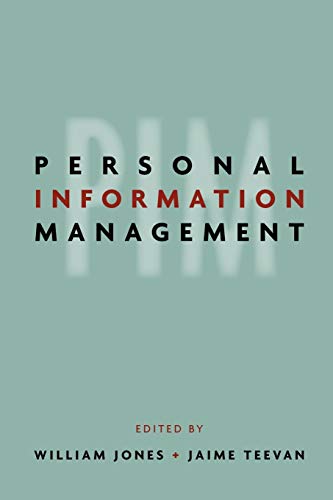
In an ideal world, everyone would always have the right information, in the right form, with the right context, right when they needed it. Unfortunately, we do not live in an ideal world. This book looks at how people in the real world currently manage to store and process the massive amounts of information that overload their senses and their systems, and discusses how tools can help bring these real information interactions closer to the ideal.Personal information management (PIM) is the study and practice of the activities people perform to acquire, organize, maintain, and retrieve information for everyday use. PIM is a growing area of interest as we all strive for better use of our limited personal resources of time, money, and energy, as well as greater workplace efficiency and productivity.Personal information is currently fragmented across electronic documents, email messages, paper documents, digital photographs, music, videos, instant messages, and so on. Each form of information is organized and used to complete different tasks and to fulfill disparate roles and responsibilities in an individual’s life. Existing PIM tools are partly responsible for this fragmentation. They can also be part of the solution that brings information together again. A major contribution of this book is its integrative treatment of PIM-related research.The book grows out of a workshop on PIM sponsored by the National Science Foundation, held in Seattle, Washington, in 2006. Scholars from major universities and researchers from companies such as Microsoft Research, Google, and IBM offer approaches to conceptual problems of information management. In doing so, they provide a framework for thinking about PIM as an area for future research and innovation.
User’s Reviews
Editorial Reviews: Review “Jones and Teevan have put together a fabulous resource on the subject of managing personal information. With the excellent contributions of their notable guest authors, they look at all angles of the problem of keeping track of everyone and everything in their lives. They’ve done a thorough investigation and it shows that we have a long journey ahead to handle the torrent of emails, calendars, contacts, bookmarks, and everything else that deluges us regularly. This book will become the seminal reference for anyone thinking about how we solve this critical problem.”―Jared M. Spool, User Interface Engineering About the Author William Jones is a research associate professor in the Information School at the University of Washington, Seattle. Jaime Teevan is a researcher in the Context, Learning, and User Experience for Search group at Microsoft Research, Redmond, Washington.
Reviews from Amazon users which were colected at the time this book was published on the website:
⭐This was recommended for my electronic/digital records class for graduate school. It’s written in an easy to read format for the layman or the new student. There is a running explanation/scenario of the planning of a birthday party, which is good for understanding unfamiliar concepts.It also discusses at length and in detail the different types of information management and could really help someone understand their own personal information management (to steal the book’s title), as well as how other people manage and handle their information.
⭐I edited the book Personal Information Management with William Jones, so my opinion of it is, not surprisingly, glowing. Below is the table of contents, to help you make a more informed purchasing decision. Each chapter is written by one or more leading researchers in the chapter’s subject area, and is worth reading independent of the book. However, the book also holds together well as a whole, with many common themes, and even common characters, being woven throughout.1. IntroductionWilliam Jones (University of Washington)Jaime Teevan (Microsoft Research)Part I. Understanding Personal Information Management2. How People Find Personal InformationJaime Teevan (Microsoft Research)Robert Capra (University of North Carolina)Manuel Pérez-Quiñones (Virginia Tech)3. How People Keep and Organize Personal InformationWilliam Jones (University of Washington)4. How People Manage Information over a LifetimeCatherine C. Marshall (Microsoft)5. Naturalistic Approaches for Understanding PIMCharles M. Naumer (University of Washington)Karen E. Fisher (University of Washington)Part II. Solutions for Personal Information Management6. Save Everything: Supporting Human Memory with a Personal Digital Lifetime StoreDesney Tan (Microsoft Research)Emma Berry (Addenbrooke’s Hospital and Microsoft Research)Mary Czerwinski (Microsoft Research)Godon Bell (Microsoft Research)Jim Gemmell (Microsoft Research)Steve Hodges (Microsoft Research)Narinder Kapur (Addenbroke’s Hospital)Brian Meyers (Microsoft Research)Nuria Oliver (Microsoft Research)George Robertson (Microsoft Research)Ken Wood (Microsoft Research)7. Structure EverythingTiziana Catarci (Università di Roma “La Sapienza”)Luna Dong (University of Washington)Alon Halevy (Google)Antonella Poggi (Università di Roma “La Sapienza”)8. Unify Everything: It’s All the Same to MeDavid R. Karger (MIT)9. Search EverythingDaniel M. Russell (Google)Steve Lawrence (Google)10. Everything through EmailSteve Whittaker (University of Sheffield)Victoria Bellotti (PARC)Jacek Gwizdka (Rutgers)11. Understanding What Works: Evaluating PIM ToolsDiane Kelly (University of North Carolina)Jaime Teevan (Microsoft Research)Part III. PIM and the Individual12. Individual DifferencesJacek Gwizdka (Rutgers)Mark Chignell (University of Toronto)13. Personal Health Information ManagementAnne Moen (University of Oslo and University of Washington)Part IV. PIM and Other People14. Group Information ManagementWayne G. Lutters (University of Maryland)Mark S. Ackerman (University of Michigan)Xiaomu Zhou (University of Michigan)15. Management of Personal Information Disclosure: The Interdependence of Privacy, Security, and TrustClare-Marie Karat (IBM TJ Watson)John Karat (IBM TJ Watson)Carolyn Brodie (IBM TJ Watson)16. Privacy and Public RecordsMichael Shamos (CMU)17. ConclusionWilliam Jones (University of Washington)Jaime Teevan (Microsoft Research)AcknowledgmentsBibliographyContributorsIndex
⭐This book is well over due. The subject of PIM is still new but really important to all of us who are overwhelmed by the flow of information through our personal and professional lives. Jones and Teevan do a good job of bringing together a host of opinions and approaches. I can’t wait for Jones’s own book in the subject to come out!
⭐Very good book, and provides all what you need to know about PIM (as a start off course). William Jones ! had done a great job to bring everything together.
⭐
Keywords
Free Download Personal Information Management in PDF format
Personal Information Management PDF Free Download
Download Personal Information Management 2007 PDF Free
Personal Information Management 2007 PDF Free Download
Download Personal Information Management PDF
Free Download Ebook Personal Information Management