Ebook Info
- Published: 2014
- Number of pages: 290 pages
- Format: PDF
- File Size: 7.09 MB
- Authors: Hao Wang
Description
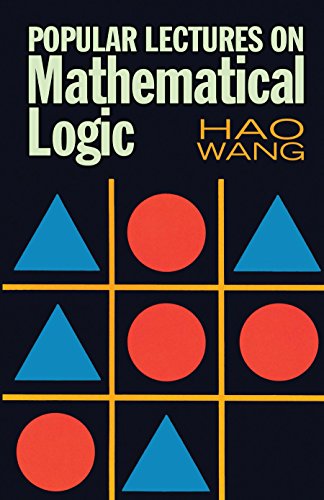
A noted logician and philosopher addresses various forms of mathematical logic, discussing both theoretical underpinnings and practical applications. Author Hao Wang surveys the central concepts and theories of the discipline in a historical and developmental context, and then focuses on the four principal domains of contemporary mathematical logic: set theory, model theory, recursion theory and constructivism, and proof theory.Topics include the place of problems in the development of theories of logic and logic’s relation to computer science. Specific attention is given to Gödel’s incompleteness theorems, predicate logic and its decision and reduction problems, constructibility and Cantor’s continuum hypothesis, proof theory and Hilbert’s program, hierarchies and unification, proof of the four-color problem, the Diophantine problem, the tautology problem, and many other subjects. Three helpful Appendixes conclude the text.
User’s Reviews
Reviews from Amazon users which were colected at the time this book was published on the website:
⭐In 1977 Hao Wang gave a series of advanced lectures on mathematical logic to the Chinese Academy of Science. Wang’s presentations were well-received and subsequently published in 1981 under the title Popular Lectures on Mathematical Logic. Wang’s lectures are not intended for the layman. A 1993 reprint edition by Dover includes a useful postscript in which Wang briefly outlines recent advances in mathematical logic.In his introduction Wang states: The reader is advised not to spend too much time on any particular point that seems to present serious difficulties. It is to be expected that various readers will find certain parts too elementary or too advanced. I found very little that was too elementary. Wang’s extensive appendix (more than 100 pages) should perhaps be scanned before reading the text itself.Setting the difficulty aside, Wang’s lectures are quite good. He carefully traces the historical development of key ideas, develops a unifying framework, and identifies opportunities for new work. The computer sections are now outdated, but still make good reading from a historical perspective. Wang’s lectures can also serve as a valuable reference source.The primary sections are titled One Hundred Years of Mathematical Logic, Computers, First Order Logic, Computation: Theoretical and Practical, How Many Points on a Line?, and Unifications and Diversifications. Example topics include Godel’s Incompleteness Theorems, Model Theory, the Lowenheim-Skolem theorem, Ramsey’s theorem and indiscernibles, and Cantor’s continuum hypothesis (GCH).Looking for something less daunting? Foundations and Fundamental Concepts of Mathematics by Howard Eves offers several excellent introductory chapters on mathematical logic, symbolic logic, and axiomatic set theory. Five stars.An Introduction to Symbolic Logic by Susanne Langer is a bit dated, but it is a good place to start. Four stars.Godel’s Proof by Nagel and Newman is an exceptionally good introduction to Godel’s remarkable work. Five stars.What is Mathematical Logic? by J. N. Crossley (and others) is an advanced text that warrants the extra effort required. Five stars.Introduction to Mathematical Philosophy by Bertrand Russell is the classic introduction to logicism; it will require careful reading. Four stars.The Advent of the Algorithm by David Berlinski is a strange, eclectic, discursive, popular work. Not a textbook. Three stars.
⭐Although this book may be somewhat outdated (published in the mid-70’s), it does provide a cohesive view of the developments in logic up until that point. One gets a very strong sense of the status of logical development, while at the same time receiving a historical motivation for the methods employed in developing the theory. Many proofs are shortened or synopsized, however the integrity and technical level of the work is never compromised. In my opinion, the sections on Model Theory, Set Theory, Proof Theory and Recursion Theory provided the reader with a good sense of the major results in those areas. The section on computers (and their limitations) was a hoot to read, because of the limited view provided by the author, but otherwise, Wang has a strong intuition as to where modern developments could have led. Recommended for anyone trying to get a unifying view of the major developments in logic.
⭐A classic series of lectures on logic and computability. Some of the stuff on practical computing is very outdated, nonetheless, the bulk of the mathematical material is excellent.
Keywords
Free Download Popular Lectures on Mathematical Logic (Dover Books on Mathematics) in PDF format
Popular Lectures on Mathematical Logic (Dover Books on Mathematics) PDF Free Download
Download Popular Lectures on Mathematical Logic (Dover Books on Mathematics) 2014 PDF Free
Popular Lectures on Mathematical Logic (Dover Books on Mathematics) 2014 PDF Free Download
Download Popular Lectures on Mathematical Logic (Dover Books on Mathematics) PDF
Free Download Ebook Popular Lectures on Mathematical Logic (Dover Books on Mathematics)