Ebook Info
- Published: 2016
- Number of pages: 111 pages
- Format: PDF
- File Size: 13.40 MB
- Authors: Henri Poincare
Description
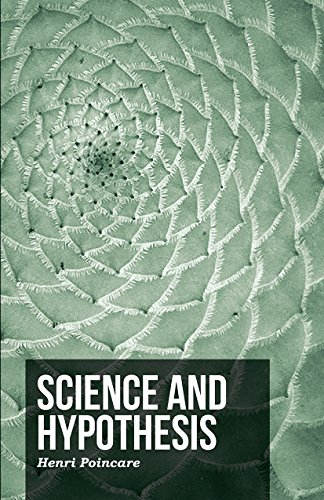
“Science and Hypothesis” is a study written in 1902, by the French mathematician, Henri Poincaré. It was designed with non-specialist readers in mind, and contains information on mathematics, space, physics and biology. The main theme of this work is that the absolute truth of science is non-existent. It postulates that many scientific beliefs are closer to convenient conventions than valid explanations. The chapters of this book include: “Number and Magnitude”, “On the Nature of Mathematical Reasoning”, “Mathematical Magnitude and Experiment”, “Space”, “Non-Euclidean Geometries”, “Space and Geometry”, “Experiment and Geometry”, etcetera. Many vintage texts such as this are increasingly scarce and expensive, and it is with this in mind that we are republishing this book now, in an affordable, high-quality, modern edition. It comes complete with a specially commissioned biography of the author.
User’s Reviews
Reviews from Amazon users which were colected at the time this book was published on the website:
⭐This is a fascinating book, for reasons other reviewers note – insights into the science of the day, for example – but also because Poincare is such a thoughtful and interesting man, and a, generally, engaging writer. His views, sometimes asides, on science, scientific reasoning and the philosophy of science, and their implications for scientific education, are strikingly modern and relevant today.The opening chapters, in which mathematics and mathematical reasoning are dealt with, are not as useful, although he makes a pitch for a continuum of reasoning that sort of hangs together. In those days math was regarded, at least by Poincare, as a “science”, and so he subjects the process of mathematical reasoning (we review the proof that “2+2 = 4” for example) to the same kind of analysis that he later applies, much more stimulatingly, IMHO, to experimental science.Finally, a note on this “book” – it is undated, with an nice introductory note by “J. Larmor” who is otherwise unidentified here, but who turns out to have been the 14th Lucasian Professor (Newton was the 2nd, Hawking the 18th) at Cambridge, and no mean physicist in his own right. There is no indication anywhere in the volume that I have of who printed the book, when, or where, so that’s weird too.I liked it, but concede that it might not be to everyone’s taste. BTW, it seems that there are free pdfs of Poincare’s essay available on-line…
⭐great book. happy to have found it.
⭐This book is a 1905 English translation of Poincare’s “La Science et l’hypothèse” which was originally published in 1903. It is an excellent reproduction, obviously photographic, with none of the contamination rife in books “re-created” by optical character recognition software. It is published by Forgotten Books ([…]), who say on their webpage: “We reprint classical literature and old books that have long been out of print.”
⭐This is definitely a very good book for me who aspire to be known for illuminating the hidden secrets of nature.
⭐Jules Henri Poincaré (1854-1912) was a French mathematician, theoretical physicist, engineer, and philosopher of science. He also wrote
⭐,
⭐, etc. [NOTE: page numbers refer to a 240-page Dover paperback edition.]He wrote in the Author’s Preface to this 1902 book, “The method of the physical sciences is based up the induction which leads us to expect the recurrence of a phenomenon when the circumstances which give rise to it are repeated. If all the circumstances could be simultaneously reproduced, this principle could be fearlessly applied; but this never happens; some of the circumstances will always be missing. Are we absolutely certain that they are unimportant? Evidently not! It may be probable, but it cannot be rigorously certain. Hence the importance of the role that is played in the physical sciences by the law of probability. The calculus of probabilities is therefore not merely a recreation… and we must thoroughly examine the principles on which it is based… I have but very incomplete results to lay before the reader, for the vague instinct which enables us to determine probability almost defies analysis.” (Pg. xxvi-xxvii)He suggests, “The geometrical axioms are therefore neither synthetic à priori intuitions nor experimental facts. They are conventions. Our choice among all possible conventions is GUIDED by experimental facts; but it remains FREE, and is only limited by the necessity of avoiding every contradiction, and thus it is that postulates may remain rigorously true even when the experimental laws which have determined their adoption are only approximate. In other words, the axioms of geometry… are only definitions in disguise. What, then, are we to think of the question: Is Euclidean geometry true? It has no meaning. We might as well ask if the metric system is true, and if the old weights and measures are false… One geometry cannot be more true than another; it can only be more convenient.” (Ch. III, pg. 50)He asks, “Are the laws of acceleration and of the composition of forces only arbitrary conventions? Conventions, yes; arbitrary, no—they would be so if we lost sight of the experiments which led the founders of the science to adopt them, and which, imperfect as they were, were sufficient to justify their adoption. It is well from time to time to let our attention dwell on the experimental origin of these conventions.” (Ch. VI, pg. 110)He points out, “There is no one who does not know that [the law of conservation of energy] is an experimental fact. But then who gives us the right of attributing to the principle itself more generality and more precision than to the experiments which have served to demonstrate it? … One thing alone is certain. If this permission were refused to us, science could not exist; or at least would be reduced to a kind of inventory, to the ascertaining of isolated facts. It would not longer be to us of any value, since it could not satisfy our need of order and harmony, and because it would be at the same time incapable of prediction. As the circumstances which have preceded any fact whatever will never again, in all probability, be simultaneously reproduced, we already require a first generalization to predict whether the fact will be renewed as soon as the least of these circumstances is changed. But every proposition may be generalized in an infinite number of ways. Among all possible generalisations we cannot but choose the simplest. We are therefore led to adopt the same course as if a simple law were, other things being equal, more probable than a complex law… In formulating a general, simple, and formal law, based on a comparatively small number of not altogether consistent experiments, we have only obeyed a necessity from which the human mind cannot free itself.” (Ch. VIII, pg. 129-130)He summarizes, “when principles gain in generality and certainty they lose in objectivity. It is therefore especially with the early familiarized, and this can only be by passing from the particular to the general, instead of from the general to the particular. Principles are conventions and definitions in disguise. They are, however, deduced from experimental laws, and these laws have, so to speak, been erected into principles to which our mind attributes an absolute value. Some philosophers have generalized far too much. They have thought that the principles were the whole of science, and therefore that the whole of science was conventional. This paradoxical doctrine, which is called Nominalism, cannot stand examination. How can a law become a principle?” (Ch. VIII, pg. 138)He observes, “To undertake the calculation of any probability, and even for that calculation to have any meaning at all, we must admit, as a point of departure, an hypothesis or convention which has always something arbitrary about it. In the choice of this convention we can be guided only by the principle of sufficient reason. Unfortunately, this principle is very vague and very elastic, and in the cursory examination we have just made we have seen it assume different forms. The form under which we meet it most often is the belief in continuity, a belief which it would be difficult to justify by apodictic reasoning, but without which all science would be impossible. Finally, the problems to which the calculus of probabilities may be applied with profit are those in which the result is independent of the hypothesis made at the outset, provided only that this hypothesis satisfies the condition of continuity.” (Ch. XI, pg. 210)This is an extremely thought-provoking book, that will be absolute “must reading” for anyone studying the philosophy of science, or philosophy in general.
⭐Heard of the Poincaré conjecture? You know, the one with the three spheres and 4D interaction.His contribution was massive, I would say especially in the fields of quantum theory, special theory of relativity and celestial mechanics. This is to name but a few, for in reality Poincaré was a true polymath, and who wouldn’t want to learn from what a genuine polymath has written?[This is a re-production, based upon an early twentieth century translation. While not perfect, be assured that there are no (overly critical) points worth raising here]
⭐low quality printing, not edited. weird font.
⭐bought this book hoping for a counterexample to an acquaintance who said that the modern view of the scientific methodd began with Popper. Nope, she won…speaks to ideas from the 19th century that we don’t worry about any more.
⭐The paperback version of this book is physically huge. There are 10 words per line. Do not buy the paperback.
Keywords
Free Download Science and Hypothesis in PDF format
Science and Hypothesis PDF Free Download
Download Science and Hypothesis 2016 PDF Free
Science and Hypothesis 2016 PDF Free Download
Download Science and Hypothesis PDF
Free Download Ebook Science and Hypothesis