

Ebook Info
- Published: 2015
- Number of pages: 424 pages
- Format: PDF
- File Size: 2.96 MB
- Authors: Michael H. Short
Description
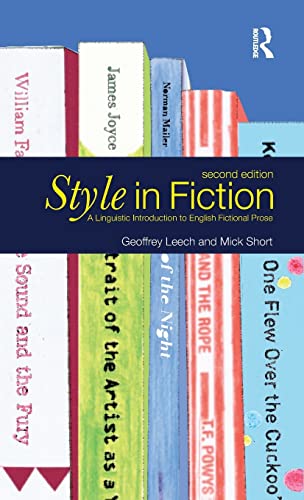
“Stylistics” is the study of language in the service of literary ends, and in Style in Fiction, Geoffrey Leech and Mick Short demonstrate how stylistic analysis can be applied to novels and stories. Writing for both students of English language and English literature, they show the practical ways in which linguistic analysis and literary appreciation can be combined, and illuminated, through the study of literary style. Drawing mainly on major works of fiction of the last 150 years, their practical and insightful examination of style through texts and extracts leads to a deeper understanding of how prose writers achieve their effects through language. Since its first publication in 1981, Style in Fiction has established itself as a key textbook in its field, selling nearly 30,000 copies. Now, in this revised edition, the authors have added substantial new material, including two completely new concluding chapters. These provide an extensive, up-to-date survey of developments in the field over the past 25 years, and apply the methods presented in earlier chapters to an analysis of an entire short story. The Further Reading section and the bibliographical references have also been thoroughly updated.In 2005 Style in Fiction was awarded the 25th Anniversary Prize by PALA (The Poetics and Linguistics Association) as the most influential book published in the field of stylistics 1980. Further proof, if proof were needed, that Style in Fiction remains a classic guide to its discipline.
User’s Reviews
Editorial Reviews: Review “Style in Fiction is a welcome addition to a body of writings by stylisticians who have over the past two decades cumulatively increased our knowledge of the workings of language in a range of literary genres.” Applied Linguistics About the Author Professor Geoffrey Leech is Professor Emeritus of English Linguistics at Lancaster University. He has written, co-authored or co-edited over 25 books, including A Glossary of English Grammar (2006) and Longman Grammar of Spoken and Written English (1999).’ Professor Mick Short is Professor of English Language and Literature at Lancaster University. He is the author of, among others, Exploring the Language of Poems, Plays and Prose (1996) and (with Elena Semino) Corpus Stylistics: Speech, Writing and Thought Presentation in a Corpus of English Writing (2004).
Reviews from Amazon users which were colected at the time this book was published on the website:
⭐I am enthralled by this text. I wish I had been introduced to it as a university student. Studies of English literature are sometimes so bloody political. This book focuses on the text. I am learning, as well as enjoying what was implicit in my studies regarding linguistic analysis of fictional texts being made explicit in this book; for me it is of interest.
⭐At least judging by the authors’ own comments in the book, the first edition of this book became a standard work in the linguistic analysis of fictional prose after it was published ca. 1980. Since I’m just starting to poke my nose back into this field after a hiatus of almost 40 years, I won’t presume to question the book’s importance. I do remember enough, though, about what it feels like to be a college student to believe that I’d be very disappointed to use it in a class. The subject matter is interesting, but the treatment here is overwhelming and dessicating. On the plus side, the authors are generous in furnishing illustrative passages from English literature for analysis.The structure of this second edition (2007) has a few problems. The first edition of the book was completed in 1979, when the winds of structuralism, narratology, deconstructionism and other forms of “critical theory” were barely beginning to wreak havoc on Anglophone academia. As a result, that edition didn’t discuss those trends at all. Unfortunately, that history remains pertinent today: even with this revised version, you’re still pretty much reading that first edition until you get past the first 280 pages or so. If you’ve been dipping into any other more recent introductory books — such as H. Porter Abbott’s excellent “Cambridge Introduction to Narrative” — it’s hard to integrate what you read there with what you’re reading here.A related problem is that the authors have chosen a sedimentary style of updating the book. That is, aside from a few minor tweaks in the endnotes of a few chapters, all the updates are in two new chapters deposited on top of the old material, at the end. The first of these is a catch-up on 25 years’ worth of critical trends, in roughly 22 pages. As often happens with this style of updating, the catch-up tends to be brisk and superficial, with a lot of name-dropping and not enough explanation. The second new chapter attempts to make up for this by applying several “new” techniques to a specimen text. The text is a very short story called “The Bucket and the Rope,” from a 1929 collection by T.F. Powys, and here presented in full.Powys’s story has some charm and interest, and might be fun to teach in a freshman/sophomore college class (or even in a high school that wouldn’t get up in arms about suicide and obliquely mentioned adultery). Here, however, the story is given a merciless lab-coat treatment for almost 40 pages, and has all the life bled out of it. The reasons why one might prefer one technique over another aren’t well communicated. Nor are the explanations of specific techniques always clear. I got especially confused at pp. 322-323, in a section whose heading announces the method of Claude Lévi-Strauss: after telling us that Lévi-Strauss used a four-column tableau for analyzing stories, the authors proceed instead with another author’s two-column method. By the end of the chapter, the authors have trudged through a partial gamut of critical approaches with much diligence and no joy.There are some other knock-on effects of the layered approach to revision. The two new chapters use an entirely different citation format from the 10 original ones (surprising that no editor caught that). The endnotes in the original chapters, meanwhile, only occasionally show more recent material; mostly they still cite to sources from the 1980s and earlier. The index sometimes misses references to subjects in the add-on chapters. E.g., the entry for “implied author” doesn’t pick up the authors’ important discussion of why they no longer think this is a necessary concept (at p. 300).Disappointing in a larger sense is a lack of interdisciplinarity all too common in works like this. Since the authors are linguists, the references tend to be limited to the linguistics tradition. So, for example, both Erich Auerbach and Dorrit Cohn, comparative literature scholars whose contributions are directly relevant to the book, are absent from these pages; even Roman Jakobson, a “structuralist” linguist who in the 1950s was among the first to do linguistic analyses of literature, gets only a passing mention.Despite what seemed to me to be serious shortcomings, I subtract only one star, after considering the book’s broad topical coverage and the wealth of analyses, as well as taking into account my own dilettantism in the field. But while there’s a great deal one can learn from this book, after you’ve read it you may need some time for literature to seem enchanting once again.
⭐Quite good book in the sphere of linguistics.
⭐
⭐
Keywords
Free Download Style in Fiction: A Linguistic Introduction to English Fictional Prose 2nd Edition in PDF format
Style in Fiction: A Linguistic Introduction to English Fictional Prose 2nd Edition PDF Free Download
Download Style in Fiction: A Linguistic Introduction to English Fictional Prose 2nd Edition 2015 PDF Free
Style in Fiction: A Linguistic Introduction to English Fictional Prose 2nd Edition 2015 PDF Free Download
Download Style in Fiction: A Linguistic Introduction to English Fictional Prose 2nd Edition PDF
Free Download Ebook Style in Fiction: A Linguistic Introduction to English Fictional Prose 2nd Edition