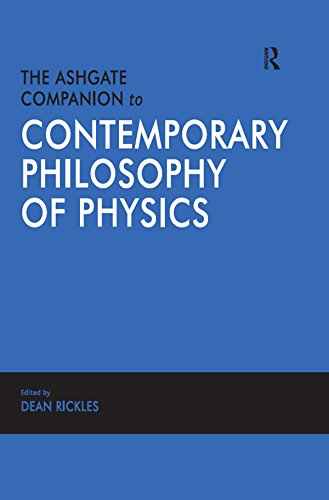
Ebook Info
- Published: 2016
- Number of pages: 389 pages
- Format: PDF
- File Size: 10.05 MB
- Authors: Dean Rickles
Description
Introducing the reader to the very latest developments in the philosophical foundations of physics, this book covers advanced material at a level suitable for beginner and intermediate students. A detailed overview is provided of the central debates in the philosophy of quantum mechanics, statistical mechanics, quantum computation, and quantum gravity. Each chapter consists of a ‘state of the art’ review written by a specialist in the field and introduces the reader to the relevant formal aspects along with the philosophical implications. These, and the various interpretive options, are developed in a self-contained, clear, and concise manner. Special care is given to situating the reader within the contemporary debates by providing numerous references and readings. This book thus enables both philosophers and physicists to engage with the most pressing problems in contemporary philosophy of physics in a fruitful way.
User’s Reviews
Reviews from Amazon users which were colected at the time this book was published on the website:
⭐Review of `Ashgate Companion to Contemporary Philosophy of Physics’As the editor of this volume notes, there exists a gulf between the small number of philosophy of physics textbooks on the one hand, and the wealth of current research found in journals on the other. The former are replete with outdated science, philosophers `toy’ examples, and sketches of debates long since grown stale and ill-tended. The latter contain examples from real, contemporary science, with cutting edge research in theoretical physics, cosmology, mathematical physics, mathematical logic, and philosophy combined. The Companion attempts to plug that gap. Note that there also exists a `Handbook on the Philosophy of Physics’ by Butterfield and Earman (2007) that is pitched at a more advanced level; this book is aimed at grad students and early career.I offer a chronological analysis of the subsections of the book below.1. The first subsection by David Wallace is a brilliant examination of the measurement problem (in the context of modern decoherence theory) from various foundational positions (`interpretations’) of QM. Wallace argues convincingly that these are in fact different QM’s. He clearly favours the Everett interpretation but eruditely outlines the basis of the other interpretations. The wealth of information here could serve as an advanced undergrad course, the references alone would suffice. Alternatively, it would do for a 1 semester grad course. Interestingly, on Wallace’s analysis the Everett interpretation (`Everettian QM’) comes out as the only `pure’ `realist’ interpretation. Read the book to see what he means by that. Wallace’s section is worth the price by itself!2. The second subsection by Roman Frigg is a kind of primer-cum-field-guide re Statistical Mechanics. It outlines the two traditional approaches to SM, i.e. the Boltzmann approach and the Gibbs approach; Frigg uses these as a heuristic to sort the wealth of material available. Thus he will deal with e.g. ergodicity programme in the first approach and then e.g. ontic probabilities in the second. There is much overlap and interconnection within the subfields of the philosophy of SM and Frigg manages to comprehensively cover them without too much repetition, also minimising confusion for the mathematically adept but ignorant noob.3. The third subsection, by Chris Timpson, offers a tour de force around Quantum Information Theory. Pretty much every major topic is sketched out, from quibits to teleportation to the Church-Turing Thesis/Hypothesis. Interestingly, Timpson also covers foundational issues in QM, like Wallace outlining the major options available in the QM-interpretation market, however within the very different setting of Quantum Information. Comparing these two parts of the book is very instructive for beginners.4. The fourth subsection by Dean Rickles is quite simply the best primer on QG ever written for philosophers! Philosophers of all career stages will appreciate it, as will interested physicists. Rickles lays out (in a highly pedagogical and somewhat historically inaccurate manner) the terrain in clear, analytical style. Included are: motivational arguments, historical positions and issues, current research avenues, a good list of special topics in QG. Especially interesting are Rickles’ concluding remarks regarding the future of QG.In sum, the Companion is a good resource for both physicists and philosophers, at both grad and research levels.In addition, I would recommend the book to any interested reader who say did a course in basic linear algebra at the undergrad level and has a passion for the kind of issues sketched out above.
⭐Hier kann man praktisch alles finden, was man über die Philosophie der Physik wissen wollte.
⭐
Keywords
Free Download The Ashgate Companion to Contemporary Philosophy of Physics 1st Edition in PDF format
The Ashgate Companion to Contemporary Philosophy of Physics 1st Edition PDF Free Download
Download The Ashgate Companion to Contemporary Philosophy of Physics 1st Edition 2016 PDF Free
The Ashgate Companion to Contemporary Philosophy of Physics 1st Edition 2016 PDF Free Download
Download The Ashgate Companion to Contemporary Philosophy of Physics 1st Edition PDF
Free Download Ebook The Ashgate Companion to Contemporary Philosophy of Physics 1st Edition