Ebook Info
- Published: 2004
- Number of pages: 208 pages
- Format: PDF
- File Size: 4.30 MB
- Authors: Steven Runciman
Description
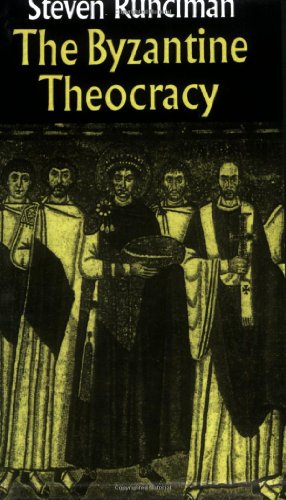
The constitution of the Byzantine Empire was based on the conviction that it was the earthly copy of the Kingdom of Heaven. Just as God ruled in Heaven, so the Emperor, made in his image, should rule on earth and carry out his commandments. This was the theory, but in practice the state was never free from its Roman past, particularly the Roman law, and its heritage of Greek culture. Sir Steven Runciman’s Weil lectures trace the various ways in which the Emperor tried to put the theory into practice – and thus the changing relationship between church and state – from the days of the first Constantine to those of the eleventh. The theocratic constitution remained virtually unchanged during those eleven centuries. No other constitution in the Christian era has endured for so long.
User’s Reviews
Editorial Reviews: Book Description A study of the theocratic constitution of the Byzantine Empire. Book Description Sir Steven Runciman’s Weil lectures trace the various ways in which the Emperor tried to put the theory into practice – and thus the changing relationship between church and state – from the days of the first Constantine to those of the eleventh. The theocratic constitution remained virtually unchanged during those eleven centuries.
Reviews from Amazon users which were colected at the time this book was published on the website:
⭐Wonderful British historian Steven Runciman herein chronicles the terribly important saga of the Byzantine Theocracy, from its foundation by Constantine, until its tragic fall, over 1,100 years later. As Runciman so clearly and insightfully illustrates, the theory of the Byzantine, or later Roman, Empire was that it was the Kingdom of God on Earth. With this lofty concept in mind, we see the various human machinations of the many interesting players in Byzantine history in the context of their membership in the Mystical Body of Christ, His Holy Church. We have read no more important treatise on Christian government to date.In historical context, the Byzantine theory of government is of crucial importance. For it was this theory that was inherited by Holy Russia. It is in this context, that Moscow was known as the Third Rome, after the original Rome, the first city of the Church, and the second Rome, Constantinople, which fell in 1453. When Constantinople fell, Moscow became the leading city of Orthodoxy, a role in which she served until her fall to the Bolshevik butchers in 1917. And we wait anxiously to see if Moscow, the Third Rome, can emulate her predecessor, Constantinople, and rise again. On this question turns much of the story of Civilization yet to come.We strongly recommend Sir Steven Runciman’s very important work. He writes beautifully, and with a proper sense of justice.
⭐In his book “The Byzantine Theocracy” is an excellent survey of the relationship between Emperors and the Church hierarchy throughout Byzantium’s 1,100 year old history. This book is in fact a collection of six separate lectures given by Runciman given at the Weil Institute in Cincinnati. The six chapters in the book chronologically map the evolution of Byzantine political thought, from the Constantine I and the era of Christological controversies, through the Iconoclastic controversy, Schism with the West, and the Byzantine Empire’s decline and eventual collapse in 1453.Runciman’s main argument is that an unwritten Byzantine constitution, formulated by the fourth century Bishop Eusebius, regarded the Emperor as God’s Viceroy on earth. Runciman’s view is that throughout the Empire’s history, Byzantines following this understanding of divine kingship jealously struggled to maintain the dignity of the Imperial office in the face of abuse, incompetence and challenges from ecclesiastical authorities.”The Byzantine Theocracy” is also a rather pleasant history of Church history from the 4th through 15th century, demonstrating many of Byzantium’s splendid contributions to Christian history. Byzantine emperors were very much involved in virtually all of the ecumenical councils that took place during this era. As well, the complicated history of the relationship between the Ecumenical Patriarch of Constantinople, the Pope and the other eastern Patriarchs is intertwined with Byzantine political history.This is a fascinating book and an essential read for anyone interested in Byzantine history, Church history, applied politics or anyone curious how a state that lasted more than a millennium governed itself.
⭐Runciman’s book is misleading. One thinks one is about to enter a balanced discussion of Byzantine political theory. After the first chapter one expects nuanced and detailed comparisons and contrasts between Eusebius and Augustine, and perhaps the different trajectories of East and West. It is nothing of the sort. This book is simply a $50 (albeit only 160 pages!) summary of the Byzantine Empire.Runciman does a good job explaining Byzantine political theory in the first chapter. He anticipates arguments later Royalists would use against democracy: the King is an icon of heaven, and if we are to pray that the Kingdom come on earth as in heaven, we need to see at least a mirror of that on earth. That’s how the Byzantine reasoned and Runciman does a good job with it. (Runciman mentions the Cappadocian fathers but oddly avoids discussing how Gregory of Nazianzus’s *Monarchy of the Holy Trinity* necessarily implies a political monarchy on earth, a point later theologians–albeit modernist and anti-royalist ones–were to accuse Nazianzus of’; see Third Theological Oration). Runciman also notes the tensions within many of the arguments that would later become contradictions for the Byzantines Of particular interest was the Byzantine definition of the Church and how that played out in “Church/State” politics. All in all, a dazzling first chapter.And then Runciman’s discussion of his thesis disappears for 120 pages. This book feels like the ultimate “bait and switch.” At this point Runciman’s gives a highly-condense, if well-written, summary of Byzantine history from St Constantine the Great to the Martyr-King Constantine XI Dragases. One does see examples of tensions within Runciman’s thesis now and then (the church often opposed the emperor, yet if he were the viceroy of God on earth, how could they get away with it?), but never a protracted discussion of his thesis.Runciman’s concluding chapter, like his original chapter, is very engaging and deals with the topic. One leaves the book keenly aware of many problems in Byzantine political theology, but this is actually good for royalists. The Byzantines developed their political theology within a strongly theological position. Problems were to come, to be sure, but that’s true with any political system. The Byzantines were valuable because their system demonstrates the best and worst of absolutism (though as any Byzantine ruler knew, his reign was never absolutist–if he did something the priests and people did not like, his reign would be tumultuous).Conclusion:Don’t buy this book. I’ve summarized in two paragraphs all that you need to know concerning the thesis. The rest is simply a history of the Byzantine empire, which one can find in any historical volume at the local library. Do read the book, though, but only borrow it. Ask yourself, “Are you willing to spend $50 on a 160 page book that doesn’t deal with the thesis and merely summarizes information you could easily get for free at the local library?”
⭐This is a short but a great book on the subject. Runciman’s style of writing is beautiful and also very informative.This is a very good and also concrete presentation of the Byzantine Empire state ideology and its unusual political system.To understand the Byzantine civilization you have to know properly the relations between the church and the state, which existed in this specific ”organism” what is called the Byzantine Empire for over 1000 years. This Greek and Christian Empire was a straight successor (with some modifications caused by the triumph of the Christianity) of the classic antiquity.
⭐To the point story of the byzantine empire and the church and all its changes over time.
Keywords
Free Download The Byzantine Theocracy: The Weil Lectures, Cincinatti in PDF format
The Byzantine Theocracy: The Weil Lectures, Cincinatti PDF Free Download
Download The Byzantine Theocracy: The Weil Lectures, Cincinatti 2004 PDF Free
The Byzantine Theocracy: The Weil Lectures, Cincinatti 2004 PDF Free Download
Download The Byzantine Theocracy: The Weil Lectures, Cincinatti PDF
Free Download Ebook The Byzantine Theocracy: The Weil Lectures, Cincinatti