Ebook Info
- Published: 2009
- Number of pages: 330 pages
- Format: PDF
- File Size: 42.61 MB
- Authors: William A. Dembski
Description
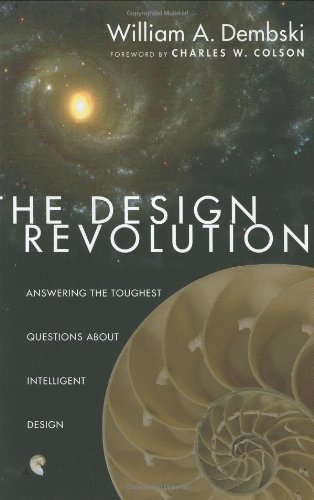
Winner of a Christianity Today 2005 Book Award!A 2005 Gold Medallion finalist.Is it science? Is it religion? What exactly is the Design Revolution?Today scientists, mathematicians and philosophers in the intelligent design movement are challenging a certain view of science–one that limits its investigations and procedures to purely law-like and mechanical explanations. They charge that there is no scientific reason to exclude the consideration of intelligence, agency and purpose from truly scientific research. In fact, they say, the practice of science often does already include these factors! As the intelligent design movement has gained momentum, questions have naturally arisen to challenge its provocative claims. In this book William A. Dembski rises to the occasion clearly and concisely answering the most vexing questions posed to the intelligent design program. Writing with nonexperts in mind, Dembski responds to more than sixty questions asked by experts and nonexperts alike who have attended his many public lectures, as well as objections raised in written reviews. The Design Revolution has begun. Its success depends on how well it answers the questions of its detractors. Read this book and you’ll have a good idea of the prospects and challenges facing this revolution in scientific thinking.
User’s Reviews
Reviews from Amazon users which were colected at the time this book was published on the website:
⭐In The Design Revolution: Answering the Toughest Questions About Intelligent Design (2004), William “Bill” Dembski presents a handbook-style compendium of questions and answers that explains and supports the theory of intelligent design (ID). With two Ph.D.’s in mathematics (University of Chicago) and philosophy (University of Illinois at Chicago), and an impressive array of contributions and research on the topic (billdembski.com), Dembski is regarded as a pioneer of the ID movement and is eminently qualified for the task of “answering the toughest questions about intelligent design.” His related publications include Intelligent Design: The Bridge Between Science & Theology (2002); The Design Inference: Eliminating Chance through Small Probabilities (2006); and Intelligent Design Uncensored: An Easy-to-Understand Guide to the Controversy (2010).Dembski approaches this project with the conviction that it will revolutionize science and our conception of the world, mainly by challenging the “grand idol of evolutionary biology (Darwinism),” but also by altering the prevailing naturalistic assumptions which dominate modern science and thus exclude design inferences by fiat. He frames the sequence of this revolution in the context of J.B.S. Haldane’s four stages of acceptance: “(i) this is worthless nonsense; (ii) this is an interesting, but perverse, point of view; (iii) this is true, but quite unimportant; (iv) I always said so.” Dembski’s purpose for writing The Design Revolution was to assist in transitioning ID from stage two to stage three by equipping ID supporters with a comprehensive resource to answer critics. He also deems the unabridged nature of this material suitable for honest skeptics who are interested in examining the merits of ID’s claims.As mentioned, this book functions more like a reference manual than something one might attempt to read from cover to cover in a single sitting, though it has been written carefully enough to accommodate that. Dembski begins each of the book’s 44 succinct chapters with an objection to ID in the form of a question: “Is intelligent design testable”; “Isn’t intelligent design just an argument from ignorance?” are two such examples. In keeping with the handbook format, the chapters are sub-titled by such critically-raised questions and therefore provide a convenient means of reference via the table of contents. The chapters are then framed within six broader sections which provide an overall logical flow: (1) Basic Distinctions [what ID is and is not]; (2) Detecting Design [what is a design inference and how does it function]; (3) Information [what is it?]; (4) Issues Arising from Naturalism; (5) Theoretical Challenges to Intelligent Design; and (6) A New Kind of Science.Perhaps the greatest strength of The Design Revolution is its no-nonsense approach to engaging the most salient objections to ID. A liability of this format is inevitable overlap, but Dembski is conscious of this and does an excellent job of minimizing unnecessary redundancies. The question-and-answer presentation is very pragmatic as it prepares readers to think in a point-counterpoint manner, which is often the way these conversations unfold. The bite-sized chapters also necessitate the absence of superfluous ramblings and are ideal for readers who merely want clarification on particular aspects of the theory; though, they are equally suitable for those desiring a fully-orbed view of ID’s tenets. More importantly, the content is presented with clarity and accessibility, but without dumbing-down concepts or terms. For example, specified complexity is a fundamental component within ID theory and one that can only be distilled so far before it loses its essential qualities. The “complexity” of the topic notwithstanding, one needn’t be a math whiz to digest Dembski’s presentation, though it may take two or three passes for unfamiliar readers to grasp a solid understanding. Additionally, related publications are mentioned in context for those who may want to explore various aspects of ID in greater depth—The Design Revolution is, after all, a popular treatment.Anyone familiar with intelligent design is likely acquainted with the associated criticism, much of which has been targeted toward ID’s chief advocates. In this regard, it is to Dembski’s credit that he refrains from using his book as a platform from which to dispense retribution on his critics. Rather, he engages their objections with substance and in a philosophically responsible manner (i.e., no straw-man arguments, ad hominems, etc.). Nevertheless, he is clearly not interested in diplomacy at the expense of conviction and does not hesitate to highlight deficiencies in the claims of his critics by name. For example, in a polemical fashion that has become typical of ID-Darwinism discourse, he asserts that Larry Moran and Kenneth Miller are “disingenuous … in claiming that evolutionary biology has resolved the problem of biological complexity,” yet he is careful not to make such appraisals in the absence of sufficient justification.Of course, Dembski’s main objective is not to show how individual critics are wrong, but to advance ID by equipping its supporters with a resource that sufficiently addresses the spectrum of criticism leveled against the theory. Insofar as he seems to have covered the range of substantive questions and provided thorough and accessible answers, his book has accomplished its intent. Furthermore, he has achieved this by presenting a host of complex and abstract issues in an interesting and engaging way. Perhaps the only feature that might make this project better would be the addition of more anecdotes and analogies to help the material stick in the minds of its readers.In any event, The Design Revolution is written with a broad audience in view and is therefore suitable for anyone interested in exploring various aspects of intelligent design against the backdrop of its toughest objections. It is highly recommended for students entering the university, where they will face inevitable indoctrination into Darwinian dogmatism. It will also serve as a useful manual for anyone desiring a convenient reference to address various issues related to design theory. There are many excellent books published on intelligent design, but this is one readers will surely return to time and again.
⭐It came on time and in very good condition not sure it was new even though I paid the highest price. The worst thing was it smelled so musty like it had been packed away for a long time. So I have been trying to air it out with dryer sheets because it is a gift.
⭐It is puzzling to me that today in the information age, confusion abounds about the nature of intelligent design. It is not a conceptually difficult idea that is claimed, and yet misrepresentations abound. Dembski’s book, therefore, is invaluable at setting the record straight. It consists of 44 short chapters, each of which is only 6-8 pages long and deals with a specific question that he has encountered about intelligent design. Taken as a whole, the intelligent design position is sharply clarified and in so doing, the main objections often simply melt away. Now of course, intelligent design may yet prove to be false, but the key claims cannot be engaged until it is clear what they are. The main objection about intelligent design is that is an argument from ignorance, falling into god-of-the-gaps thinking by invoking divine action at every point where science at the moment doesn’t have an explanation. What intelligent design actually claims is the following:1. Intelligent agents sometimes leave empirical indicators, or fingerprints, in the world; examples include Mt. Rushmore, written texts, soundwaves carrying vocal communication. On the basis of these indicators we can infer intelligent rather than natural causation. This much is uncontroversial, but it gets controversial when we get to the second claim:2. The natural world has such empirical indicators of intelligence. There is, in the natural world, in those domains that are properly the study of natural science, observable, empirical evidence of intelligence. Dembski clarifies this idea further by formalizing it into an argument consisting of three premisses and a conclusion:Premise 1: Certain biological systems exhibit a feature called specified complexity.Premise 2: Evolutionary biology does not know how biological systems with that feature originated.Premise 3: In everday experience we know that intelligent agency has the causal power to produce systems that exhibit specified complexity. Many things produced by human intelligent designers exhibit this feature – for example, the internal combustion engine.Conclusion: Therefore, biological systems that exhibit specified complexity are likely to be designed. Premise 3 is the crucial connecting premise that is left out by people who say that ID is just an argument from ignorance (we don’t know how it happened, therefore God did it). Design theorists, in attributing design to systems that exhibit specified complexity, are simply doing what scientists do generally, which is to attempt to formulate a causally adequate explanation for the phenomenon in question. Specified complexity is a marker for the presence of information, and our uniform and repeated experience is that information always comes from minds, from intelligence, and not from unguided natural processes. Thus when one makes a design inference one is not arguing from ignorance, but making a positive case based on what we do know, employing standard scientific reasoning by making an inference to the best explanation. An example from the movie “Contact” shows that this kind of reasoning is already accepted within the scientific community. Jodie Foster’s character was an astronomer working for the SETI program (Search for Extraterrestrial Intelligence). She picked up a signal from outer space that she concluded was not noise but came from an intelligence. What was it that allowed her to come to that conclusion? It was just this: Was the signal random? No. Was it merely ordered? No. What allowed her to infer intelligence was that the signal contained the first twenty prime numbers in a row. Now, not only is that improbable (or complex), but there’s a way to specify that sequence independently of the fact that it’s the one she picked up; namely we already know that the prime numbers are a special set of numbers. Thus the conjunction of improbability and independent specifiability indicated the presence of specified complexity, a marker for intelligence which in turn our uniform experience tells us always comes from minds. Now why is it that a SETI researcher hasn’t stopped doing science when she concludes that the scientific evidence is best explained by intelligent design, but a scientist is accused of doing just that when the focus is shifted from outer space to molecular biology, and an identical reasoning process leads to a design inference? Intelligent design is revolutionary because it looks at reality in an entirely new way. In the nineteenth century when Darwin formulated his theory it was thought that there were two fundamental entitites in nature – matter and energy. At the beginning of the twenty-first century we recognize there is a third fundamental entity – information, that is not reducible to either matter or energy. How do we know this? If you hold up two computer disks, one blank, and the other filled with software, and you ask the question, what is the difference in mass between these two as a result of the difference in information content, the answer of course is zero. That is because information is a massless entity; it is immaterial. You can no more explain the origin of information by materialistic explanations than you can the written text on a page by the laws of the chemistry of ink and paper. Evolutionary biology is faulty because it tries to make natural causes do the work of intelligent causes. But intelligent design does not throw out the whole of evolutionary biology and satisfy itself by merely pointing out instances of design. No, it adds to the explanatory toolbox of science that Darwinism untilizes; it does not take away from it. It still sees a role for natural causes, but it does not inflate that role beyond what the evidence indicates. The relationship between ID and Darwinism is something like that between Einstein’s theory of relativity and the Newtonian mechanics it replaced. Einstein’s theory did not make Newtonian mechanics worthless, it just greatly limited its scope of applicability. ID is not looking to reinvent the wheel, but just to have the conceptual tools to deal with the flow of information in biological systems that Darwinism lacks.
⭐I loved this book. It should be considered the philosophical base that establishes Intelligent Design as a valid scientific discipline. Most people don’t seem to understand that the supposed refutations of ID proceed from faulty assumptions about the nature of science. Mostly it reveals the ignorance of those individuals as to their subjective world-view, that biological systems can’t, by definition, be designed (which is an absurd and unprovable viewpoint). This books offers detailed refutations of all the ultimately metaphysical attacks against ID (there is no valid scientific evidence against ID – only hand-waving and just-so stories). For anyone who disputes these points, read the book before you offer a weak response to its arguments.
⭐The book is sometimes technical but easily readable. It gets right to the point anwsering with no-nonsense clarity. I certainly suggest it.
⭐Finally a scientific proof of what we all know intuitively – that we are not a product of just random chance events. Will stump any atheist.
⭐Before reading this book I had the impression from various comments I had read, that William Dembski was some sort of religious fanatic whose views could be dismissed as unworthy of serious consideration. I had not got very far into this book when I realised that here was an intelligent and very clear thinking scientist whose views were such that they ought to be taken very seriously.Not being either a scientist or a mathematician, there were a few places where I needed to carefully re-read passages to try to understand exactly what was being said, but on the whole the book is written in layman’s language. Since reading this book I have read various reviews and articles on the other side of the argument, but have not found any convincing response. Frequently there has been dismissive contempt and that in itself suggests a paucity of reasonable counter argument. The fact that the scientific community is opposed to the publication of papers supporting intelligent design, suggests to me that the implications of it being true, simply cannot be countenanced. If science is meant to be an investigation and search for truth, then there needs to be an openness to both sides of an argument.I strongly recommend this book. Truth can be suppressed for a time, but in the end like a spring of water it will emerge and will not remain hidden forever.
⭐Over the past few months, I have read a number of books from the so-called “Intelligent Design” supporters, plus several critical commentaries on them. This is, in many ways, by far the worst of those books, and one that took a great effort to read. A major problem is that it is not clear who the audience is supposed to be. The natural audience (non-scientific people who disagree with evolution on religious grounds) will be turned off by the style – never use a short word when two or three longer ones can be substituted, etc. And anyone wanting to learn about the “science of intelligent design” will, of course, find nothing at all. If you are contemplating buying this book to learn more about the debate, spend your money elsewhere.At least with, say, Johnson, you know what you are getting – no pretence of being scientific, just religiously motivated rhetoric. Dembski, on the other hand, pretends to be scientific, whilst constantly whingeing about how science is done wrong, because it does not support his views. He goes out of his way to insult scientists at every opportunity, accusing them of heinous crimes (such as ‘just asserting something without proof’), whilst being guilty of those crimes himself. Same old, same old.As others have noted elsewhere, and as you might expect, the book does not “answer the toughest questions” about intelligent design. It answers the questions he wants to answer, thus carefully avoiding all the really tough ones (like “what is ‘intelligent design’ really?”), or pretending to answer them but actually giving evasive answers, or answers to a different (and usually uninteresting) question.From the reading that I have done elsewhere, even opponents of Dembski and crew say that he is personable, polite, good humoured, in fact an all round ‘good chap’. And we know that he is a committed Christian. Nevertheless, the book seems to be intellectually dishonest in the extreme. I can only assume that his religious commitments are such that he believes that he is being honest to some ‘higher truth’. For example, he trots out many points (his, or from, say Behe) that have been thoroughly disproved elsewhere, without any apparent embarrassment, as if those points were valid. So it gets very wearing to be told these things time and time again, or to be presented with a 7 or 8 page argument which is based on an statement which has been disproved elsewhere.Simply dreadful.
Keywords
Free Download The Design Revolution: Answering the Toughest Questions About Intelligent Design in PDF format
The Design Revolution: Answering the Toughest Questions About Intelligent Design PDF Free Download
Download The Design Revolution: Answering the Toughest Questions About Intelligent Design 2009 PDF Free
The Design Revolution: Answering the Toughest Questions About Intelligent Design 2009 PDF Free Download
Download The Design Revolution: Answering the Toughest Questions About Intelligent Design PDF
Free Download Ebook The Design Revolution: Answering the Toughest Questions About Intelligent Design