Ebook Info
- Published: 2004
- Number of pages: 224 pages
- Format: PDF
- File Size: 1.05 MB
- Authors: Harold J. Morowitz
Description
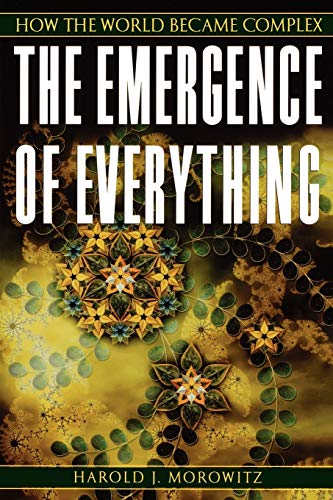
When the whole is greater than the sum of the parts–indeed, so great that the sum far transcends the parts and represents something utterly new and different–we call that phenomenon emergence. When the chemicals diffusing in the primordial waters came together to form the first living cell, that was emergence. When the activities of the neurons in the brain result in mind, that too is emergence. In The Emergence of Everything, one of the leading scientists involved in the study of complexity, Harold J. Morowitz, takes us on a sweeping tour of the universe, a tour with 28 stops, each one highlighting a particularly important moment of emergence. For instance, Morowitz illuminates the emergence of the stars, the birth of the elements and of the periodic table, and the appearance of solar systems and planets. We look at the emergence of living cells, animals, vertebrates, reptiles, and mammals, leading to the great apes and the appearance of humanity. He also examines tool making, the evolution of language, the invention of agriculture and technology, and the birth of cities. And as he offers these insights into the evolutionary unfolding of our universe, our solar system, and life itself, Morowitz also seeks out the nature of God in the emergent universe, the God posited by Spinoza, Bruno, and Einstein, a God Morowitz argues we can know through a study of the laws ofnature. Written by one of our wisest scientists, The Emergence of Everything offers a fascinating new way to look at the universe and the natural world, and it makes an important contribution to the dialogue between science and religion.
User’s Reviews
Editorial Reviews: Review “Morowitz claims that emergence supplies us with a new foundation for religion-one that enables the natural sciences to supply a foundation for spiritual realities.” — C.P. Goodman, The Polyani Society Periodical”Closely reasoned and rich in scientific and philosophical background.”–Scientific American”This is a brilliant book. Morowitz has provided the first state-of-the-art overview of the theory of emergence across the scientific disciplines. Neither too detailed nor too abstract, his 28 stages of emergence trace the history of the universe from the Big Bang through the appearance of culture, philosophy and spirituality. No other work has laid out the core case for emergence–and hence against the ultimacy of reductionism–across the whole spectrum of science. This introduction to emergence theory should guide philosophers of science and anthropologists, theologians and metaphysicians, as they reflect on the nature of Homo sapiens and our place in the cosmos.”–Philip Clayton, Harvard University About the Author Harold J. Morowitz is Clarence Robinson Professor of Biology and Natural Philosophy at George Mason University and the former Director of the Krasnow Institute for Advanced Study, in Fairfax, Virginia. A leading figure in the study of complexity, he was Editor-in-Chief of the journal Complexity and is co-chair of the science board of the Santa Fe Institute. His writing has appeared in The New York Times, Discover, The Washington Post, The Sciences, and Psychology Today.
Reviews from Amazon users which were colected at the time this book was published on the website:
⭐This book attempts to unravel the mind of god as Morowitz feels that “knowing the mind of god is our task as humans, our vocation”. Whether it fully succeeds in that task or not, you do understand the mind of Morowitz by reading this book and marvel at his intellectual virtuosity and ability to absorb knowledge from so many disparate fields like cosmology and biology and present such a succinct synthesis of the emergence of phenomena in each of those fields. A major portion of the book consists of a discussion of twenty-eight emergences that “represent a continuous series going from the reductionist core of particle physics to the most noetic aspect of human thought”.Despite such extensive coverage of scientific advances, the book manages to read somewhat like an absorbing whodunit: you are waiting till the end for Morowitz – while he maintains the suspense – to finish describing various emergences – from the Big Bang to the evolution of life-forms and the mind to ultimately answer (or attempt to answer) the question: who engineered these emergences? A question posed by theists in this context that is never easy to answer from a non-teleological perspective is “Who was the ultimate mover?” What came before then? What gives life the ability to replicate, to procreate and to grow? The sections (especially the chapters on the emergence of metabolism and cells) dealing with emergence in life forms in this book do a well-argued job of explaining these inquiries. Beware therefore if you are on the epistemic borderline between belief in a supernatural force – let alone a benevolent or omniscient god – and considering other more matter-based alternatives, as this book is wont to sow doubts in your mind and surreptitiously loosen the foundations of your beliefs.Morowitz argues that such emergence is triggered by natural features such as auto-catalysis (similar to the concept of autopoiesis – a system capable of creating itself – propounded by Chilean biologists Humberto Maturana and Francisco Varela) and endosymbiosis and the fact that matter is informatic in nature in the sense that information for change and evolution is created and is re-used in ensuing phenomena. The conclusions in this book (fresh, even startling to some) may end up pleasing neither rationalists nor believers. This does not mean that the book is either inconclusive or ends unsatisfactorily. This is apparent when one reminds oneself of the rubric that there are no pat answers to questions like what does it all mean or why is there something instead of nothing. Morowitz observes, “Eating at the tree of knowledge seems like an inevitable consequence of the development of the universe.” The more you eat, the less you seem satiated, though.If at all there is a shortcoming to this book, it is this: it more or less wholly ignores Eastern thought. (Morowitz is himself conscious of this lacuna as he admits that this omission stems from his ignorance of the vast amount of thoughts “outside the one in which my education occurred”.) For instance, he presents towards the end of the book a list of the greatest thinkers in history, ranging from Aristotle to Charles Darwin. Some of the very notable exclusions from this list are intellectual giants such as Confucius and the Buddha. The latter particularly was inimical in postulating a metaphysic and epistemology which dealt with existential questions without bringing a deity or supernatural being into the equation. A discussion of ideas that some of the non-Western thinkers gave the world would have contributed immensely towards a better expostulation of the latter emergences that Morowitz talks about, especially those relating to the rise of the noosphere, the mind and consciousness.
⭐For me, this book defies ranking, roaming somewhere between a 1-star rating and 5. I was introduced to the author, George Mason University’s Harold Morowitz (1927-2016), after reading a riveting article on prebiotic chemistry and the origins of life by he and two others in a 2009 issue of American Scientist waiting for me for years on the shelf. [1] The topic here is emergence. One of my favorite examples is wetness. Less than a million or so molecules of water between your fingers feel dry and dusty. Exceed that number, and it feels wet and slippery. Wetness is an emergent property once a satisfactory threshold is crossed. There are countless such properties: an emergent property of the Big Bang was matter, stars are emergent from the property of gravity that comes with all that matter, consciousness emerges from a particular ordering of that inanimate jell between our ears. Morowitz treats 28 different emergences: including the periodic table; metabolism; cells; prokaryotes; reptiles; hominids; language; agriculture; philosophy; spirit.Morowitz is good at presenting the obvious-but-isn’t kernel of evolutionary adaptations. What does the billion-year evolution of the neuron mean? It means slow, short-range cell-to-cell chemical communication got an upgrade. Plugging the first cell into a wire at one end and the second cell into the wire’s other end and we get fast long-range communication. Suddenly creatures can grow in size, able to sense stimulus many cells away and respond accordingly: eat, flee, or have sex. Morowitz concisely explains Spinoza’s God, the curious and delightful Jesuit paleontologist Teilhard de Chardin (The Phenomenon of Man), and does a bang-up job on that profound question of Athens and Jerusalem: “On a spring day in the year 350 B.C., there was a stir in the academy at Athens. The increasingly independent experimentalist Aristotle was debating with the seminar mentor Plato, who adopted a much more theoretical view. Forty-nine years earlier, Socrates had downed his hemlock and thus ended his ‘misleading’ the young of Athens. Two hundred miles away in the palace of Philip of Macedon, six-year-old Alexander was beginning his education. Some 400 miles distant in another academy in Jerusalem, a group of scholars were debating the meaning of a biblical passage… both were developing comprehensive world-views of God, man, and the universe, which would resonant far into the future. As Alexander matured and conquered half the world, including Jerusalem, the Greek and Hebrew views were finally to come into a dialogue that has lasted for well over two millennia and has a current importance that can be impressively seen in writings like the 1998 papal encyclical, Faith and Reason.”And yet, for long sections, the book reads like a list: This happened, then that happened, then another thing took place. After that, this happened, then that happened, and another thing occurred. Morowitz sailed when he entered his field of biology but quickly wore me out looking up so much technical jargon I couldn’t bear the hundredth pause and just read through them, “whatever that is….” And then, there’s God. At the book’s conclusion, it sounds like Morowitz is trying to have both the impersonal laws-of-the-universe-god, which he explicitly aligns with, and the mysterious personal God of tradition. “Transcendence is an emergent property of God’s immanence and rules for emergence,” writes Morowitz. Oh. Really? We can pray to stop a bacterial infection or take antibiotics, says Morowitz. “In both cases, there is a miracle.” No, one is a “miracle” that defies explanation, if it worked, which repeated tests show it doesn’t, and the other is “miraculous,” understood by the cause and effect of science.A book at times brilliant, at others, perturbing.[1] JAMES TREFIL, HAROLD J. MOROWITZ, ERIC SMITH, The Origin of Life: A case is made for the descent of electrons, American Scientist, May-June, 2009
⭐An informative read–fairly clear for the layperson (myself), with some jargon and technical spots.Successful in presenting the basic principle of ’emergence’, but most of the book is spent in a long-winded struggle to further flesh out emergence and provide examples. . . . as a result I felt that I had to learn quite a bit of biology and geological history just so that they could be drawn into basic examples of emergence. (Not necessarily a bad thing, but a lot of time was spent on the outskirts just to support the theme). I know that the concept (and field) of ’emergence’ is new, but I expected to learn more on the dynamics, not just see exemplification. There are a few broad assumptions and much of the author’s personal bias can be seen. However, (to me) the author was redeemed when they turned away from the empirical science aspects to cite philosophers (such as Kant) and draw up major points about emergence as a bridge between worldviews of science and religion. This brings surprising balance and broadens the topic, making it more of an insightful work rather than a murky scientific textbook. This exemplifies the broadness of emergence, rather than trapping it in empirical views.
⭐It starts with Big Bang, goes on to emergence of Man. Has nice bits of theology, rather Jewish – that’s why I like’m!
⭐Great overview of complexity as it applies to selected domains.
Keywords
Free Download The Emergence of Everything: How the World Became Complex in PDF format
The Emergence of Everything: How the World Became Complex PDF Free Download
Download The Emergence of Everything: How the World Became Complex 2004 PDF Free
The Emergence of Everything: How the World Became Complex 2004 PDF Free Download
Download The Emergence of Everything: How the World Became Complex PDF
Free Download Ebook The Emergence of Everything: How the World Became Complex