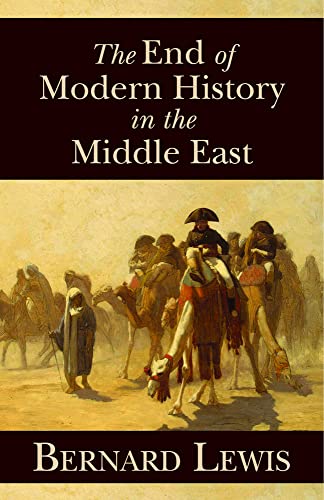
Ebook Info
- Published: 2011
- Number of pages: 216 pages
- Format: PDF
- File Size: 0.55 MB
- Authors: Bernard Lewis
Description
With the ending of global strategic confrontation between superpowers, those in the Middle East must adjust to a new reality: to accept final responsibility for their own affairs, to make and recognize their mistakes, and to accept the consequences. In The End of Modern History in the Middle East, Bernard Lewis discusses the future of the region in this new, postimperialist era. For each and every country and for the region as a whole, he explains, there is a range of alternative futures: at one end, cooperation and progress; at the other, a vicious circle of poverty and ignorance. The author examines in detail the issues most critical to the region’s future. He describes oil as the current, most important export to the outside world from the Middle East but warns that technology will eventually make it obsolete, leaving those who depend solely on oil revenues with a bleak future. The three factors that could most help transform the Middle East, according to Lewis, are Turkey, Israel, and women. He also argues that there is enough in the traditional culture of Islam on the one hand and the modern experience of the Muslim peoples on the other to provide the basis for an advance toward freedom in the true sense of that word and to achieve the social, cultural, and scientific changes necessary to bring the Middle East into line with the developed countries of both West and East.
User’s Reviews
Editorial Reviews: From the Inside Flap For the first time in almost two hundred years, the rulers, and to some extent the peoples, of the Middle East must accept responsibility for their own affairs, to make and recognize their own mistakes, and to accept the consequences. Today, increasing numbers of Middle Easterners, disillusioned with past ideals and—in many countries—alienated from their present rulers, are turning their thoughts or their loyalties or both to one of two ideologies: liberal democracy or Islamic fundamentalism. Each offers a reasoned diagnosis of the ills of the region and a prescription for their cure. But if freedom fails and terror triumphs, the peoples of Islam will be the first and greatest victims. They will not be alone, and many others will suffer with them.In The End of Modern History in the Middle East, Bernard Lewis looks at this new era there. With the departure of imperial powers, the region must now, on its own, resolve the political, economic, cultural, and societal problems that have held it back in the world. Lewis details the critical issues for the future of the region—not surprisingly, oil and water will be key—and the important elements that could help transform the Middle East: women, Turkey, and Israel. Women, he explains, have the strongest vested interest in social and political freedom. Turkey can and probably will play a growing role in the region because the Turks have greater political experience, a more developed economy, and a more balanced society than the Arab states. And the Arab-Israeli conflict as well, in one way or another, will profoundly influence the development of the region as a whole. If the struggle becomes more bitter, it will have a corrosive effect on both Israeli and Arab societies. Peace, in contrast, would speed the progress of the region toward a new age of advanced technology and political freedom. But the continuing struggle within the region, with the consequent diversion of energy and resources to the politics and weaponry of war, can only make likely a resumption of outside interference and domination. From the Back Cover For the first time in almost two hundred years, the rulers, and to some extent the peoples, of the Middle East must accept responsibility for their own affairs, to make and recognize their own mistakes, and to accept the consequences. Today, increasing numbers of Middle Easterners, disillusioned with past ideals and—in many countries—alienated from their present rulers, are turning their thoughts or their loyalties or both to one of two ideologies: liberal democracy or Islamic fundamentalism. Each offers a reasoned diagnosis of the ills of the region and a prescription for their cure. But if freedom fails and terror triumphs, the peoples of Islam will be the first and greatest victims. They will not be alone, and many others will suffer with them.In The End of Modern History in the Middle East, Bernard Lewis looks at this new era there. With the departure of imperial powers, the region must now, on its own, resolve the political, economic, cultural, and societal problems that have held it back in the world. Lewis details the critical issues for the future of the region—not surprisingly, oil and water will be key—and the important elements that could help transform the Middle East: women, Turkey, and Israel. Women, he explains, have the strongest vested interest in social and political freedom. Turkey can and probably will play a growing role in the region because the Turks have greater political experience, a more developed economy, and a more balanced society than the Arab states. And the Arab-Israeli conflict as well, in one way or another, will profoundly influence the development of the region as a whole. If the struggle becomes more bitter, it will have a corrosive effect on both Israeli and Arab societies. Peace, in contrast, would speed the progress of the region toward a new age of advanced technology and political freedom. But the continuing struggle within the region, with the consequent diversion of energy and resources to the politics and weaponry of war, can only make likely a resumption of outside interference and domination. About the Author Bernard Lewis is the Cleveland E. Dodge Professor of Near Eastern Studies Emeritus at Princeton University. A widely read expert on the Middle East, he is regarded as one of the West’s leading scholars on the region. He has published numerous books; the most recent of which he coauthored with Buntzie Ellis Churchill, Islam: The Religion and the People. Read more
Reviews from Amazon users which were colected at the time this book was published on the website:
⭐This book could be summed up as the “musings” of its author, Bernard Lewis, in what was obviously published before the most recent, and significant tremor in the region as of late, the “Arab Spring.” There are only four chapters: 1) The End of Modern History in the Middle East 2) Propaganda in the Middle East 3) Iran: Haman or Cyrus 4) The New Anti-Semitism–First Religion, Then Race, Then What? The first two chapters alone take up nearly 70% percent of the book. I found the book, particularly the first part, to consist mostly of the “musings” of its author concerning the trends of the modern Middle East in light of its past two hundred years; Nevertheless, given the depth and breadth of his knowledge, his musings still presented a reservoir of new information which I had yet to encounter in my other readings, and was most happy to come across in this book…particularly, the chronology and process by which the printing press slowly was introduced into the region, long after being exploited in Europe. The consequences of this process, particularly it’s tardiness in both its arrival and dissemination to the masses of the region left me aghast and questioning the extent to which this process contributed to today’s disparity in literacy between the “West” and the modern Islamic world. The connection is cogent, considering that the original reason for the lack of enthusiasm that greeted the arrival of the printing press had to do with a an Islamic fundamentalist fear of erring in the printing of God’s Word, the Q’uran…and, today’s lack of publishing and translation of books from Western languages into Arabic seems to be similarly derived from a fear of printing anything that contradicts the Prophet’s revelation. One of his more valuable assertions is the explosive (in a good way!) potential of woman (over 50% of the population of these countries) on the economies of the Middle East, should they be liberated from their traditional subjection/subjugation. The chapter on Propaganda was the most scholarly and packed with information. My only regret, which is why I gave it four stars, was that the book is not annotated…no footnotes or endnotes to pursue further reading or citations. This was particularly surprising, given that the book is published by Stanford University. One would expect a book published by such a respected research university to include citations and notes. The chapter “Iran: Haman or Cyrus,” is both timely, for obvious reasons, and revelatory in that it offers an original and innovative deduction with regard to the mediaeval Shiite position on the “uncleanliness” of the Jews. Lewis suggests that it is more a byproduct of local Indo-European thinking, related to the more famous Indian world view of people of other classes being relegated to catagories of “untouchable,” than to something that was the the fruit of purely Muslim thinking. Lastly, I appreciated the author’s candor…necessary in good scholarship, rather than being a politically correct apologist for the dysfunction of the Middle Eastern nations, which too many other authors have a propensity for doing. It is evident that this does not flow from any hostility toward the subject, as it is quite obvious that he hopes that the region will adopt the path which will liberate it from its current dysfunction, and help it to take a more dignified and elevated seat in the family of nations.
⭐Essential reading to understand present situation. Much of the 4 chapters has been taken from different previous presentations by the author. There is no over arching organization or thesis. Some of the writing is verbose and convoluted. I found myself wishing to take a red pencil and shorten sentences, eliminating redundancies, double negatives, useless words. Believe this is from using transcripts of lectures. But writing in the last chapter is entirely clear and concise. Chapter 3, Iran, is very important. Chapter 4, Antisemitism, is the most complete and insightful discussion of this I have ever found. Chapter 4 alone justifies reading this book.
⭐Bernard Lewis is something close to a national treasure. He was writing about the Islamic cauldron before 9/11/01. The first book of his that I read was What Went Wrong, written prior to 9/11 and published after. This book is actually a collection of 4 essays that he wrote subsequent to that book. They do not hang together in a way that the the title might suggest, but are informative nonetheless. His treatment of propaganda is very good. His essential on-going theme is evident – Islamists are at the same time embarassed, hateful, and revegefull at the way the West has overtaken them for now over 200 years. The ideas are enlightening, but do not sufficiently suggest a way out of the current mess beyond hoping that women will be a force for the ultimate good.I recomment the book.
⭐Excellent review of recent history in Middle East. Bernard Lewis is an encyclopaedia of kowledge and does not mince words. If you really want to know how the Arab culture evolved and how religion became prominent in desicion making and how nowadays we should not piously neglect the influence of religious thoughts believing that Islam is a partially secular movement, we should start off by reading Bernard Lewis
⭐The latest book from Bernard Lewis is up to the high standards of his previous works. The book is easy to read even if you are not an expert in the subjects covered, and presents an insightful analysis of the subject matter. His coverage of the possibilities in the Middle East is thoughtful, and his treatment of Iran is thought-provoking. The chapter on anti-Semitism should be read by everybody for an understanding of a phenomenon that is again rearing its ugly head.
⭐This book is an excellent piece for describing the history of the middle east. I recommend it to any teachers or professors to use this in classrooms. It covers a lot of nuances that many books will miss and not even talk about. It doesn’t read like rote memorization either, it’s actually interesting to read.
⭐If a better, broader, more accessible view exists of the region, its culture & failures, I am unaware of it. Lewis is outstanding as always. & if you’ve not yet read his musings on a century on ME studies, give yourself a present & spend time learning from him.
⭐Interesting. Especially these days. Preferred his other book on islam, but still an excellent read.
⭐I was hoping for a scholarly referenced logically laid out book to understand the current affairs in the middle east. Unfortunately this is more like a collection of personal views, maybe previously published in different forms, in a very loose frame, buttressed by some interesting historical and linguistic facts to make it more appealing. I am not impressed.
⭐Lewis is one of the greatest voices in Middle Eastern studies. On the one hand, he says things that many other voices in those debates are either too afraid or too limited to say; on the other hand, his apparent connections to the far Right of the American political spectrum are frightening.
⭐Year 2012-2013 has proved that this book is a failure. Extensively explaining the word propaganda, it has become itself a one.The author likes to mention facts, very appreciated, but always fails to channel the reader to conclusion, rightfully!!!His observation about the Middle East comes from one perspective, and very subjective.Defect!For instance, on the subject of oil and water/ war and peace , he suggests that Middle East countries can benefits from three elements, Israel advanced economy, women and tourism. The women and tourism items were briefly explained in 3 pages with no real structured solution. While the first element was explained and enhanced with examples in more then 20 pages, which often has nothing to do with Progressing economy in the Middle East.The author clearly defends the Israel occupation of Palestine, and it fuels the anger and fear from Iran. The author intentions are absurd, and insinuates that a war might be compulsory against “Shi’ite terrorism ” in the Middle East, so the M.E. prospers; otherwise the Middle East will get weak and weaker and might be invaded by Iran, China, India or Russia!!!I was expecting a better structured book written by a well known academic. The books has failed but to promote war in the Middle East, which is happening anyway for various reasons ( Egypt, Libya, Syria).My personal advice to Mr. Lewis is to pray, as at your age, you are not far from your judgement day, pray and do one good thing to human kinds. Armed with your extensive knowledge of Middle East facts and figures, be kind and write a book to promote Peace and Love instead of war and hatred among people. We are all brothers and sisters and we have to learn to live together peacefully, believe we are all descendants of Adam… excepting Darwin who insists that his grand grand parents are monkeys.Peace among us, and a blind star
Keywords
Free Download The End of Modern History in the Middle East (Hoover Institution Press Publication) (Volume 604) in PDF format
The End of Modern History in the Middle East (Hoover Institution Press Publication) (Volume 604) PDF Free Download
Download The End of Modern History in the Middle East (Hoover Institution Press Publication) (Volume 604) 2011 PDF Free
The End of Modern History in the Middle East (Hoover Institution Press Publication) (Volume 604) 2011 PDF Free Download
Download The End of Modern History in the Middle East (Hoover Institution Press Publication) (Volume 604) PDF
Free Download Ebook The End of Modern History in the Middle East (Hoover Institution Press Publication) (Volume 604)