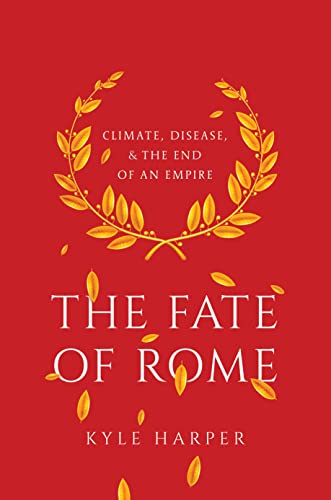
Ebook Info
- Published: 2017
- Number of pages: 440 pages
- Format: PDF
- File Size: 6.37 MB
- Authors: Kyle Harper
Description
How devastating viruses, pandemics, and other natural catastrophes swept through the far-flung Roman Empire and helped to bring down one of the mightiest civilizations of the ancient worldHere is the monumental retelling of one of the most consequential chapters of human history: the fall of the Roman Empire. The Fate of Rome is the first book to examine the catastrophic role that climate change and infectious diseases played in the collapse of Rome’s power―a story of nature’s triumph over human ambition.Interweaving a grand historical narrative with cutting-edge climate science and genetic discoveries, Kyle Harper traces how the fate of Rome was decided not just by emperors, soldiers, and barbarians but also by volcanic eruptions, solar cycles, climate instability, and devastating viruses and bacteria. He takes readers from Rome’s pinnacle in the second century, when the empire seemed an invincible superpower, to its unraveling by the seventh century, when Rome was politically fragmented and materially depleted. Harper describes how the Romans were resilient in the face of enormous environmental stress, until the besieged empire could no longer withstand the combined challenges of a “little ice age” and recurrent outbreaks of bubonic plague.A poignant reflection on humanity’s intimate relationship with the environment, The Fate of Rome provides a sweeping account of how one of history’s greatest civilizations encountered and endured, yet ultimately succumbed to the cumulative burden of nature’s violence. The example of Rome is a timely reminder that climate change and germ evolution have shaped the world we inhabit―in ways that are surprising and profound.
User’s Reviews
Editorial Reviews: Review “One of Medium.com’s Books of the Year 2017″”One of The Times Literary Supplement’s Books of the Year 2017″”One of the Forbes.com “Great Anthropology and History Books of 2017” (chosen by Kristina Killgrove)””One of The Federalist’s Notable Books for 2017″”Honorable Mention for the 2018 PROSE Award in Classics, Association of American Publishers””One of Strategy + Business’s Best Business Books in Economics for 2018″”One of Choice Reviews’ Outstanding Academic Titles of 2018″”I read a lot of history in my spare time, and as best I can tell modern scholarship is telling us that Rome really was something special. What I learned from Peter Temin, and at greater length from Kyle Harper, was that Rome wasn’t your ordinary pre-industrial economy. . . . Harper notes that Rome was held back in some ways by a heavy burden of disease, an unintentional byproduct of urbanization and trade that a society lacking the germ theory had no way to alleviate. But still, the Romans really did achieve remarkable things on the economic front.”—Paul Krugman, New York Times”A work of remarkable erudition and synthesis, Harper’s timely study offers a chilling warning from history of ‘the awesome, uncanny power of nature’.”—P. D. Smith, The Guardian”Original and ambitious. . . . [Harper] provide[s] a panoramic sweep of the late Roman Empire as interpreted by one historian’s incisive, intriguing, inquiring mind.”—James Romm, Wall Street Journal”Ingenious, persuasive. . . . Lucidly argued.” ― Publishers Weekly”A view of the fall of Rome from a different angle, looking beyond military and social collapse to man’s relationship to the environment. There is much to absorb in this significant scholarly achievement, which effectively integrates natural, social, and humanistic sciences.” ― Kirkus”An excellent new book. . . . [Harper] has managed a prodigious scholarly output that uses date-driven, twenty-first-century methods to solve enduring problems of ancient history.”—Noel Lenski, Times Literary Supplement”[A] sweeping retelling of the rise and fall of an empire, [that] was brought down as much by ‘germs as by Germans.'”—Keith Johnson, Foreign Policy”Harper argues his case brilliantly, with deep scientific research into weather, geology and disease.”—Harry Mount, The Spectator”An ambitious and convincing reappraisal of one of the most studied episodes of decline and fall in human history.”—Ellie Robins, Los Angeles Review of Books”Beautifully and often wittily written, this is history that has some of the impact of a great work of dystopian science fiction.”—Tom Holland, BBC History Magazine”This beautifully written book is ground-breaking stuff, both for its method and content, and one of the most important of the year.”—Adrian Spooner, Classics for All”Harper’s focus is resolutely historical, dealing only glancingly with modern climate concerns. But the book’s theme is essentially a timeless one: how big, complex societies handle strain and shocks from factors outside of their control. That gives it some relevance to the challenges we face today. . . . If the Fate of Rome proves anything, it’s that nature always has the last laugh.”—Asher Elbein, Earther.com, “Harper offers a striking reinterpretation with worrisome implications for the present day. . . . Today, we inhabit a global system with a very similar combination of climatologic disturbances, urbanization, less diverse diets, and globalization. Ancient history reveals the risks we run.”—Andrew Moravcsik, Foreign Affairs”The Fate of Rome is one of the most immediately readable histories of the year, always investing even the most well-known subjects with the vigor of fresh perspective.”—Steve Donoghue, Open Letters Monthly”A recent book makes a convincing case that we need to be more cognizant of the natural world’s role in all this. The Fate of Rome: Climate, Disease and the End of An Empire, by the University of Oklahoma’s Kyle Harper, makes a strong argument for the role of plague and a shifting climate in the confluence of political, economic, and social processes that we label the fall of the Roman Empire.”—Patrick Wyman, Deadspin”Drawing on cutting-edge research into ice cores, cave stones, lake deposits, and other sediments, Harper explores the influence of the changing climate on Rome’s history. With a storyteller’s flair, he describes how the climate’s impact was by turns subtle and overwhelming, alternately constructive and destructive, but that the changing climate was ultimately a ‘wild card’ that transcended all the other rules of the game. . . . Harper reveals how the fate of Rome was decided not just by emperors, soldiers, and barbarians, but also by climate instability and pernicious disease.”—Lucia Marchini, World Archaeology”[Harper’s] aim in The Fate of Rome, however, is to foreground one class of explanations that has hitherto been relatively neglected by historians: the influence of climate and disease. Such explanations are not new, but Harper brings to the table a large body of recent scientific research into the evolution of ancient diseases, disease ecology and historical climate variations. . . . The wealth of new detail Harper offers to support his general theses is the true strength of his book.”—Jeffrey Mazo, Survival”Harper . . . has assembled compelling evidence that Rome died mainly from natural causes: pandemic diseases and a temperamental climate. . . . We know far more about both the causes of climate change and the ecology of germs than our ancient ancestors did. Perhaps we have a fighting chance of avoiding Rome’s fate, if we heed the true lessons of its fall.”—Madeline Ostrander, Undark Magazine”The Fate of Rome should probably sit on shelves next to Gibbon’s masterwork. In time, one feels, it will be seen every bit as much an essential text.”—Andrew Masterson, Cosmos Magazine”Gibbon’s is just one of myriad theories as to why Rome fell after a millennium of unprecedented (and never repeated) strength. [Harper] adds a fascinating theory to the corpus―one that could only be ventured at this particular point in history . . . because his thesis rests entirely on modern science. Harper, an able and often eloquent writer argues, Rome was brought down by two environmental components: pestilence and climate. And when these two worked in concert, things really got bad.”—Tony Jones, Christian Century”This is an exciting book that provides a fresh look at a perennial topic, the fall of the Roman Empire, in sparkling prose accessible to all economic historians. . . . Others interested in plagues will find time lines and stories to ground the biology in its Roman context. And anyone who is attempting to use the fall of the Roman Empire as an example in contemporary life should read this book before expounding one or another outmoded theory of the fall of the Roman Empire.”—Peter Temin, EH.net”Harper has produced a wonderful case study that demands a general rethinking of how we view the decline and fall of the Roman Empire.”—Williamson Murray, The Strategy Bridge”[T]he author takes pains not to descend into the kind of reductive or utterly contingent account of the Roman experience that eliminates human agency from the story. Instead Harper furnishes a richly detailed account of the environment in which―and with which―Romans and their enemies contended.”—W. Jeffrey Tatum, Quarterly Review of Biology”I recommend The Fate of Rome: Climate, Disease, and the End of an Empire by Kyle Harper. Given all of the other threats we face we thankfully don’t have to deal with the added dual challenges of climate change or new pandemics―right?”—William F. Wechsler, Atlantic Council”The Fate of Rome is the book every scholar wants to write once during his or her career. . . . In the end, The Fate of Rome is nothing short of monumental. . . . An important work need not be an excellent one―this is both.”—Carson Bay, H-Net Reviews”This is an important book . . . . [Harper] should be congratulated on his attempt to create closer connections between traditional visions of Roman imperial history and the emerging scientific evidence regarding past populations and their environments.”—Adam Izdebski, Environment and History”The Fate of Rome is engaging and accessible for readers of all stripes. Historians will appreciate the fuller picture gained from incorporating nonhuman forces into our understanding of the past . . . . Its story will also resonate with those interested in climate change, empire, and science.”—John Bowlus, Energy Reporters Review “This is the story of a great civilization’s long struggle with invisible enemies. In the empire’s heyday, in 160 CE, splendid cities, linked by famous roads and bustling harbors, stand waiting for the lethal pathogens of Central Africa and the highlands of Tibet. Yet, under the flickering light of a variable sun, beneath skies alternately veiled in volcanic dust or cruelly rainless, this remarkable agglomeration of human beings held firm. Harper’s account of how the inhabitants of the empire and their neighbors adjusted to these disasters is as humane as his account of the risks they faced is chilling. Brilliantly written, at once majestic and compassionate, this is truly great history.”―Peter Brown, author of Through the Eye of a Needle: Wealth, the Fall of Rome, and the Making of Christianity in the West, 350–550 AD”In this riveting history, Kyle Harper shows that disease and environmental conditions were not just instrumental in the final collapse of the Roman Empire but were serious problems for centuries before the fall. Harper’s compelling and cautionary tale documents the deadly plagues, fevers, and other pestilences that ravaged the population time and again, resulting in far more deaths than ever caused by enemy forces. One wonders how the empire managed to last as long as it did.”―Eric H. Cline, author of 1177 B.C.: The Year Civilization Collapsed”This brilliant, original, and stimulating book puts nature at the center of a topic of major importance―the fall of the Roman Empire―for the first time. Harper’s argument is compelling and thoroughly documented, his presentation lively and robust.”―Peter Garnsey, coauthor of The Roman Empire: Economy, Society, and Culture”Kyle Harper’s extraordinary new account of the fall of Rome is a gripping and terrifying story of the interaction between human behavior and systems, pathogens and climate change. The Roman Empire was a remarkable connector of people and things―in towns and cities, through voluntary and enforced migration, and through networks of trade across oceans and continents―but this very connectedness fostered infectious diseases that debilitated its population. Though the protagonists of Harper’s book are nonhuman, their effects on human lives and societies are nonetheless devastating.”―Emma Dench, author of Romulus’ Asylum: Roman Identities from the Age of Alexander to the Age of Hadrian”Kyle Harper is a Gibbon for the twenty-first century. In this very important book, he reveals the great lesson that the decline and fall of the Roman Empire can teach our own age: that humanity can manipulate nature, but never defeat it. Sic transit gloria mundi.”―Ian Morris, author of Why the West Rules―for Now”The Fate of Rome is a breakthrough in the study of the Roman world―intrepid, innovative, even revolutionary.”―Walter Scheidel, The Great Leveler: Violence and the History of Inequality from the Stone Age to the Twenty-First Century”Kyle Harper’s The Fate of Rome illuminates with a strong new light the entirety of Roman history, by focusing relentlessly on the ups and downs of the Roman coexistence with the microorganisms that influenced every aspect of their lives in powerful ways, while themselves being conditioned by what the Romans did, and failed to do. Others, including myself, have devoted pages to the impact of the greatest epidemics in our books. We missed what happened in between. Harper does not, and the result is a book that is fascinating as well as instructive.”―Edward N. Luttwak, author of The Grand Strategy of the Roman Empire”Learned, lively, and up-to-date, this is far and away the best account of the ecological and environmental dimensions of the history of the Roman Empire.”―J. R. McNeill, author of Something New under the Sun: An Environmental History of the Twentieth-Century World From the Back Cover “This is the story of a great civilization’s long struggle with invisible enemies. In the empire’s heyday, in 160 CE, splendid cities, linked by famous roads and bustling harbors, stand waiting for the lethal pathogens of Central Africa and the highlands of Tibet. Yet, under the flickering light of a variable sun, beneath skies alternately veiled in volcanic dust or cruelly rainless, this remarkable agglomeration of human beings held firm. Harper’s account of how the inhabitants of the empire and their neighbors adjusted to these disasters is as humane as his account of the risks they faced is chilling. Brilliantly written, at once majestic and compassionate, this is truly great history.”–Peter Brown, author of Through the Eye of a Needle: Wealth, the Fall of Rome, and the Making of Christianity in the West, 350–550 AD”In this riveting history, Kyle Harper shows that disease and environmental conditions were not just instrumental in the final collapse of the Roman Empire but were serious problems for centuries before the fall. Harper’s compelling and cautionary tale documents the deadly plagues, fevers, and other pestilences that ravaged the population time and again, resulting in far more deaths than ever caused by enemy forces. One wonders how the empire managed to last as long as it did.”–Eric H. Cline, author of 1177 B.C.: The Year Civilization Collapsed”This brilliant, original, and stimulating book puts nature at the center of a topic of major importance–the fall of the Roman Empire–for the first time. Harper’s argument is compelling and thoroughly documented, his presentation lively and robust.”–Peter Garnsey, coauthor of The Roman Empire: Economy, Society, and Culture”Kyle Harper’s extraordinary new account of the fall of Rome is a gripping and terrifying story of the interaction between human behavior and systems, pathogens and climate change. The Roman Empire was a remarkable connector of people and things–in towns and cities, through voluntary and enforced migration, and through networks of trade across oceans and continents–but this very connectedness fostered infectious diseases that debilitated its population. Though the protagonists of Harper’s book are nonhuman, their effects on human lives and societies are nonetheless devastating.”–Emma Dench, author of Romulus’ Asylum: Roman Identities from the Age of Alexander to the Age of Hadrian”Kyle Harper is a Gibbon for the twenty-first century. In this very important book, he reveals the great lesson that the decline and fall of the Roman Empire can teach our own age: that humanity can manipulate nature, but never defeat it. Sic transit gloria mundi.”–Ian Morris, author of Why the West Rules–for Now”The Fate of Rome is a breakthrough in the study of the Roman world–intrepid, innovative, even revolutionary.”–Walter Scheidel, The Great Leveler: Violence and the History of Inequality from the Stone Age to the Twenty-First Century”Kyle Harper’s The Fate of Rome illuminates with a strong new light the entirety of Roman history, by focusing relentlessly on the ups and downs of the Roman coexistence with the microorganisms that influenced every aspect of their lives in powerful ways, while themselves being conditioned by what the Romans did, and failed to do. Others, including myself, have devoted pages to the impact of the greatest epidemics in our books. We missed what happened in between. Harper does not, and the result is a book that is fascinating as well as instructive.”–Edward N. Luttwak, author of The Grand Strategy of the Roman Empire”Kyle Harper’s The Fate of Rome illuminates with a strong new light the entirety of Roman history by focusing relentlessly on what the Romans did and failed to do about the microorganisms that influenced every aspect of their lives in powerful ways. Others, including myself, have devoted pages in our books to the impact of the greatest epidemics. We missed what happened in between. Harper does not, and the result is a book that is fascinating as well as very instructive.”–Edward N. Luttwak, author of The Grand Strategy of the Roman Empire”Learned, lively, and up-to-date, this is far and away the best account of the ecological and environmental dimensions of the history of the Roman Empire.”–J. R. McNeill, author of Something New under the Sun: An Environmental History of the Twentieth-Century World About the Author Kyle Harper is professor of classics and letters at the University of Oklahoma. He is the author of Slavery in the Late Roman World, AD 275–425 and From Shame to Sin: The Christian Transformation of Sexual Morality in Late Antiquity. He lives in Norman, Oklahoma. Excerpt. © Reprinted by permission. All rights reserved. The Fate of RomeClimate, Disease, and the End of an EmpireBy Kyle HarperPRINCETON UNIVERSITY PRESSCopyright © 2017 Princeton University PressAll rights reserved.ISBN: 978-0-691-16683-4ContentsList of Maps, xi, Timeline, xii, Prologue: Nature’s Triumph, 1, Chapter 1 Environment and Empire, 6, Chapter 2 The Happiest Age, 23, Chapter 3 Apollo’s Revenge, 65, Chapter 4 The Old Age of the World, 119, Chapter 5 Fortune’s Rapid Wheel, 160, Chapter 6 The Wine-Press of Wrath, 199, Chapter 7 Judgment Day, 246, Epilogue: Humanity’s Triumph?, 288, Acknowledgments, 295, Appendixes, 299, Notes, 317, Bibliography, 351, Index, 413, CHAPTER 1Environment and EmpireThe Shape of the Roman EmpireRome’s rise is a story with the capacity to astonish us, all the more so since the Romans were relative latecomers to the power politics of the Mediterranean. By established convention, Rome’s ancient history is divided into three epochs: the monarchy, the republic, and the empire. The centuries of monarchy are lost in the fog of time, remembered only in fabulous origins myths that told later Romans how they came to be. Archaeologists have found the debris of at least transient human presence around Rome going back to the Bronze Age, in the second millennium BC. The Romans themselves dated their city’s founding and the reign of their first king, Romulus, to the middle of the eighth century BC. Indeed, not far from where Claudian stood in the forum, beneath all the brick and marble, there had once been nothing more than a humble agglomeration of wooden huts. This hamlet could not have seemed especially propitious at the time.For centuries, Rome stood in the shadow of her Etruscan neighbors. The Etruscans in turn were outclassed by the political experiments underway to the east and south. The early classical Mediterranean belonged to the Greeks and Phoenicians. While Rome was still a village of letterless cattle rustlers, the Greeks were writing epic and lyric poetry, experimenting with democracy, and inventing drama, philosophy, and history as we know them. On nearer shores, the Punic peoples of Carthage built an ambitious empire, before the Romans knew how to rig a sail. Fifteen miles inland, along the soggy banks of the Tiber River, Rome was a backwater, a spectator to the creativity of the early classical world.Around 509 BC the Romans shuffled off their kings and inaugurated the republic. Now they gradually step into history. From the time they are known to us, Rome’s political and religious institutions were a blend of the indigenous and the adopted. The Romans were unabashed borrowers. Even the first code of Roman law, the Twelve Tables, was proudly confessed to be plagiarized from Athens. The Roman republic belongs among the many citizenship-based political experiments of the classical Mediterranean. But the Romans put their own accents on the idea of a quasi-egalitarian polity. Exceptional religious piety. Radical ideologies of civic sacrifice. Fanatical militarism. Legal and cultural mechanisms to incorporate former enemies as allies and citizens. And though the Romans themselves came to believe that they were promised imperium sine fine by the gods, there was nothing ineluctable about Rome’s destiny, no glaring geographical or technological secret of superiority. Only once in history did the city become the seat of a great empire.Rome’s rise coincided with a period of geopolitical disorder in the wider Mediterranean in the last centuries before Christ. Republican institutions and militaristic values allowed the Romans to concentrate unprecedented state violence, at an opportune moment of history. The legions destroyed their rivals one by one. The building of the empire was bloody business. The war machine whetted its own appetite. Soldiers were settled in rectilinear Roman colonies, imposed by brute force all over the Mediterranean. In the last century of this age of unbridled conquest, grand Shakespearean characters bestride the stage of history. Not by accident is western historical consciousness so disproportionately concentrated in these last few generations of the republic. The making of Rome’s empire was not quite like anything that had happened before. Suddenly, levels of wealth and development lunged toward modernity, surpassing anything previously witnessed in the experience of our species. The teetering republican constitution generated profound reflections on the meaning of freedom, virtue, community. The acquisition of imperial power inspired enduring conversations about its proper exercise. Roman law helped to birth norms of governance, by which even the masters of empire might be held to account. But the scaling up of sheer power also fueled the cataclysmic civil violence that ushered in an age of autocracy. In the apt words of Mary Beard, “the empire created the emperors — not the other way round.”By the time Augustus (r. 27 BC–AD 14) brought the last meaningful stretches of the shore under Roman dominion, it was no idle boast to call the Mediterranean “mare nostrum,” our sea. To take full measure of the Roman accomplishment, and to understand the mechanics of ancient imperialism, we must know some basic facts about life in an ancient society. Life was slow, organic, fragile, and constrained. Time marched to the dull rhythms of foot and hoof. Waterways were the real circulatory system of the empire, but in the cold and stormy season the seas closed, and every town became an island. Energy was forbiddingly scarce. Human and animal muscle for force, timber and scrub for fuel. Life was lived close to the land. Eight in ten people lived outside of cities. Even the towns had a more rural character than we might imagine, made lively by the bleats and brays — and pungent smells — of their four-legged inhabitants. Survival depended on the delivery of rain in a precarious environment. For the vast majority, cereals dominated the diet. “Give us this day our daily bread” was a sincere petition. Death always loomed. Life expectancy at birth was in the 20s, probably the mid-20s, in a world where infectious disease raged promiscuously. All of these invisible constraints were as real as gravity, defining the laws of motion in the world the Romans knew.These limits cast into relief the sheer spatial achievement of the Roman Empire. Without telecommunications or motorized transport, the Romans built an empire connecting vastly different parts of the globe. The empire’s northern fingers reached across the 56 parallel, while the southern edges dipped below 24° N. “Of all the contiguous empires in premodern history, only those of the Mongols, Incas, and Russian czars matched or exceeded the north-south range of Roman rule.” Few empires, and none so long-lived, grasped parts of the earth reaching from the upper mid-latitudes to the outskirts of the tropics.The northern and western parts of the empire were under the control of the Atlantic climate. At the ecological center of the empire was the Mediterranean. The delicate, moody features of the Mediterranean climate — arid summers and wet winters against a relatively temperate backdrop — make it a distinct type of climate. The dynamics of a giant, inland sea, combined with the knuckled texture of its inland terrains, pack extreme diversity into miniature scale. Along the empire’s southern and eastern edges, the high pressure of the subtropical atmosphere won out, turning the land into pre-desert and then true desert. And Egypt, the breadbasket of the empire, plugged the Romans into wholly other climate regimes: the life-bringing Nile floods originated in Ethiopian highlands watered by the monsoons. The Romans ruled all this.The Romans could not impose their will on so vast a territory by violence alone. The maintenance of the empire required economies of force and constant bargaining with those inside Roman boundaries and beyond. Over the course of the empire’s long life, the inner logic of imperial power, those economies and bargains, shifted shape many times.Augustus gave order to the regime we recognize as the high Roman Empire. Augustus was a political genius, gifted with an uncannily long lifespan, who presided over the death throes of the republican constitution. During his reign, the campaigns of conquest, which had been fueled by elite competition for power in the late republican regime, started to slow. His reign was advertised as a time of peace. The gates to the Temple of Janus, which the Romans left open in times of war, had been closed twice in seven centuries. Augustus made a show of closing them three times. He demobilized the permanent citizen legions and replaced them with professional armies. The late republic had still been an age of gratuitous plunder. Slowly but surely, though, norms of governance and justice began to prevail in the conquered territories. Plunder was routinized, morphed into taxation. When resistance did flare, it was snuffed out with spectacular force, as in Judea and Britain. New citizens were made in the provinces, coming like a trickle at first, but subsequently faster and faster.The grand and decisive imperial bargain, which defined the imperial regime in the first two centuries, was the implicit accord between the empire and “the cities.” The Romans ruled through cities and their noble families. The Romans coaxed the civic aristocracies of the Mediterranean world into their imperial project. By leaving tax collection in the hands of the local gentry, and bestowing citizenship liberally, the Romans co-opted elites across three continents into the governing class and thereby managed to command a vast empire with only a few hundred high-ranking Roman officials. In retrospect, it is surprising how quickly the empire ceased to be a mechanism of naked extraction, and became a sort of commonwealth.The durability of the empire depended on the grand bargain. It was a gambit, and it worked. In the course of the pax Romana, as predation turned to governance, the empire and its many peoples flourished. It started with population. In the most uncomplicated sense, people multiplied. There had never been so many people. Cities spilled beyond their accustomed limits. The settled landscape thickened. New fields were cut from the forests. Farms crept up the hillsides. Everything organic seemed to thrive in the sunshine of the Roman Empire. Sometime around the first century of this era, the population of Rome itself probably topped one million inhabitants, the first city to do so, and the only western one until London circa 1800. At the peak in the middle of the second century, some seventy-five million people in all came under Roman sway, a quarter of the globe’s total population.In a slow-moving society, such insistent growth — on this scale, over this arc of time — can easily spell doom. Land is the principal factor of production, and it is stubbornly finite. As the population soared, people should have been pushed onto ever more marginal land, harder and harder pressed to extract energy from the environment. Thomas Malthus well understood the intrinsic and paradoxical relationships between human societies and their food supplies. “The power of population is so superior to the power of the earth to produce subsistence for man, that premature death must in some shape or other visit the human race. The vices of mankind are active and able ministers of depopulation. They are the precursors in the great army of destruction, and often finish the dreadful work themselves. But should they fail in this war of extermination, sickly seasons, epidemics, pestilence, and plague advance in terrific array, and sweep off their thousands and tens of thousands. Should success be still incomplete, gigantic inevitable famine stalks in the rear, and with one mighty blow levels the population with the food of the world.”Yet … the Romans manifestly did not succumb to mass-scale starvation. Herein is to be found the hidden logic of the empire’s success. Far from steadily sinking into misery, the Romans achieved per capita economic growth, straight into the teeth of headlong demographic expansion. The empire was able to defy, or at least defer, the grim logic of Malthusian pressure.In the modern world, we are accustomed to annual growth rates of 2–3 percent, on which our hopes and pension plans depend. It was not so in ancient times. By their nature, pre-industrial economies were on a tight energy leash, constrained in their ability to extract and exchange energy more efficiently on any sustainable basis. But premodern history was neither a slow, steady ascent toward modernity, nor the proverbial hockey stick — a flat-line of bleak subsistence until the singular energy breakthroughs of the Industrial Revolution. Rather, it was characterized by pulses of expansion and then disintegration. Jack Goldstone has proposed the term “efflorescence” for those phases of expansion, when background conditions conduce to real growth for some happy length of time. This growth can be extensive, as people multiply and more resources are turned to productive use, but as Malthus described, this kind of growth eventually runs out of room; more promisingly, growth can be intensive, when trade and technology are employed to extract energy more efficiently from the environment.The Roman Empire set the stage for an efflorescence of historic proportions. Already in the late republic, Italy experienced precocious leaps forward in social development. To a certain extent, the prosperity of Italy might be written off as the result of sheer takings, naked political rents seized as the fruits of conquest. But underneath this veneer of extracted wealth, real growth was afoot. This growth not only continued after the military expansion had reached its outer bounds — it now diffused throughout the conquered lands. The Romans did not merely rule territory, transferring some margin of surplus from periphery to center. The integration of the empire was catalytic. Slowly but steadily, Roman rule changed the face of the societies under its dominion. Commerce, markets, technology, urbanization: the empire and its many peoples seized the levers of development. For more than a century and a half, on a broad geographical scale, the empire writ large enjoyed both intensive and extensive growth. The Roman Empire both staved off Malthusian reckoning and earned uncalculated political capital.This prosperity was the condition and the consequence of the empire’s grandeur. It was a charmed cycle. The stability of the empire was the enabling background of demographic and economic increase; people and prosperity were in turn the sinews of the empire’s power. Soldiers were plentiful. Tax rates were modest, but collections were abundant. The emperors were munificent. The grand bargain with the civic elites paid out for both sides. There seemed to be enough wealth everywhere. The Roman armies enjoyed tactical, strategic, and logistical advantages over enemies on every front. The Romans had achieved a kind of favorable equilibrium, if more fragile than they knew. Gibbon’s great History of the Decline and Fall of the Roman Empire launches from the sunny days of the second century. In his famous verdict, “If a man were called to fix the period in the history of the world, during which the condition of the human race was most happy and prosperous, he would, without hesitation, name that which elapsed from the death of Domitian [AD 96] to the accession of Commodus [AD 180].”The Romans had edged outward the very limits of what was possible in the organic conditions of a premodern society. It is no wonder that the fall of such a colossus, what Gibbon called “this awful revolution,” has been the object of perennial fascination.Our Fickle PlanetBy AD 650, the Roman Empire was a shadow of its former self, reduced to a Byzantine rump state in Constantinople, Anatolia, and a few straggled possessions across the sea. Western Europe was broken into fractious Germanic kingdoms. Half the former empire was swiftly carved off by armies of believers from Arabia. The population of the Mediterranean basin, which once stood at seventy-five million people, had stabilized at maybe half that number. Rome was inhabited by some 20,000 souls. And its denizens were none the richer for it. By the seventh century, one measly trunk route still connected east and west across the sea. Currency systems were as fragmented as the political mosaic of the early middle ages. All but the crudest financial institutions had vanished. Everywhere apocalyptic fear reigned, in Christendom and formative Islam. The end of the world felt nigh.These used to be called the Dark Ages. That label is best set aside. It is hopelessly redolent of Renaissance and Enlightenment prejudices. It altogether underestimates the impressive cultural vitality and enduring spiritual legacy of the entire period that has come to be known as “late antiquity.” At the same time, we do not have to euphemize the realities of imperial disintegration, economic collapse, and societal simplification. These are brute facts in need of explanation, as objective as an electricity bill — and measured in similar units. In material terms, the fall of the Roman Empire saw the process of efflorescence run in reverse, toward lower levels of energy capture and exchange. What we are contemplating is a monumental episode of state failure and stagnation. In Ian Morris’s valiant effort to create a universal scale of social development, the fall of the Roman Empire emerged as the single greatest regression, in all of human history.(Continues…)Excerpted from The Fate of Rome by Kyle Harper. Copyright © 2017 Princeton University Press. Excerpted by permission of PRINCETON UNIVERSITY PRESS. All rights reserved. No part of this excerpt may be reproduced or reprinted without permission in writing from the publisher.Excerpts are provided by Dial-A-Book Inc. solely for the personal use of visitors to this web site. Read more
Reviews from Amazon users which were colected at the time this book was published on the website:
⭐This is an interesting history of the fall of the Roman Empire which concentrates on ecological factors such as pandemics and climate change. The main point is that the Rome prospered during the Roman Warm Period (aka Roman Climate Optimum) and fell apart during the Late Antique Little Ice Age.Republic Rome lasted about 500 years (509 BC – 27 BC) and this is when Rome conquered most of its territory. It was able to create allies out of the conquered by employing the local elites to be its tax collectors. The Roman Empire was formed in 27 BC with the accession of Augustus Caesar and its main role was to maintain the empire the republic had created. The most successful era stretching from the late republic to the early empire occurred during the Roman Warm Period (200 BC – 150 AD). This period includes the era known as Pax Romana which the famous historian Edward Gibbon described as of one the best periods of history.The first assault on the Roman Empire occurred in 165 AD with the Antonine Plague, believed to be small pox. This plague killed millions of people. The population of the Roman Empire had been about 75 million and that of Rome about 1 million before the plague. That was the peak and the population of the empire never recovered after that. This was of course a time when military and economic power depended on manual labor. But the Second Century was still the height of the Roman Empire even though a civil war broke out late in the century.Meanwhile a transitional cooling period had begun that decreased agricultural production which was the basis of the Roman economy. This helped lead to what is known as the Crisis of the Third Century (aka the First Fall of the Roman Empire), but this was only a setback and not a collapse. The main events were the assassination of the emperor in 235 AD, civil war, and the Cyprian Plague, a bubonic plague which began in 249 AD. This plague is also estimated to have killed millions of people. The main causes were a vast economic network which made it easy for infected rats, which carry the bubonic pathogen, to reach the empire from Asia in boats, and a somewhat weakened population from decreased food production.The empire was finally stabilized with the accession of Constantine the Great in 324 AD. His other accomplishments included establishing in the eastern part of the empire a second capital which eventually was named Constantinople and adopting Christianity as the state religion. In 395 AD the empire was divided into a Western Empire with its capital in Rome an Eastern Empire with its capital in Constantinople. The peace and prosperity of the Fourth Century recovery eventually descended to the Second Fall of the Roman Empire in the Fifth Century.This decline was caused by political instability, civil wars, barbarian migrations and invasions, as well as economic decline and an increase in welfare recipients. This breakdown of Roman order led to the barbarian sacking of Rome by the Visigoths in 410 AD and by the Vandals in 455 AD. Meanwhile the Huns, a nomadic warlike tribe form the Asian steppes, had entered the Western Empire and were also threatening Rome. All this led to the final fall of the Western Roman Empire when the local barbarian warlord Odoacer deposed the last western emperor in 476 AD. But while the rule of the Western Roman emperors came to an end, what was left of Roman life simply continued under various barbarian conquerors.The story of the Roman Empire usually ends here but what is less known is the Eastern Roman Empire accomplished a big comeback in the Sixth Century under the eastern emperor Justinian. He re-conquered most of the lost areas of the Western Roman Empire including Italy, the Balkans, North Africa, and southern Spain. He also codified one thousand years of Roman law for the first time with the Justinian Code. This comeback ended in 541 AD when the Justinian Plague, another bubonic plague, struck the Roman Empire again. This time the plague killed about half of the population. By this time the Late Antique Ice Age had kicked in, decreasing agricultural production and apparently forcing infected rodents into coastal cities.All this led to the Third Fall of the Roman Empire in the Seventh Century. The former Western Empire was again lost to various barbarian tribes who formed new states that led to the future formation of Europe, such as the Franks controlling Gaul. Then Muslim invasions from the East took all of the Mid-Eastern and North African provinces of the Eastern Empire. Meanwhile the Avars, another nomadic warlike tribe from the Asian steppes, took the Balkans. The Eastern Empire was reduced to a small state around Constantinople called Byzantium but managed to survive until conquered by the Turks in 1453.
⭐This book is essential for all lovers of Roman History. It overlays the history with the events of epidemic diseases and climate change. In so doing, you will find what C. S. Lewiscalls ‘Transposition’: the flooding of a lower medium and the raising of it to a new significance by incorporation into a higher medium. The book also reveals a mastery of language, and lays out the events in a captivating manner. A great history book all around.
⭐Excellent book. I would give it 5 Stars for the level of scholarship and the overall interesting subject matter (at least for me).One idea or theme that comes across is that the Roman Empire did not just disappear or collapse overnight one day in 410 CE (or AD, as you will) when Rome was sacked by the Goths or in 476 when the last emperor Romulus Augustus was deposed and never replaced or superseded. It gradually collapsed as a political and economic entity between around 400 and 600. For most people, there were probably really no great changes in their lives during that period. Perhaps for the ruling or economic elite (the Roman equivalent of the 1%), things might have been significantly and noticeably worse. Even the symbols of the decaying Empire and Republic still existed until quite late. I have read elsewhere that the last recorded meeting of the old republican Senate occurred in 605, even though the Senate had long ceased to have any real political power. By 600 in general, though, the territories of the old Empire were noticeably less populous and less wealthy than they had been in, say, 150.Another major theme of the book is that the Roman Empire didn’t collapse for a single reason, such as being invaded by barbarians from the east. Several things happened simultaneously: the benign climate of the early empire changed for the worse, devastating smallpox and bubonic plagues occurred, and the fiscal system deteriorated significantly so that the Emperors and the bureaucracy couldn’t pay the army and administer the government. The Roman Empire was a resilient entity but it had much less inner strength than a modern nation state.The reason I gave the book a 4 Star rating is because it is not an easy book to read. I have a university Master’s degree and I found it to be pretty turgid at times. I wonder how many potential readers routinely use words such as “concatenation” (one of his favorites – the author uses it often), “demimondaine,” “eschatological,” and “caesura” in their reading and writing. The author also occasionally inserts Greek words (transliterated into the Latin alphabet) and Latin words and phrases. I had Latin for three years in high school and remembered enough to be able to make a reasonable translation of the Latin, but the Greek lost me.
⭐This book focuses on the link between climate, epidemics of plague and the collapse of the Roman empire. I found it most interesting. It is quite a technical book and best suited to those with an interest in science and enjoy looking at graphs and considering quantitative data. I actually work on population dynamics so it was on the edge of my field. It presents some interesting and well argued ideas on the role of disease and climate on the fate of civilizations. One is left considering what the fate of our civilization will be. I recommend this book.
⭐A fascinating take on the collapse of the Roman Empire, perceiving the many factors which both made a fairly obscure city the master of the Mediterranean and beyond and eventually rendered any such significance historical. While political and military factors are not ignored, the impact alterations in weather cycles and in the ambient disease pool had on these changes is given centre stage.Naturally a degree of sacrifice of small scale detail has had to be made to suit the small number of pages, but this is really only noticeable in the discussion of the ‘barbarian’ cultures of eastern and central Europe. For non-specialists, moreover, more grounding in the history of the northern hemisphere’s weather since the last Ice Age might also have been helpful.
⭐The only disappointing thing about this book is that it ends to soon. Surprisingly so, because while my Kindle told me we have a third of the book left, this turned out to be appendices (valuable), notes (absorbing), a bibliography (impressive) and an index (comprehensive). When I was at school our Latin Master (the great Gordon Rodway) told us the cause of the fall of the empire was a mystery.Now I have an answer to the question that has vexed me for so many years.
⭐What the world needs now is, more (like Kyle Harper), historians that can engage people in what preceeded their short stay on earth. . Not more climate change experts. We have so much to learn from histories like this. Thank you Kyle Harper. Prompted to write this late review, we purchased the Fate of Rome, as an audio book and paperback, last year was the email announcing his new book & am very much looking forward to that.
⭐Found this a very useful work synthesising environmental science and history.
Keywords
Free Download The Fate of Rome: Climate, Disease, and the End of an Empire (The Princeton History of the Ancient World, 2) in PDF format
The Fate of Rome: Climate, Disease, and the End of an Empire (The Princeton History of the Ancient World, 2) PDF Free Download
Download The Fate of Rome: Climate, Disease, and the End of an Empire (The Princeton History of the Ancient World, 2) 2017 PDF Free
The Fate of Rome: Climate, Disease, and the End of an Empire (The Princeton History of the Ancient World, 2) 2017 PDF Free Download
Download The Fate of Rome: Climate, Disease, and the End of an Empire (The Princeton History of the Ancient World, 2) PDF
Free Download Ebook The Fate of Rome: Climate, Disease, and the End of an Empire (The Princeton History of the Ancient World, 2)