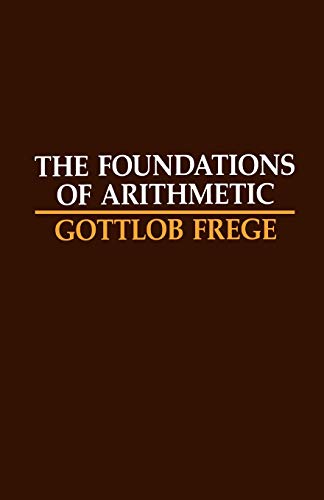
Ebook Info
- Published: 1980
- Number of pages: 144 pages
- Format: PDF
- File Size: 5.13 MB
- Authors: Gottlob Frege
Description
The Foundations of Arithmetic is undoubtedly the best introduction to Frege’s thought; it is here that Frege expounds the central notions of his philosophy, subjecting the views of his predecessors and contemporaries to devastating analysis. The book represents the first philosophically sound discussion of the concept of number in Western civilization. It profoundly influenced developments in the philosophy of mathematics and in general ontology.
User’s Reviews
Editorial Reviews: Review “There can be no doubt about the greatness of this work.” —Philosophy”It will be welcomed by all who are interested in mathematical logic and the foundations of mathematics . . . Frege’s style of exposition is a model for all who think and write about abstract topics.” —Mind About the Author FRIEDRICH LUDWIG GOTTLOB FREGE (1848–1925) was a German mathematician, logician and philosopher. He is considered to be one of the founders of modern logic and made major contributions to the foundations of mathematics. He is generally considered to be the father of analytic philosophy, for his writings on the philosophy of language and mathematics. While he was mainly ignored by the intellectual world when he published his writings, Giuseppe Peano (1858–1932) and Bertrand Russell (1872–1970) introduced his work to later generations of logicians and philosophers.
Reviews from Amazon users which were colected at the time this book was published on the website:
⭐Frege, arguably one of the most important theoreticians of logic in the history of philosophy published only 4 major book length works: Begriffsschrift (Conceptual Notation) in 1879; Grundlagen der Arithmetik (Foundations of Arithmetic) in 1884; and two volumes of Grundgesetze der Arithmetik (Basic Laws of Arithmetic)released in 1893 and 1903.The Good and the Bad:This is Austin’s translation of Gottlob Frege’s second major work, Grundlagen der Arithmetik. As a translation it offers several laudable feats to the reader. The first is its overall fidelity to the author’s intentions. The second is its consistency of translation. Important technical terms are translated in the same manner throughout. With the passage of time –some 70 years– this translation, despite it’s qualities, has come to seem dated. Austin was not an accomplished German scholar, and though his English is laudable, as a translation concerned with a highly technical subject, this book sometimes misses the mark. In its original form, presented with German and English pages side by side, the problems of J. L. Austin’s translation were of little importance. As a sole text divorced from German text, I fear that it would at times be far too easy to sometimes misconstrue Frege’s arguments in either their strengths or weaknesses.I offer 2 lesser criticisms. The first is the quality, or rather lack of quality in this editions printing. The typography has the washed out characters of a copy of a copy, a problem that’s most often seen when a publisher, having run out of its initial printings, decides to continue offering the work without resetting the type. With digital technology this needn’t happen, but this book has all the visual qualities of yesterday’s photocopying.Finally, as one with substantial disabilities I resent the publisher’s decision not to digitise the book. Those with either movement or visual limitations find the lack of ebook version a severe impediment.At recent published translation, that of Dale Jacquette for Taylor & Francis, is available as both an ebook and on paper, though the ebook is absurdly priced at more than 11 times the asking of the paper edition.
⭐I’m a self-directed learner and had been struggling with generating interest in mathematics for some time. I had bought this book in the hopes that it would bridge my love and interest in logic with a new found interest in mathematics. It did exactly that.
⭐Excellent
⭐It’s no exaggeration to say Frege was one of the greatest logicians of all time. What’s more for the reader these days, he’s also one of the greatest and most lucid teachers of this sometimes arcane and difficult science. This book is an excellent introduction to this towering figure’s genius.
⭐I have no idea what’s going on but I hope one day to be smart enough to understand the foundations of mathematics. Respect
⭐The amazing thing about the little handful of books on Mathematical Philosophy–2 by Shapiro, Frege, Russell and of course Benacerraf and Putnam’s classic, is the paucity of literature in this key field!Some will say that mathematical philosophy, or the closely related philosophy of mathematics, only began in the 1980’s in earnest. But reading the “big 5” shows threads going back to antiquity. The field is far from settled, and the two aspects–the philosophy of math itself, and the closely related field of applying math and logic TO other branches of philosophy, has enough active journalized information in the mid 2014+ years to fill 50 volumes. Since thousands have been written in mainline philosophy, and even the philosophy of science as well as logic, this is not without surprise and mystery.The good news is that an invested, energetic reader can pick up this handful of keys and be in the top percent of folks on the planet with a good foundation! This is hardly true of any other field. I’d start with Shapiro’s Oxford Encylopedia, study Benacerraf and Putnam’s classic collection of essays, then finish with Shapiro’s deep and difficult “Thinking about” and of course Russell and Frege for historic and specialized puzzle pieces.One “sleeper” I’d like to recommend that is not usually included in comparisons of books in this field is Steinhart:
⭐.Eric helps with both math within philosophy (the basics) and tangentially helps with the math used as examples within the philosophy OF math. Beyond the issues of categorization, discovery, math as model vs. underpinning reality ala the Matrix, there of course is the whole field of logic, induction, deduction, etc. which has thousands of volumes. The six mentioned here cover logic, but are much more specific in the broader subject area of mathematics, which now includes dynamical systems and differential equations undreamt of in the past, and bringing many new mental tools to bear, from intuition to analytic, qualitative, numeric, perturbative and of course stochastic. Here are the other links to those mentioned in this survey:
⭐Enjoy!
⭐If the ‘proof is in the pudding’, then apparently this book was written by a pompous ass who doesn’t wish to be understood.I highly recommend Bertrand Russel’s Introduction to Mathematical Philosophy.
⭐The publisher: good quality print, didn’t like the font for numbers very much, no complaints otherwise.The book: if you study something related to logic and maths, it’s a must read but be prepared to reread certain sections multiple times and really think through what’s going on. For a casual reader who likes maths, engage at your own risk.
Keywords
Free Download The Foundations of Arithmetic: A Logico-Mathematical Enquiry into the Concept of Number in PDF format
The Foundations of Arithmetic: A Logico-Mathematical Enquiry into the Concept of Number PDF Free Download
Download The Foundations of Arithmetic: A Logico-Mathematical Enquiry into the Concept of Number 1980 PDF Free
The Foundations of Arithmetic: A Logico-Mathematical Enquiry into the Concept of Number 1980 PDF Free Download
Download The Foundations of Arithmetic: A Logico-Mathematical Enquiry into the Concept of Number PDF
Free Download Ebook The Foundations of Arithmetic: A Logico-Mathematical Enquiry into the Concept of Number