Ebook Info
- Published: 2019
- Number of pages: 313 pages
- Format: PDF
- File Size: 1.95 MB
- Authors: Bernardo Kastrup
Description
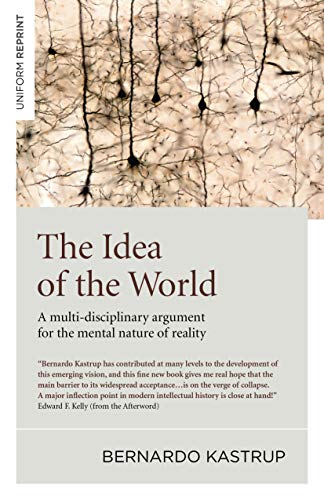
A rigorous case for the primacy of mind in nature, from philosophy to neuroscience, psychology and physics. The Idea of the World offers a grounded alternative to the frenzy of unrestrained abstractions and unexamined assumptions in philosophy and science today. This book examines what can be learned about the nature of reality based on conceptual parsimony, straightforward logic and empirical evidence from fields as diverse as physics and neuroscience. It compiles an overarching case for idealism – the notion that reality is essentially mental – from ten original articles the author has previously published in leading academic journals. The case begins with an exposition of the logical fallacies and internal contradictions of the reigning physicalist ontology and its popular alternatives, such as bottom-up panpsychism. It then advances a compelling formulation of idealism that elegantly makes sense of – and reconciles – classical and quantum worlds. The main objections to idealism are systematically refuted and empirical evidence is reviewed that corroborates the formulation presented here. The book closes with an analysis of the hidden psychological motivations behind mainstream physicalism and the implications of idealism for the way we relate to the world.
User’s Reviews
Reviews from Amazon users which were colected at the time this book was published on the website:
⭐This is the first book I have read by this author. It provides an in depth description of the nature of being and reality from an idealist’s perspective. The parsimony and explanatory power of the idealist perspective is contrasted both with that of the realist and with other perspectives. Those – like me – who have not been thoroughly initiated into the academic exploration of this topic are encouraged to purchase the Kindle version as easy access to a dictionary may prove to be useful. That said, this book is very readable.A central focus of the book centers around the discussion of Markov Blankets which are thought to surround all alters (metabolizing organisms). The Markov blankets are the sites of the ongoing and continuous creation of the physical world we perceive. The discussion of Markov Blankets provides a well reasoned description of a codependent relationship between alters and the ever present ground state of That Which Experiences or TWE (universal consciousness or mind-at-large) within which the alters are located.Before and after can be conceived when clocks and rulers can be perceived. The idealist perspective presented in this book indicates this is only possible when there is excitation of TWE in the presence of matter in the form of metabolizing organisms (alters). But, the book makes several references to a time “before” the first alter formed. And, the idealist perspective as presented indicates the physical world is only present when alters are present. So, what are the characteristics of time within TWE in the absence of both the physical world and alters? I have not located a discussion of this topic in the book. So, the suggestion there is an arrow of time present in their joint absence does not enhance my understanding of idealism. (A statement in Chapter 10 specifically avoids implying universal consciousness necessarily has a spatial or temporal extension.) Substituting a statement that describes a time free (instantaneous, timeless) transition between a TWE without alters and a TWE with alters might more clearly address this issue – at least as it can be comprehended by an alter encased metabolizing organism such as myself. This transition could be presented as entailing the instantaneous appearance of an ongoing classical physical world with a historical component (via a Markov Blanket) as both time and the first alter make their joint appearances. Historic time measured as predating the first alter is “unformed (superposition state) time” definitively created only upon the simultaneous appearance of the material world together with that first alter. Anyway, that’s my current understanding of this core idealist perspective as it is presented in this book.I am presently about half way through my second slow paced reading of this book. It tentatively has a place among my most significant reads of all time (going on 70 years). Reading it has helped me picture a more complete framework regarding the nature of being and reality. Take the plunge if you have an interest in this topic and lack a detailed understanding of idealism.
⭐This book is actually a collection of papers the author has published in various open-access journals, with some additional material added to help unify the presentation. This means there is a lot of repetition of the background assumptions, which have not been edited out of the individual chapters, which make the book longer than it needed to be. It would have benefited from an index as well (no such luck). You can read the papers for free on his website, but I purchased the full book for my reading pleasure.The arguments in this book are based on two main postulates 1) physical theory doesn’t have a convincing explanation for the origin of consciousness from a physical brain and 2) the physical world is only known by our perceptions of it; further scientific explanations and modeling of the physical world are abstractions. In the author’s opinion, the most parsimonious model of the world is that the physical world doesn’t exist, and only mind exists (mind is the “ontological primitive”). Our individual minds (“altars”) are dissociated from a universal mind. What we perceive in the world outside of us is how we perceive the universal mind that we are dissociated from. Likewise, how we see others is just how we perceive the mental activity of other altars. Even though we are dissociated, we can still interact with other altars and the universal mind through a “Markov Blanket”, a conceptual interface which I don’t understand, but it passes interference patterns of mental interactions between altars or with the universal mind.So how do I rate this book? I give it 3 stars, only because it caused me to think very hard for a long period of time to try to understand the author’s hypotheses in terms of his own model. Ultimately it was unsatisfying, because in effect, everything known to experience or to science has to be reinterpreted in terms of a mental model which simplifies nothing. In fact, if perceptions and mental processes are primary, why shouldn’t we believe what we see, that objects have dimensions and solidity and mass? But no, actually what we actually perceive and believe is denied at every turn. Why did that bottle of whiskey you drank last night screw up your thought process? Well that was your interaction with the universal mind through a Markov blanket that appeared to you to look like an intoxicating substance but, no, actually it was a purely mental interaction. Why do humans suffer so many neuroses and other mental deficiencies? Well they were baked in by evolution! But isn’t evolution a physical process resulting from interaction of an organism with its environment? He never explains that apparent contradiction. In fact there are many points at which an apparent physical process or analogy is invoked without explanation. In other words, he doesn’t adequately explain elaborate his hypotheses in terms of his own logic.He also doesn’t fail to invoke quantum physics as somehow showing that the world is really mental rather than the more reasonable interpretation that things on a quantum scale are just different than we expect from macroscopic experience (thank you physical theory for providing us the tool for your demise, ha ha ). Death? Reintegration with the universal mind. Why? Not explained; perhaps there is a law of conservation of mind. Finally, there is quite a bit of polemic against the scientific enterprise, especially towards the end chapters, and in the afterward, which you come to expect if you manage to read that far. Not to worry, it’s just our perceptions of the altars of scientists abstracting their perceptions of the universal mind through their Markov blankets. By the time you unpack that sentence the threat of science may become the least of your problems!
⭐When I saw this book was a compilation of ten papers I thought that they might have been rewritten in order to provide a flowing, coherent narrative. This is not the case. After a self-indulgent slew of acknowledgements, forewords, notes, preambles, overviews and prefaces (I’m not exaggerating, they’re all in there) the papers are simply copy-pasted and presented as chapters.The writing is a chore. The prose is tortured philosophy speak and not suited whatsoever to a mass market paperback. It’s rare to go two sentences without reading the words ‘ontological’ or ‘epistemically’ at least once. We are told prior to the first paper that:’The paper highlights the primacy of perceptual constructs over explanatory abstraction on both epistemic and ontic levels’I bet you can’t wait.You need to put so much effort into parsing the sentences, which invariably describe concepts at such a high level as to be futile anyway, that it’s difficult to make any significant progress. It certainly isn’t enjoyable.So unless this manner of presentation fits with your ‘logico-conceptual schema’ then I’d advise you to give this book a miss.
⭐This book is truly exceptional. The author draws upon an impressive range of authentic and credible sources to articulate a range of arguments that prove beyond any doubt that the true nature of reality is non-dual consciousness. The extraordinary breadth of the bibliography includes the latest thinking in philosophy, physics, neuroscience and psychology. He has clearly undertaken an immense amount of research and he draws upon the very latest experiments in a variety of fields to provide concise explanations as to what is really happening. I had to make extensive use of a dictionary as the writing is necessarily academic in nature and contains many words that were initially unfamiliar to me. Once the terminology gradually became familiar, the power and precision of the rationale emerged to reveal a picture of beautiful simplicity. As well as being intellectually satisfying, the book also provides a framework for understanding life and death, evolution, spirituality and the history of mankind so far. We can spend a lifetime searching for pieces of the jigsaw to make sense of life, but this book provides the whole picture in a single viewing. As a writer myself who has attempted to explore this subject, I stand in awe and with gratitutute for what Bernado Kastrup has achieved with this book. It really is pure genius.
⭐Kastrup’s stunning original idea in this book, an advance on his previous books, is that every conscious being on this planet (human or animal) is a dissociated “alter” of Universal Consciousness. Kastrup’s contention is that this is the only way to circumvent the “hard problem of consciousness” which confronts every philosopher or neuroscientist who tries to explain consciousness on the basis of physical events in the brain.“Alter” is a psychiatric term used to denote the “alternate personalities” of someone suffering from Dissociative Identity Disorder. Kastrup is obviously NOT saying that Universal Consciousness is diseased in any way. His hypothesis is an attempt to understand how conscious individuals could arise in the course of evolution.Kastrup valiantly defends Idealism against his materialist critics, and I have to say that his idealist metaphysics is counter-intuitive at first sight. The reason is that we have been brought up in a materialist world. If materialism is true, we live in a meaningless world and life is meaningless. Kastrup’s ideas on Universal Consciousness give meaning to life.
⭐Having been fascinated with metaphysics and consciousness for as long as I can remember, I’ve had the pleasure of reading many enlightening books on the subject matter – most notably from Shimon Malin, Ervin Laszlo, Pim Van Lommel, Amit Goswami, Robert Lanza and Bernard Haisch. Having come across Bernardo Kastrup fairly recently through ‘Why Materialism Is Baloney’, I’ve found he produces a clear, concise, compelling and intuitive case for idealism. ‘The Idea of the World’ brings together his ideas in what for me is a smack down to the prevailing materialist (or physicalist) paradigm – one where they struggle to solve the hard problem of consciousness, the subject-combination problem and the need to invoke multiple universes and other outlandish theories in order to satisfy their outdated model. The idea that mind is the ontological primitive, is a simple and powerful one – and given that is the only thing we know, seems a logical deduction. As Bernardo says… “The existence of a physical world outside and independent of consciousness is a theoretical inference arising from interpretation of sense perceptions, not an empirical fact. After all our only access to the physical is through the screen of perception, which is itself a phenomenon of and in consciousness”. Great book, which I hope fosters more open discussion into the materialism vs idealism debate (especially between Bernardo and his critics).
⭐The form of Idealism described in this book seems the most plausible of its variations. The author describes it straightforwardly and explains that its relationship with the scientific data and everyday experience is unproblematic. With the skill and precision of a surgeon he identifies and disposes of almost all competing theories.The topics are approached from the direction of the sciences. A professional background and expert understanding allows the author to make it quite clear that in the natural sciences Idealism is an excellent theory easily able to accommodate all the data.The case for Idealism as presented leaves the metaphysical details for another discussion. It describes a general idea of Idealism by which all that exists are ideas, as this enough for the author’s purposes, and does not explore its implications for the ‘problems of philosophy’ or make an onward connection to the metaphysical doctrine of the Perennial philosophy. Thus even if we concede the soundness of his arguments we need not believe the author’s Idealism is entirely correct. What we would have to concede is that this form of Idealism must at worst be a close approximation to ‘what is the case’.Idealism is well championed in the sciences by this author for he is terse and precise, wasting no words and taking no prisoners as he disposes of almost all other metaphysical and pseudo-metaphysical theories. The discussion puts an end to the idea that Idealism is ‘unscientific’ or in conflict with the natural sciences. Rather, it may lead a scientifically-minded person to the view that almost all other theories are implausibly naïve.
Keywords
Free Download The Idea of the World: A Multi-Disciplinary Argument for the Mental Nature of Reality in PDF format
The Idea of the World: A Multi-Disciplinary Argument for the Mental Nature of Reality PDF Free Download
Download The Idea of the World: A Multi-Disciplinary Argument for the Mental Nature of Reality 2019 PDF Free
The Idea of the World: A Multi-Disciplinary Argument for the Mental Nature of Reality 2019 PDF Free Download
Download The Idea of the World: A Multi-Disciplinary Argument for the Mental Nature of Reality PDF
Free Download Ebook The Idea of the World: A Multi-Disciplinary Argument for the Mental Nature of Reality