Ebook Info
- Published: 2005
- Number of pages: 288 pages
- Format: PDF
- File Size: 13.34 MB
- Authors: Gregory L. Baker
Description
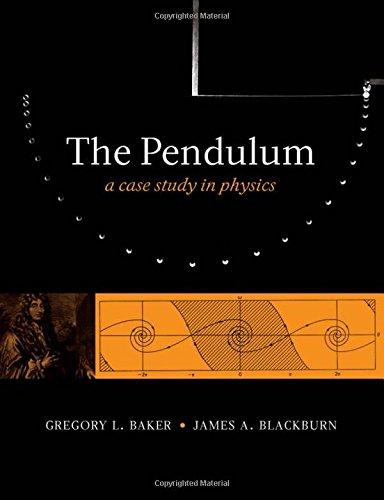
The Pendulum: A Case Study in Physics is a unique book in several ways. Firstly, it is a comprensive quantitative study of one physical system, the pendulum, from the viewpoint of elementary and more advanced classical physics, modern chaotic dynamics, and quantum mechanics. In addition, coupled pendulums and pendulum analogs of superconducting devices are also discussed. Secondly, this book treats the physics of the pendulum within a historical and cultural context, showing for example that the pendulum has been intimately connected with studies of the earth’s density, the earth’s motion and timekeeping. While primarily a physics book, the work provides significant added interest through the use of relevant cultural and historical vignettes. This approach offers an alternative to the usual modern physics courses. The text is amply illustrated and augmented by exercises at the end of each chapter.
User’s Reviews
Editorial Reviews: Review “a book devoted thematically to the history and physics of the pendulum is most welcomeGregory Baker and James Blackburn do an excellent job of weaving physical explanations with literary quotes and amusing anecdotes from the history of science. The authors have written their account for undergraduate physics majorsThe book offers a tour of different incarnations of the pendulum. An enjoyable theme and variations, it is well suited for use as a resource or as a recommended text in an advanced course on mechanincs.”–Science”In this well-illustrated treatment of the study of pendulum, Baker and Blackburn provide fascinating information about the history of the pendulum and what scientists thought it did, the revolution wrought by Foucault, the special cases of the torsion pendulum, the chaotic pendulum, the quantum pendulum, and coupled pendulums, the effects of superconductivity, and the most familiar to most of us, the pendulum clock. They include information on special interests in the appendices, such as the inverted pendulum and the Longnow clock.”–SciTech Book News”Pendulums simple, compound, chaotic, and quantum are described and analyzed in this concise book. Setting the tone, the small ample oscillations of a simple pendulum with no friction are modeled with differential equations. Time series graphs and phase plane diagrams are introduced for the simple pendulum and used later in the book for more complicated pendulums, especially the chaotic pendulum. Good historical and cultural background enliven the book, as do detailed drawings of historically significant apparatus such as the torsion pendulums used by Cavendish for his experiments on Earth’s gravity and by Coulomb for his experiments on the fundamental electrostatic force. Chapters on modern topicsare supported with excellent use of graphs, diagrams, historical background, and differential equations…Fascinating aspects of the Foucault pendulum, Newton’s Cradle, and other well-known pendulums are provided.” –CHOICE About the Author Gregory L. Baker is Professor of Physics at Bryn Athyn College of the New Church, Pennsylvania. James A. Blackburn is Professor of Physics at Wilfrid Laurier University, Ontario, Canada.
Reviews from Amazon users which were colected at the time this book was published on the website:
⭐The science of the pendulum is relevant far beyond clocks and swings. Simple harmonic motion is all around us and provides the basis to understand quantum mechanics.This provides a historical approach with progressively more challenging mathematics.An excellent survey
⭐The authors here tried to keep this book at an undergrad level, even in the quantum section. That’s a tough assignment, because, for example, if you look at the pendulum in 1 then 2 then 3 then… n.. dimensions, you immediately have to get into partial differential equations because of uncertainty and indeterminate pairs– needing to hold one variable constant to solve another, even with such a simple parameter pair as time vs. frequency (or period). This is actually a feature of any Fourier/LaPlace pair.The book is astonishing in conveying how a seemingly “simple” device can really encompass all of physics! It’s like a chip of a hologram, suggesting the entire universe is connected to each concept you explore in any real depth. And this is depth indeed! If you take a dozen physics texts, it is amazing how the authors point out that the pendulum is like the blind men with the elephant– each point of view sees it differently!If you dumb it down, you can have a non-elliptical path without considering all the “real” physical forces like friction and higher dimensional mechanics. You can then “almost” have an ordinary differential equation that is the derivative of pendulum length, bob weight, acceleration, etc. vs. a gravity angle, and equate the two to zero (or make the force on one side equal to gravity pulling and slowing it down on the other). Yet, the authors try to stop at ODE’s to keep the text manageable for undergrads!Even backing off of PDE’s can give a wealth of learning, since both static and dynamic examples can be formulated as ODEs and even difference equations, but beyond the basics, frankly, pendulum motion gets very complex, very fast! In fact, when you get into two of them, they are mirror images with both real and imaginary parts– not joking, you actually get into complex numbers fairly quickly with this model.In doing animations for PDE’s, we sometimes use Feynman’s little “clocks” to simplify QED. Reading this book gives the “aha” that each of those clock faces circumscribes a type of pendulum motion, from ellipse to wave to sine curve. This is an unusually rich door to quantum mechanics, and very clever of these authors.After reading this book, I realized as a tutor that you really could take this one example and cover all of math from basic algebra right up to Fourier and LaPlace transforms. The authors don’t take it that far (at least sparing readers solving inverses and duals!), but show us how one of the most ubiquitous forces can take us as far as we want to go. Living in a world of duality, most of our lives contain one type of pendulum or another, and economists have used the math you’ll explore in this text to explain many phenomena.Far reaching– will help you with BOTH math and physics, because when others are trying to visualize a force or formula, you’ll have one of hundreds of pendulum visuals in mind to “get it” intuitively, and then generalize to many other forces and equations, from heat to populations of coyotes vs. rabbits. Highly recommended.Library Picks reviews only for the benefit of Amazon shoppers and has nothing to do with Amazon, the authors, manufacturers or publishers of the items we review. We always buy the items we review for the sake of objectivity, and although we search for gems, are not shy about trashing an item if it’s a waste of time or money for Amazon shoppers. If the reviewer identifies herself, her job or her field, it is only as a point of reference to help you gauge the background and any biases.
⭐ottimo libro per studiare i movimenti con calcolo differenziale, purtroppo lo stampano solo in inglese
⭐
⭐Interesting topics.
⭐振り子という一見ありふれたものをテーマに、物理学を横断的に理解することができる。技術史的にも興味深い本である。
⭐
Keywords
Free Download The Pendulum: A Case Study in Physics in PDF format
The Pendulum: A Case Study in Physics PDF Free Download
Download The Pendulum: A Case Study in Physics 2005 PDF Free
The Pendulum: A Case Study in Physics 2005 PDF Free Download
Download The Pendulum: A Case Study in Physics PDF
Free Download Ebook The Pendulum: A Case Study in Physics