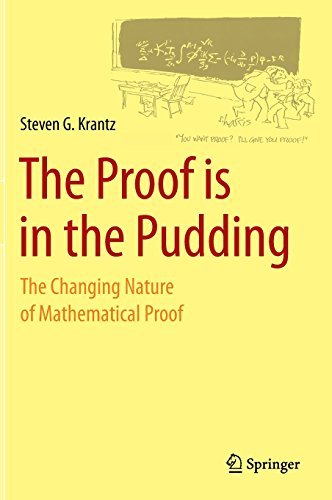
Ebook Info
- Published: 2011
- Number of pages: 281 pages
- Format: PDF
- File Size: 4.44 MB
- Authors: Steven G. Krantz
Description
This text explores the many transformations that the mathematical proof has undergone from its inception to its versatile, present-day use, considering the advent of high-speed computing machines. Though there are many truths to be discovered in this book, by the end it is clear that there is no formalized approach or standard method of discovery to date. Most of the proofs are discussed in detail with figures and equations accompanying them, allowing both the professional mathematician and those less familiar with mathematics to derive the same joy from reading this book.
User’s Reviews
Reviews from Amazon users which were colected at the time this book was published on the website:
⭐I haven’t yet looked into it much, but my husband found a lot of interesting facts in it. It does tell one something about how the concept of proof has changed over time.
⭐This is an entertaining book, although not entirely in ways that you might expect. Although it certainly includes discussions of proofs, there is as much about mathematicians and their quirks as there is about the proofs that they write.As with so many books nowadays, it is hard to believe that anyone read the final draft, let alone copy-edited it. (Are there any copy-editors left?) On page 101, we learn that measure theory was “pioneered” by Lebesgue in 1901. This may come as a surprise because we have just read, earlier on the same page, that measure theory was “invented” by Kolmogorov, who was born in 1903. A footnote on page 160 tells the story of “quasithin” groups: a problem first identified as a “gap” was subsequently filled by a two-volume tome of 1200 pages. This anecdote is repeated, almost verbatim, in the text on page 163. There are many typographical errors, though few will lead the reader astray.Naturally, the usual favourites are included. Krantz gives the conventional proof that the square root of two is irrational. He mentions Apostol’s elegant visual proof but, sadly, does not show it. Pythagoras’ theorem gets a proof and the claim that there are “well over 50 proofs altogether” – an understatement, considering that one book alone (Loomis’s ‘The Pythagorean Proposition’) contains 367 proofs. Dirichlet’s approximation theorem provides a nice example of a deep result with a straightforward proof (not given in the book, however) using the pigeonhole principle.The book discusses may results anecdotally – who made the conjecture, who tried to prove it but failed, who finally proved the theorem, how many hundreds of pages of proof were required, etc. – but only Brouwer’s fixed point theorem gets more than a superficial treatment.The fifth chapter is entitled “Hilbert and the Twentieth Century” and begins with a one-page section about Hilbert. The next section starts with Birkhoff and Wiener then segues into a long and somewhat unnecessary paean about the excellence of American mathematics. The chapter continues with Brouwer, the ham sandwich theorem, proof by contradiction, constructive analysis, Bourbaki, Ramanujan, Erdos, Halmos, and paradoxes – altogether a bit of a hodge-podge. Subsequent chapters cover the four-colour theorem, computer-generated proofs, and “elusive” proofs: the Riemann Hypothesis, Goldbach Conjecture, P=NP, Fermat’s Last Theorem, and other old friends. Mixed in with these are diatribes about Wolfram, Mandelbrot, and Penrose, perhaps because they have failed to come up with nifty proofs.Krantz’s treatment of Euclid’s Theorem contains a rather basic error that I have seen elsewhere. He starts with the assumption that the set of primes is finite, say S = {P1,P2,…,Pn}, constructs P = P1 x P2 x … x Pn + 1, and observes that P is not divisible by any of the primes. So far, so good. He then says that “the only possible conclusion is that P is another prime”, which is not so. There are two possibilities: either P is prime, or it is composite with prime factors that are not in S. Either case contradicts the original assumption.Mathematicians – and Krantz is most certainly a mathematician – do not make mistakes like this. Perhaps Euclid’s proof is so “obvious” that mathematicians repeat it on autopilot: but that also would be uncharacteristic. My guess is that they are paraphrasing an ur-theorem that postulates a finite set S of natural numbers with the property that every natural number is either a member of S or can be factored into members of S. Then P, constructed as above, has neither property, hence the contradiction.Krantz mentions, but does not dwell on, metamathematics. He demonstrates, successfully I believe, that proof is a social process: a theorem is proved when mathematicians agree that a correct proof has been found. Proofs that depend on computer programs are causing unease, and even outright rejection in some cases, but have not yet changed the conventions of publication established in the seventeenth century. He also explains that the proof of a theorem is expected to provide insight into why the theorem is true.In summary, this book is a good, quick read and would fit well in the paperback section of an airport bookstore. Sadly, it is a Springer hardcover and priced accordingly.
⭐Wenn ein Mathematiker ein Buch für Nicht-Mathematiker schreibt, ist das immer ein Problem. Mathematiker denken anders, und was für sie selbstverständlich ist, bereitet dem Laien Schwierigkeiten, da er ein oder zwei Gedankengänge nicht nachvollziehen kann, die dem Mathematiker ganz selbstverständlich erscheinen und die er deswegen nicht erwähnt. So auch hier. Doch dies tut dem ansonsten höchst lesenswerten Buch keinen Abbruch, da die mathematischen Teile auf ein Minimum beschränkt sind. Nur zwei oder drei der Themen werden ernsthaft aufbereitet, dann aber auf hohem Niveau. Der überwiegende Rest besteht aus höchst instruktiven, teils amüsanten, teils tragischen Episoden aus der Geschichte der Mathematik. Erstaunliche menschliche Tragödien tun sich auf, wenn beispielsweise mathematische Beweise so kompliziert sind, dass sie von der Gemeinde der Mathematiker nicht mehr überprüft werden können oder wollen. Manchmal wird der Schöpfer des Beweises dennoch anerkannt – wie im Fall Hale beim Beweis der Keplerschen Vermutung, vor dessen Überprüfung alle Mathematiker kapitulierten – , manchmal wird der Schöpfer des Beweises erst ignoriert und dann vergessen, bis ein anderer, Jahrzehnte später, den Faden aufnimmt, den Beweis erneut versucht und den Ruhm einheimst.So entwirft der Autor ein ungewöhnliches Panorama höchst menschlicher Aktivitäten, Schicksale und Tragödien, bei dem der unbedarfte Leser nur staunen kann: Wo er die Vorherrschaft von Logik, Rationalität und Vernunft vermutet, da regieren allzu oft Eifersucht, Beleidigtsein und gelegentlich (wie im Fall Perelmann) pathologisch-unverständliche Verhaltensweisen. Alles in allem: eine wunderbare Anekdotensammlung. Bei den wenigen mathematischen Exkursen hätte ich mir eine ausführlichere Abhandlung gewünscht, besonders bei der Behandlung des Brouwerschen Fixpunktsatzes, da dieser für die Philosophie der Mathematik (konstruktiv kontra nicht-konstruktiv) eine so große Bedeutung hat.
⭐
Keywords
Free Download The Proof is in the Pudding: The Changing Nature of Mathematical Proof 2011th Edition in PDF format
The Proof is in the Pudding: The Changing Nature of Mathematical Proof 2011th Edition PDF Free Download
Download The Proof is in the Pudding: The Changing Nature of Mathematical Proof 2011th Edition 2011 PDF Free
The Proof is in the Pudding: The Changing Nature of Mathematical Proof 2011th Edition 2011 PDF Free Download
Download The Proof is in the Pudding: The Changing Nature of Mathematical Proof 2011th Edition PDF
Free Download Ebook The Proof is in the Pudding: The Changing Nature of Mathematical Proof 2011th Edition