Ebook Info
- Published:
- Number of pages:
- Format: PDF
- File Size: 10.94 MB
- Authors: Cornelius Lanczos
Description
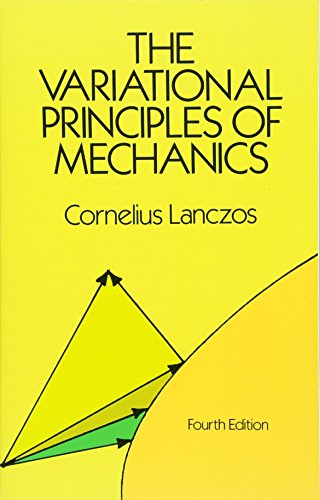
Analytical mechanics is, of course, a topic of perennial interest and usefulness in physics and engineering, a discipline that boasts not only many practical applications, but much inherent mathematical beauty. Unlike many standard textbooks on advanced mechanics, however, this present text eschews a primarily technical and formalistic treatment in favor of a fundamental, historical, philosophical approach. As the author remarks, there is a tremendous treasure of philosophical meaning” behind the great theories of Euler and Lagrange, Hamilton, Jacobi, and other mathematical thinkers.Well-written, authoritative, and scholarly, this classic treatise begins with an introduction to the variational principles of mechanics including the procedures of Euler, Lagrange, and Hamilton. Ideal for a two-semester graduate course, the book includes a variety of problems, carefully chosen to familiarize the student with new concepts and to illuminate the general principles involved. Moreover, it offers excellent grounding for the student of mathematics, engineering, or physics who does not intend to specialize in mechanics, but wants a thorough grasp of the underlying principles.The late Professor Lanczos (Dublin Institute of Advanced Studies) was a well-known physicist and educator who brought a superb pedagogical sense and profound grasp of the principles of mechanics to this work, now available for the first time in an inexpensive Dover paperback edition. His book will be welcomed by students, physicists, engineers, mathematicians, and anyone interested in a clear masterly exposition of this all-important discipline.
User’s Reviews
Reviews from Amazon users which were colected at the time this book was published on the website:
⭐Before reading this book, I knew almost nothing about analytical mechanics. My first text books taught Physics from a Newtonian approach, using mostly vectors and potentials. So, the first time I encountered Lagrangians and Hamiltonians I could not understand what these concepts meant. Because of that many areas of Theoretical Physics were forbidden for me: Phase and configuration space, Noether’s theorem, Hilbert relativistic equations, Feynman quantum-mechanical interpretation of the principle of least action, and so on.So, two years ago, I decided to buy this book. And what I encountered? A systematical and pedagogical approach to analytical mechanics, which enabled me to acquire the fundamentals of the subject.For me, the most interesting features of this book are the following:1) It explains the differences between VARIATION and DIFFERENTIATION, something that most books in the subject, leave behind.2) It explains clearly D’Alembert Principle and the Principle of Virtual Work.3) From those principles he derives the Principle of Least Action, using just elemental calculus.4) He introduces the reader in Legendre’s transformation and the relations between the two fundamental quantities of Analytical mechanics: Lagrangian and Hamiltonian.5) You get the equations of movement corresponding to those quantities: Euler-Lagrange (Lagrangian) and canonical (Hamiltonian) equations.6) A powerful insight in Configuration and Phase Spaces is given, including the wonderful Liouville’s theorem.7) Lanczos shows the analogies between Optics and Mechanics when he explains the Hamilton-Jabobi equations.So, why to learn Analytical Mechanics and why to buy this book?? These are my reasons:1) From a historical point of view, Analytical Mechanics was developed by Continental Mathematicians like Maupertuis, Euler, D’Alembert and Lagrange as a rival system to the Newtonian one exposed in the Principia Mathematica. Newton used vectors and potentials. Euler and Lagrange employed the Principle of Least Action.2) It was Analytical Mechanics the first to develop the principle of energy conservation. Even when this principle in its general form was developed by Wilhelm von Helmholtz in 1847, the conservation of the sum of kinetic and potential energy was well known to Euler a century earlier.3) The concept of phase space is very important in Thermodynamics. In fact, the definition of entropy given by Ludwig Boltzmann refers to the logarithm of a volume in phase space. Liouville theorem, which states the conservation of such phase space volumes, is very usefull today in black hole thermodynamics.4) The quantum-mechanical interpretation of the Principle of Least Action given by Richard Feynmann was a fundamental contribution in the development of Quantum Field Theory, so any student who desires to progress in this field, must have substantial knowledge of Analytical Mechanics.So, to all of you that eventually decide to buy this book, I wish you a good reading.
⭐Lanczos’ “Variational Principles of Mechanics” is an erudite piece of work that basically reconstructs the science of analytical mechanics bottom up, from the principle of virtual work to Einstein’s equivalence principle and the origin of the gravitational redshift of spectral lines. The book contains very little material on the Newtonian, vector mechanics, being entirely devoted to the Lagrangian and Hamiltonian approaches to mechanics.The book provides a perfect introduction to the foundations of the all important principle of least action that pervades all of modern physics. In this regard, a nice companion to Lanczos’ book is the treatise by W. Yourgrau and S. Mandelstam, ”
⭐.”One major “functionality” of Lanczos’ book is to bridge the gap between our modern way of thinking and that of the classics. Anyone who has already tried to read the 1762 papers by Lagrange on Miscellanea Taurinensia or the 1834-1835 papers by Hamilton on the Phil. Trans. Royal Soc. knows that the classical literature is difficult to follow, part because of old-fashioned notation, part because we lack (well, at least I lack) the spirit of the times, making it difficult to understand some seemingly byzantine questions that the authors pose and ponder on in some of their (sometimes rather lenghty) writings. The book by Lanczos helps a lot both in terms of notation and ideas.I totally disagree with those that try to compare Lanczos’ and Feynman’s styles. Lanczos is seriously concerned with the history of the ideas, their evolution, and interpretations. There is nothing like that in Feynman’s “The strange theory of light and matter,” or in his “The character of physical law,” and very little of it in his lectures on physics. Actually, Feynman pays very little credit to the historical development of the subjects. I am not saying that he personally does not recognize the credits, only that he does not communicate it. He admittedly has a “do it yourself” (or “did it myself”) attitude towards physics, while Lanczos has a visible admiration for the greatness of his subject (without being cheesy) and is sensitive to its philosophical nuances and implications. I feel the difference between the two is like the difference between getting trained and getting educated.In summary: a must have in anyone’s scientific library (unless you are an undergrad student cramming for your finals).
⭐Just as the title, the book is very informative in all aspects.First, the author shown his far-reaching understanding between principles and their correlation to each others. More, the geometrical treatment for those principles on pure mathematical view is explained and described in very clear and beautiful manner. Last, the story behind those great achievement are represented and is quite helpful to learn the concepts and its reason with historical logic.p.s I known the author from his outstanding work in approximation solution of eigenvalue problem in Finite element analysis.
⭐This is one of the ‘must read’ books for all physicists of whatever flavour. Like all Dover science books, it is clearly printedon good quality paper and bound in signatures so it will not split – they are hardbacks in disguise!The book is a classic and needs no praise from me.
⭐it’s tough reading, but it’s worth the effort – another look at mechanics since undergrads in late 80s. a good complement to good old mechanics.
⭐I was committed to getting through this book, start to finish, end to end. For about 2-3 months (since before I bought the Amazon copy) I have been doing just that. At long last… I have to give up and switch to Goldstein. I am at the beginning of Chapter VIII (Partial Differential Equation of Hamilton-Jacobi).Lanczos enjoys flowery exposition, especially to highlight the historical context or significance of mathematical developments and to repeatedly opine on his subjective opinion of the beauty of the subject of variational mechanics. However his pedagogical ability is… lacking. Actually, even that is too generous, for generally one encounters the issue in pedagogy of the master who cannot relay things simply to the novice. That is not what is wrong with this book. What is wrong is that Lanczos outright omits information, making logical leaps through equations that no reasonable person (who is ostensibly equipped to read this book) can follow. His notation is sloppy– I think he values his personal view of what ‘looks pretty’ more highly than he values writing equations correctly. More importantly, he makes grave technical errors. I also think the book was written at a time when some of the mathematical machinery was not as well-developed (symplectic geometry; Lie algebras; Poisson manifolds; differential geometry), and this shows.In order to understand many of the equations, you need to already be familiar with a geometer’s mindset of functions existing on manifolds independent of any choice of coordinates. It’s difficult for me to provide concrete examples, except to say that you really need this mindset in order to get through this book, especially after the first half. Even when it is egregiously unclear, Lanczos will notate the same function, H, without its parameters written like H(p,q). In one instance, you actually need to interpret H as being parametrised H(p,q) and in another case H(P,Q). There are times when it would be so little effort for him to just put in that little extra bit of notation. But he cares more about the equations looking beautiful than _being_ beautiful. I find this a silly trap that too many authors fall in to. The aim is to TEACH, not minimise the number of graphemes!Equation (74.2) describes the equality of action integrals in two different canonical coordinates. The equivalence of action integrals IS NOT THE DEFINITION OF A CANONICAL TRANSFORM. This equation is INCORRECT, and it is one of the most pivotal equations of the book and of the theory of canonical transforms! Even more egregiously, Lanczos says below it “here we have the most general condition for a canonical transformation” which is also EXTREMELY WRONG. After being terribly confused for a couple of days with what I felt made no sense mathematically, I consulted Goldstein and it turns out I was right! The definition of a canonical transform is simple. It’s a transform from (p,q,H) (where the equations of motion of p,q are given by the canonical equations of H) to (P,Q,K). The only requirement is that the two systems of coordinates (which also include a Hamiltonian) must describe the same paths through phase space. The explanation is simple, very intuitive, it’s not a complicated concept. But, like with everything, Lanczos makes it terribly complicated with vague explanations and poor notation. He falsely asserts that a canonical transform requires the action integral to be the same apart from the total variation of a function on phase space–this is false. This is ONE way to generate canonical transforms. Goldstein does not do much better in this regard, but at least he doesn’t make an overtly incorrect statement that this is ‘the most general condition’.Even more alarming is Lanczos’ complete omission of the *four different kinds of generating functions*. Instead he explores just a single kind, and he also assumes that it is time-invariant. Indeed, Lanczos frequently sneaks in simplifying assumptions, thinking that it will make the explanation clearer. It never does. When there are kinks in your logic it invariably confuses the attentive reader. If, like me, you experience this often with books, well you’re in for a wild ride here.I enjoyed the first third of this book. After that, it became progressively harder to read. I found myself spending hours on just a few pages (in one case 4 hours trying to understand 1 page). It always turns out to be something notation related or to be something that Lanczos should have explained but didn’t. Frequently I have had to refer to knowledge I have from other studies, and that he did not mention at all. (For example, definition of tangent space as the equivalence classes of curves passing through each point on a space– this means that the derivatives of parametrised canonical transforms can express EVERY infinitesimal canonical transform. Lanczos does not mention this at all, and yet the assumption that all infinitesimal canonical transforms can be expressed in this way is running as an undercurrent through his explanations). When I look back through some of the notes I wrote for myself, I see that the concepts can be summarised succinctly and are nowhere near as complicated as Lanczos has made them.So it is my trust in this book was seriously shaken. Initially I assumed I was dense for it being so difficult to get through, but when I peer over at Goldstein it becomes clear that I am not the problem. The grave error on one of the most pivotal equations was the nail in the coffin. I tried for a little bit after that. No surprise, a couple pages later I’m stuck again because Lanczos assumes I’m familiar with the theory of missing coordinates in nonlinear PDEs. His language is just not descriptive enough– he describes things in a way which you could only understand if this was revision material for you. Put simply, he omits essential information, treating the text like it’s revision material.Exercises in this book appear to disappear almost entirely for the middle third of the book (I have not read beyond). This worries me– I need exercises to make sure I have really understood what Lanczos intended the audience to understand. Again I peer over at Goldstein and see all these wonderful exercises… and I wish I started with Goldstein instead. I also checked out a book by Marsden and see that it is significantly more well-informed, actually providing answers to questions I had like ‘why form the canonical equations in this particular way?’. Turns out it’s a part of a larger theory of Poisson manifolds and Lie algebras etc… that is probably advanced material though.Something I find strange is that despite Lanczos’ clear proclivity for differential geometry, and his self-professed love of the ‘beautiful’, ‘coordinate-free’ approaches, he fails to mention a crucial geometric interpretation of the action of infinitesimal canonical transforms– in particular that the Poisson bracket [A,B] computes the vector derivative of A along a vector field X_B generated by B (generated according to the canonical equations, same as Hamiltonian). i.e. [A,B] = < dA, X_B >. I am confused why he doesn’t mention this; perhaps differential geometry was not as well-developed when the book was written.The ideal audience for this book is, perhaps, someone who already learned how to crank the machinery on (advanced) Hamiltonian mechanics, up to and including relativistic and fluid systems. If you know how the machinery works, and you want to review the historical and philosophical implications in a cohesive manner, this book may be for you. But, if you have that level of knowledge, you probably will be interested also in Lie Algebras and Poisson Manifolds and symplectic forms, et cetera. And none of that is covered in this book. So I’m not sure who it’s for, really. Perhaps as an historical relic. When the book reads well it is enjoyable. But those moments become sparser and sparser the more I advance.
⭐I have used multiple books in my undergrad study for theoretical mechanics but most of the books recommended by professors are meant to apply the analytical calculation to mechanics. Somehow something is missing in explanation and I never had time to revisit some philosophical problem again during my study of Physics. Only when I left academia I discovered this piece of gem. This book makes you think about why variational principle is introduced, both from historical and philosophical context.I finished this book in a few train rides. Reading and thinking about basic things in Physics is such a joy. But beware that this book is not your undergrad textbook. It is a companion book that will accompany you which you can refer to when you have non trivial questions about analytical mechanics.Geometrical interpretation is not covered here however.
Keywords
Free Download The Variational Principles of Mechanics (Dover Books on Physics) 4th Edition in PDF format
The Variational Principles of Mechanics (Dover Books on Physics) 4th Edition PDF Free Download
Download The Variational Principles of Mechanics (Dover Books on Physics) 4th Edition PDF Free
The Variational Principles of Mechanics (Dover Books on Physics) 4th Edition PDF Free Download
Download The Variational Principles of Mechanics (Dover Books on Physics) 4th Edition PDF
Free Download Ebook The Variational Principles of Mechanics (Dover Books on Physics) 4th Edition