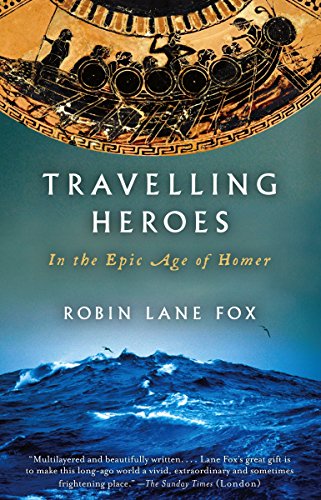
Ebook Info
- Published: 2010
- Number of pages: 496 pages
- Format: PDF
- File Size: 11.99 MB
- Authors: Robin Lane Fox
Description
The myths of the ancient Greeks have inspired us for thousands of years. Where did the famous stories of the battles of their gods develop and spread across the world? The celebrated classicist Robin Lane Fox draws on a lifetime’s knowledge of the ancient world, and on his own travels, answering this question by pursuing it through the age of Homer. His acclaimed history explores how the intrepid seafarers of eighth-century Greece sailed around the Mediterranean, encountering strange new sights—volcanic mountains, vaporous springs, huge prehistoric bones—and weaving them into the myths of gods, monsters and heroes that would become the cornerstone of Western civilization.
User’s Reviews
Editorial Reviews: Review “Multilayered and beautifully written. . . . [Lane Fox’s] great gift is to make this long-ago world a vivid, extraordinary and sometimes frightening place. Like Homer’s yearning traveller, Lane Fox longs to be there, and his longing is contagious.”—Elizabeth Speller, The Sunday Times (London) “Full of wit and suspense. . . . Lane Fox argues his case with tremendous style and verve.”—Mary Beard, Financial Times “A fascinating quest . . . that illuminates the roots of Greek thought and ideas that have shaped our own world and philosophies. . . . Lane Fox is a lively writer.”—Lois D. Atwood, The Providence Journal “Exciting. . . . With his usual panache, [Lane Fox] displays encyclopaedic erudition alongside an unusually wide historical and geographical scope. The pleasure and the education offered by this book lie in the stylishly presented detail.”—Edith Hall, The Times Literary Supplement (London) “As we follow [Lane Fox] through the pages of this learned, original and ceaselessly intriguing book, we find a strange and alien landscape opening up before us, one so remote that it had hitherto seemed lost to utter darkness. . . . This is a wonderful book.”—Tom Holland, The Spectator (London) “Original, daring, and arguably life-enhancing. . . . Lane Fox [writes] with a sweeping narrative flourish worthy of a cinematographer or screenwriter . . . seasoned and leavened with a wit that only writing can afford.”—Paul Cartledge, The Independent (London) “Lane Fox has spent his long and distinguished career negotiating a broader intellectual highway, and leading a wide range of readers along it. Travelling Heroes takes us on a dazzling journey throughout the Mediterranean world of the 8th century BC [and] he evokes the period brilliantly.”—The Telegraph (London) About the Author Robin Lane Fox is a Fellow and Garden Master of New College, Oxford, and a University Reader in Ancient History. His books include Alexander the Great, Pagans and Christians, The Unauthorized Version, and The Classical World. Since 1970 he has also been gardening correspondent for the Financial Times. Excerpt. © Reprinted by permission. All rights reserved. Chapter 1Hera’s FlightIn the fifteenth book of Homer’s Iliad, the goddess Hera flies across to Mount Olympus and the poet compares her to a particular movement of the human mind. When a man has travelled far and wide, he tells us, his mind will sometimes leap and he will think, “I wish I was here, or I wish I was there,” as he “longs for many different things.” Hera’s sideways flight is as swift as these inconsistent thoughts as she moves from the peak of one mountain to another.Two thousand seven hundred years later we still know from inner experience what Homer meant. We do not connect such thoughts with the speed of a passing goddess, which we imagine, rather, as the invisible speed of light. Homer’s imagination is so much more precise. When a goddess descends directly to earth he compares her descent to a vertical shower of hailstones. When she flies sideways he refers us inwards to those lateral fancies which express our enduring sense that life does not have to be as it is.Two thousand seven hundred years are a very long gap between Homer and ourselves and at such a distance the psychology of his heroes has been thought by some of his modern readers to be primitive. Homer’s heroes think in their “hearts,” not their brains; like us, they can disown an idea or impulse, but they often disown it as if it has come from outside or from an independent source; they have no word for a decision and because they are not yet philosophers they have no word for the self. Yet, as Hera’s flight reminds us, Homer’s idea of the mind is not limited by the words which he happens to use. Like ours, his heroes’ inconsistent thoughts belong in one unifying mind; they decide on actions; like Hector outside the walls of Troy they sometimes know what is best, but fail to act on their knowledge. Above all, they share our human hallmark, the sense that our life could be lived elsewhere and that people once loved and lost can seem in the contrasts of the present as if they were never really so.“I wish I was here, or I wish I was there . . .” In our age of global travel we are all potential heirs to the simile of Hera’s flight. Among writers it may seem most apt for novelists, the idealized heroes of our habits of reading. Novelists, surely, need to imagine, whereas earth-bound historians have only to collect such mundane information as survives. Yet novelists become constrained by their own creations and by the need for them to be coherent as they develop. Historians must amass and collect but they then have freedoms too. It is for them to assess the credentials of what survives, to pose questions which some of it helps to answer, and to check that there is not other evidence which tells against their answer and which cannot be explained. As they reconstruct a life, a practice or a social group, their sources control their image of it, but they also need to imagine what lies beyond their surface, the significant absences and the latent forces. When they imagine these absentees they need to think how life would have been beyond their own particular lives. “I wish I was here, or I wish I was there . . .”: these thoughts also flash in minds which have travelled far among evidence for other times and places.Philosophers will continue to tell us that it is an illusion, that historians cannot be in two times at once or travel backwards while remaining themselves. Yet we “long for many different things,” to be good, perhaps, in the new age of the first Christian emperor Constantine, to be wonderfully wild with Alexander the Great, to question convention in Socrates’ Athens or to uphold it on an estate of outrageous size in late Roman north Africa, with the names and pictures of the family’s beloved horses on the villa’s mosaic flooring, a Christian saint’s shrine on the farm for the prayers of the indebted tenants and a strong sympathy with that least Christianized company of Christians, the nearby members of Augustine’s congregation.We can only wish, simulating Hera’s flight, but after travelling far and wide among evidence for the years from Homer to Muhammad, I continue to wish to revisit the Greek world of the eighth century bc. It is not a world with famous names, who are exactly dated and known from biographies. It is not even known through histories or memoirs which were written in its period: history had not yet been invented. Its main sources are particularly hard to interpret: poetry and archaeological finds. From the latter, especially, modern scholars have described this period as a “Greek renaissance,” or an age of distinctive “structural transformation,” propelled, perhaps, by a newly increasing population, an increased use of cultivable land and a new willingness of its village-leaders to combine into city-states. One sign of these changes is even discerned in the use of organized burial grounds for the dead. Others detect the origins of icons of our “western world,” the birth of the “free market” after an age of exchange based on reciprocal favours, or the unencumbered ownership of small family farms, the birthright of those “other Greeks,” the small farmers whom our modern histories of warriors and lawgivers tend to pass over.It would be intriguing to test these theories by revisiting their eighth-century reality, but my own researches would be different. I would like to verify a pattern long visible to my eye, a trail of travel and myth traced by eighth-century Greeks, which stretched across the Mediterranean and is the subject of this book. Hitherto unrecognized, it bears on other great elements of ancient life to which we still respond, aspects of landscape, songs and oracles and the unsurpassed poetry of Homer and his near-contemporaries. It also points to a way of thinking and of understanding the world which is not prominent in modern histories of this early period but which was active from Israel to the furthest points of the Greeks’ presence, at a time when philosophy did not yet exist and there was no separate sphere of “western thought.”Realists in the modern world will raise immediate objections to this wish to return to the edges of what appears to be such a dark age. Life expectancy was low in the eighth century; there was extreme exploitation of the many by the very few; there were the past’s invisible companions, intense smell and pain, compounded by the absence of flushing drains and lavatories. Among Greeks there was grumbling sexism, best seen in the myth of Pandora, the origin of man’s sufferings, and “from Homer to the end of Greek literature there were no ordinary words with the specific meanings ‘husband’ and ‘wife.’ ” There was also an absence of small significant comforts, no sugar, no chocolate, no pianos. In the dry spines of a Greek landscape were there ever horses worth riding? Objects and painted pottery of the period show men naked, not clothed, and surely those Greeks who competed in sports and races had to do so in the nude? It is a mercy that our lives have moved on . . .Such objections are not all misplaced. Excavators of two of the best- studied cemeteries in the Greek world between 1000 and 750 bc have given few grounds for optimism. At Lefkandi, on the island of Euboea, “the most complete burials confirmed that adults tended to die quite young . . . in the prime of life, say between 17 and 40 years. The young persons recovered from all three cemeteries indicate that child mortality, too, was probably high.” At San Montano on the island of Ischia, where Greeks settled from c. 770, “the cemetery population was divided roughly into one-third adult and two-thirds pre-adult,” 27 per cent of whom were babies “often new or stillborn.” Studies of bones, teeth and skeletons at these and other Greek sites in this period imply a distressing proportion of damage, decay and distortion. At Pydna, up on the coast of south-east Macedon, a sample of forty buried skeletons has shown that “degenerative joint diseases emerge early, from 13–24, and concern both sexes . . . At least nine individuals in our sample were suffering from arthritic changes, mainly in the spinal column . . . both of the individuals over 45 years show severe arthritic changes.”For those who lived on there were no human rights, no challenge as yet to the domination of the many by the powerful ruling few. Without compunction, this “happy few” enslaved fellow-humans, using them in households or on their farms. They might even selltiresome dependants abroad, as the suitors in Homer’s Odyssey acknowledged when they told Odysseus’ son to pack off two troublesome beggars to “the Sicels’ (in our Sicily) in the west “in order to fetch for yourself a worthy price”; they were unaware that one of them was noble Odysseus himself, in disguise. Slavery, meanwhile, was only the most extreme form of gain. In Attica, the nobles also took one-sixth of the produce of other Attic landowners’ farms. In Sparta, by the late eighth century, the Spartans were taking half of the produce of the Greek neighbours whom they had conquered and made their “serfs.”These obstacles will hang over my wish to revisit this era unless they are agreed on and countered at the outset, from the high mortality to the nudity in public. The one counter to an early death was a lucky draw in the lottery of life. In the eighth century such a draw was possible, although the odds against it were much higher than ours. The “average” lengths of eighth-century life in some of our modern tables include all the unlucky others and obscure the peaks and valleys of an individual’s span. Prospects were longer for those who survived the acute risk of infant mortality. Individual males who passed through this hazard and escaped death in war might go on to live for more than sixty years. Aristotle noted their political prominence in early Greek communities; a council of males over sixty had political powers in Sparta; elderly Nestor exemplified wisdom in Homer’s epics. Women had to survive the further cull of giving birth, but even so there were older ones who survived: an appropriate role for them, if well born, was to be made priestesses of the gods. A small minority of people, therefore, beat the index of life, propelled, in the view of one recent elderly historian of the Greeks, “by creative activity under tension, with the rewards of achievement, honour and fame . . . tension of a different quality, so to speak, from the ceaseless tension of those who struggled daily for sheer survival, which exacerbated their anyway inferior physical conditions of life.”This “creative activity under tension” was most evident in one particular class, the male nobles who dominated their communities. To be born male into a noble family was the defence against social exploitation. Noblemen, and especially noblewomen, were at risk to enslavement, but only if their community was invaded and conquered. Ties of friendship between families, hosts and guests helped to reduce the risks from noble outsiders. Within their own home communities nobles would not be enslaved by fellow-nobles.As for the pain and the smell, they existed even in this small upper level of society: how could they be overcome? Here, we need to be cautious. Homer’s poems describe fearful wounds in battle, 148 of them, and sometimes describe the accompanying throes of death (three- quarters of the wounds are fatal). We cannot assume that Greeks’ threshold of pain in the eighth century bc was higher than ours because suffering was so much more widespread or because their texts’ emphasis on it is different from our own. Homer is already aware of a fact we now accept, the time lag between a serious injury and the sufferer’s sensation of pain. He does not trace it to our brains, as we do: he links it to the flow of blood from the wound, as if it is the blood’s flow which delays the pain’s onset.14 He says little about the prelude to a natural death: he does not show an awareness that it can be as painful as death from a wound. This silence is not evidence that the experience of pain in Homer’s time was different from ours: it may be evidence only about the aspects of pain which it was conventional for poets to describe. Except, perhaps, at the margins of our modern sensibility, eighth-century Greeks acknowledged what we also feel, the “black pain” from wounds and body-damage. The counter to it was not a difference in their sensibility: like ours, it lay in the use of palliatives. Wounds could be bound “skilfully,” although we hear only twice in Homer of specific bandages (one is called the “sling”). Pain-relief in Homer’s epics is also linked to the skills of women. In Nestor’s tent, the captive slave-girl Hecamede (her name imples “cleverness”) offers the wounded and battle- weary wine mixed with barley and flavoured with onion and grated goat’s cheese. To us it sounds like a recipe for rapid death, but the drink was assumed to relieve pain and restore strength: cheese- graters have even been found in a few pre-Homeric Greek burials, suggesting that in real life, too, rich Greeks believed in the value of mixing “cheese and wine.”Hecamede’s onion was the least of Homer’s healing plants. They are the ancestors of so many of our own painkillers which are also derived from plants in nature. Soon after Hecamede we meet another Homeric lady, freeborn fair-haired Agamede (”Extremely Clever”) who “knew all the drugs which the broad earth bore.” In the Odyssey, Helen mixes a drug into the wine of her menfolk when their storytelling causes them to shed tears: “Whoever drinks this down,” she tells them, “would not for the course of a day let a tear run down his cheeks, not even if his mother and father were both to die.” Helen’s tear-stopper came, significantly, from Egypt, a recognized source of excellent medical drugs for the Greeks. It has never been found in nature, nor has the herb “moly” which the god Hermes gave to Odysseus as an antidote, a plant with a black root and a flower like milk. We know, however, that the poet was magnifying practices in the real world. There, too, plants were used as palliatives, including opium. Pottery, shaped like the seed-heads of the opium poppy, was being made on Cyprus c. 850–800 bc and exported to neighbouring islands, including Crete. In the eighth century bc small handmade jugs may have transported opium to Greeks who had settled off western Italy on the faraway island of Ischia. Read more
Reviews from Amazon users which were colected at the time this book was published on the website:
⭐presented in a no-fuss, scholarly informative language that reads really well – hats off to Robin Lane Fox! The author is also truly adept at synthesizing multifarious threads, drawing on archaelogy, classical philology and etymology, (comparative) mythology, old and new topography, tracing the pottery trail (cups, mixing bowls), his own field research, etc.While the book is divided into four parts, please allow me to chart out the main themes in three segments.I. Voyages of Euboean Greeks in the 8th century BC Mediterraneum (pp. 29-162)Their seafaring routes in search of timber, precious metals, tin and copper for bronze making, somewhat paralleled those of the Phoenicians, who “did not begin to found settlements of their own in the west in order to defend themselves against Greek ‘encroachment’ on their trade…There was not yet a contest…Both peoples settled on new land…because there was gain to be had from taking it” (pp. 141-2). Bear in mind that these ancient Greeks were not only sailors (quite often had to pull at the oars though) but when the situation required acted as traders, warriors, or raiding pirates.We start our journey at the Toumba royal burial mound of Lefkandi’s ruler (early/mid-tenth c. BC Euboea), whence we travel to Cyprus where “Euboean and Phoenician goods had coexisted from c. 920 BC onwards” (p. 68 – referring to a tomb at Amathus).Our next port-of-call is the unexcavated Posideion on the Bay of Issus, in the Neo-Hittite cultural milieu of Cilicia (southern part of Asia Minor – chapter 5). The Euboeans of this site may have joined the Assyrian Tiglath Pileser III’s 730s campaign to the region, as attested by Near Eastern pieces of horse-harnesses from the same period found in Greek graves (pp. 109-12).Further south, in North Syria there was the trading-post of Potamoi Karon/Al Mina (founded c. 800-780) in the Orontes river delta (ch. 6). One further evidence is that many of these sites can be connected “through one particular class of small objects, a much-discussed type of engraved seal-stone which shows the schematic figure of a ‘lyre-player’ on its green or reddish surface” (p. 107 – for a sample of it, see also p. 162). Aside from trading their wares, Euboean-Phoenician interaction resulted in the creation of the Greek alphabetic script (the earliest find is dated c. 750 BC), which in turn was adopted by Etruscans; the Greek unit of weight (stater) being modeled after the Phoenicians’ shekel; and loan words related – quite understandably – to commerce.On their westward journey, the same Euboeans – chiefly from Eretria and Chalcis that engaged in the Lelantine War (ended c. 705 BC) back on their home island – founded a settlement on the volcanic isle of Ischia/Pithekoussa off the coast of Naples c. 770-60 BC to produce wine and olive oil, while also practicing gold work; and another one on the mainland, called Cumae. Worth to note that “Euboeans may have come even earlier to north Africa, following Phoenicians who were settled at Auza (by c. 850 BC), Utica, and Carthage. From there they may have joined the route west to Huelva in Spain where Euboean plates and cups arrived by c. 800 BC. The north African venture would then have developed, beginning with a local Pithecussae and spreading to a Naxos which followed the Euboean one in Sicily (734 Bc)” (p. 138).II. Myths traveling with Euboeans in their minds (pp. 163-314)”Thanks to creative mistakes about foreign languages and foreign monuments [i.e, flexible misunderstandings, linguistic faults, wishful conjectures] there was a vast enlargement of the Greeks’ ‘family of peoples.’ Cadmus included ‘Phoenix’ and ‘Cilix,’ namesakes of the Phoenicians and Cilicians; Lybia and Egypt became involved in the same genealogy, while Io, as promised, turned the lands by the Nile into a long-lasting Greek settlement, if only after Alexander the Great’s conquest. This mapping and genealogy nowadays tend to be credited with stark consequences for colonial power and Greek territorial claims…Greeks who devised these kinships were not defining their own Greekness by opposing foreign ‘others’ to themselves. They were assuming that ‘others’ were more like themselves than they really were” (p. 204).The myth of Daedalus is taken to Sicily (from the 7th c. BC onward), then as far as the west coast of Etruscan Italy – see winged figure captioned “Taitale” on a jug from Cerveteri, dated c. 630 BC (p. 189).How the notion of the “pillars of Heracles/Hercules” (straits of Gibraltar) may have been inspired by the Euboeans’ sighting of two pillars (Gr. stélai) dedicated to the patron-god Melqart of the Phoenician Tyre at Cadiz (Gr. Gades), and how stopovers of Heracles eastward journey while herding the stolen cattle of the giant Geryon were fixed to non-Greek places in the Iberian peninsula (for instance, Tartessus corresponds to Guadalquivir river in SW Spain) and Sicily (Solous, Eryx, Motya) (pp. 195-8).How the “house of Muksas” ruling 9-8th c. BC Cilicia was assigned, falsely, an origin with the migrant seer Mopsus, and how his quarrel with another mythological hero, Amphilochus reflects the strife between competing settlers from Euboea and Rhodes in Asia Minor (ch. 13).Ch. 14 traces the cult of Adonis and his women-worshippers from Babylon (Dumazi) through the Phoenician Byblos-Aphaca (Tammuz/Adonai) to Golgoi-Argos/Arsos in Cyprus.How the sickle-motif forms a common mytho-textual platform to connect the Euboean settlement called Zancle (founded c. 770-6 or 730-20) of Sicily, the “birth of Venus” (Aphrodite), with senior god Cronos of the Greeks and the Hittite Kumarbi, is unraveled elegantly in chapter 16.Comparison of the Hittite Storm god Teshub’s clash with the snaky monster Hedammu and Zeus’ confrontation with Typhon, whose lair the Euboean travellers associated with the cave of Arima (Cilicia), while the “lashing” (final imprisonment) of this serpent creature was thought to have taken place under the aforementioned Pithecussae, the island that in Etruscan language would be called Arim(a).Large prehistoric bones were regarded by ancient Greeks as remains of the insolent and rebellious giants Zeus had battled with. Adding somewhat to the “Map of Giants” in Adrienne Mayor’s
⭐(2000), Lane Fox includes the Pallene peninsula in northern Greece as the “base-camp”, the Phlegraean Fields near Naples as the “battlefield”, and the foul smelling bay by Leuca on the heel of Italy, where the mythological cohort of giants rested – sites that can easily be linked up with one another in the Euboeans’ voyages.III. Concerning Homer’s and Hesiod’s sources and their knowledge of the ancient world/geography (pp. 315-64)The author draws our attention to the curious absences of many of the previous themes in Homer’s epics. Then he refutes the idea of eastern borrowings in the Illiad, argued by other scholars: By c. 730 some of them [Euboeans] on Ischia knew Homer’s Illiad, on a defensible reading of the inscription on ‘Nestor’s cup'” (p. 338, cf. p. 148).However, it was not Homer, possibly a native of Chios, who had direct contact with 8th c. BC Euboeans but his near contemporary, fellow poet/story-teller/singer Hesiod. Indeed, he won the poetry contest by performing
⭐at the funeral-games of Amphidamas in Chalcis ca. 710-5 BC. This work, in turn, incorporated elements Hesiod had heard from Cretan priests of the Apollo oracle at Delphi. The core stories originated with the cultures we associate with Mt. Hazzi/Kasios/Jebel Aqra (“Olympus of the Near East” – see ch. 15), whence they journeyed to Cyprus and Crete, where local adjustements were made. No wonder “Theogony” resonated with his Euboean audience who “were not Orientalizing when they amplified the Greek tales of struggles and successions in heaven. They were adding details, they believed, which were told in the east about their same gods and which were supported by the landscape from Syria to Italy. They were not exotic: they were true” (pp. 350-1).& tons more…Here and there irony, in one form or another, seeps in that may elicit different responses from gentlemen (grin) and ladies (raised eyebrow): “She was Io of Argos, the first woman to become a real cow” (p. 199); or “…Adonis’ mother was named Smyrna but then became Myrrha, the world’s first spice-girl” (p. 228).Elsewhere, being closer to home and in a sarcastic vein: “…in the benighted Cotswolds, such local ‘Rassegne’ [Surveys] would merely contain articles on sheep-tracks and mullioned windows” (endnote on pp. 404-5).My only quibble is due to the author’s rather confusing use of the term “south Asian” numerous times in reference to Lycia and Cilicia in Asia Minor from page 208 through 222.8 sketch maps, 26 b&w photos, endnotes/references (pp. 365-415), bibliography (417-54), incomplete index (455-65) – note that Solous, river Tartessus (see above), or Erytheia (p.196), for instance, are not listed; while Ugarit cannot be found under letter U but is lumped together with Ras Shamra (p. 463).
⭐This Robin Lane Foxes take on the “Greece v. the Near East” debate, i.e. to what extent classical Greek culture was inspired by the older, more well established of the near east, specifically the neo-hittite indo european speakers. Fox approaches the question by taking heavily from recent archaeological studies in the Mediterranean world and methodically discussing the “world” of 8th century Greek/Euboean adventurers. The writing style and scholarship are first rate, I literally gobbled this book up. Foxes conclusion is basically that the Greek/Euboeans were aware of Near Eastern religious practices largely through individual experiences both trading and settling in places like Crete. Fox outlines different points of contact and also does an excellent job charting western expansion in the 8th century.Although I’m not a specialist in the field, I found his placement of Homer in the 8th century as convincing. I think Fox, while obviously conversant with some of the advances in “indo european” studies, is largely dismissive of that discipline, but of course it’s impossible to ignore the relationship between Hittite culture and Greek myth.
⭐A good summary of sources, but a questionable use of them. Fox tends to lay out information from Alexander to Apollodorus and then say something such as ,”One is tempted to imagine that…” to trace this line of thought back to the 8th c. Most ironically, at one point he says that Hesiod’s story of the Five Races of Men cannot have an Eastern origin or influence, unless we want to imagine a source earlier than what we have attested, and then, in the same paragraph, says that we should imagine an earlier Euboean influence, even though it is not attested. While I agree with his contention that the earliest dates we have for data do not reflect the origins of the data, Fox only adheres to this mantra when it works in his facor, and then discards it, when it does not.Also, his 8th c. Euboeans seem to have had telepathy or cell phones, as one group of them sees something in Syria or Cilicia and makes a story about it, while another does so in Sicily. Meanwhile, another group of them in Crete or Egypt is wholly cognizant of both stories and mixes them to create another story with elements of both.Furthermore, Lane never explains why Euboeans are so rarely mentioned in literature if they were such a pivotal part of establishing so many later, mythical traditions. This failure undermines the whole book.
⭐I find books are more useful and informative when they are not confined to very specific places. A legendary hero explores.
⭐Lane Fox admits his ideas are difficult to prove, but informed speculation is always a great intellectual joy, particularly if well written. The world of 8th century BC Greece comes to life.
⭐This is one of those books that I find rarely. Having been a Greekophile for many years, this work brings a rounding to my pleasure. It is a different perspective to the traveling Greeks. The author gives answers and possibilities to the Greeks many travels and fonts of knowledge. I am savoring it slowly and with a great deal of satisfaction. Knowledge before hand is almost a must.
⭐Robin Lane Fox displays his absolute mastery of the subject in a manner that compels the erudite reader to press on and complete the journey guided by Fox’s genius.
⭐I’m a huge fan of Robin Lane Fox and his works and expected this to be a binding of Homer’s literature to the history and geography of the times. Instead, it was more of a general history of ancient Greeks and their world.
⭐As a reader interested in classical history, ancient mythology and archaeology, I found this book interesting and eye-opening. I hadn’t realised just how much individuals in ancient Greece travelled, and the historical context for many migrations and journeys was interesting.The book straddles several subjects and categories. I think the combination of history, mythology and travel is successful. I’m less certain about the straddling of popular and academic non-fiction.. Sometimes it feels like the book is trying to be both and succeeds at neither.It also lacks focus and purpose, and meanders from topic to topic. This didn’t bother me much, but I feel that it could have been improved.
⭐A very good history of the period immediately after the Greek dark age. Well worth a read
⭐After struggling for 147 pages in the hope that this book might finally begin am suddenly incandescent at how bad it is. Badly written, repetitive, speculative. This page (147), for instance, is half taken up with a paragraph of 11 sentences. The first is a question. The next nine profess to answer it but all hinge on words like ” might even….may….may…would then…if…may also…perhaps…. if….it may…may” (at least one qualifier in every sentence). Only the final sentence, being the conclusion based on these speculations is presented as fact..How this has managed to masquerade as either well written and scholarly (let alone both) beats me.However it does make a good if muddled case for its basic thesis that the “dark ages” of Greece were not so dark
⭐thanks
⭐Das Buch ist gut geschrieben und liest sich angenehm. Leider sind die Hauptargumente (die Bewohner Euböas verarbeiten die Mythen des Orients zu einer neuen, griechischen Sagenwelt) nur wenig belegt. Die Grab- und Gefässfunde in Syrien, Kilikien, Zypern auf der einen Seite und in Ischia und Italien auf der anderen Seite bieten zwar Anhaltspunkte, werden aber leider nicht von weiteren Untersuchungen (Bevölkerungszahl, Wirtschaftlichkeit und Technik der Reisen) unterstützt. Selbst die Ausgrabungen in Euböa sind noch nicht soweit abgeschlossen, dass wirkliche Schlüssen belegt werden können. Die formelhaft wiederholten “travelling heroes” sind leider nur ein vorgeschobenes, attraktives Plakat, das auf sehr dünnen Argumenten steht. Im letzten Teil über Hesiod (nicht Homer) schimmern auch andere Erklärungen für die Hauptthesen des Buches durch. Homer im Untertitel ist hauptsächlich Verkaufsargument, nur selten Inhalt.
⭐
Keywords
Free Download Travelling Heroes: In the Epic Age of Homer in PDF format
Travelling Heroes: In the Epic Age of Homer PDF Free Download
Download Travelling Heroes: In the Epic Age of Homer 2010 PDF Free
Travelling Heroes: In the Epic Age of Homer 2010 PDF Free Download
Download Travelling Heroes: In the Epic Age of Homer PDF
Free Download Ebook Travelling Heroes: In the Epic Age of Homer