Ebook Info
- Published: 2011
- Number of pages: 256 pages
- Format: PDF
- File Size: 6.92 MB
- Authors: Raymond M. Smullyan
Description
“The most original, most profound, and most humorous collection of recreational logic and math problems ever written.” — Martin Gardner, Scientific American”The value of the book lies in the wealth of ingenious puzzles. They afford amusement, vigorous exercise, and instruction.” — Willard Van Orman Quine, The New York Times Book ReviewIf you’re intrigued by puzzles and paradoxes, these 200 mind-bending logic puzzles, riddles, and diversions will thrill you with challenges to your powers of reason and common sense. Raymond M. Smullyan — a celebrated mathematician, logician, magician, and author — presents a logical labyrinth of more than 200 increasingly complex problems. The puzzles delve into Gödel’s undecidability theorem and other examples of the deepest paradoxes of logic and set theory. Detailed solutions follow each puzzle.
User’s Reviews
Editorial Reviews: About the Author Raymond Smullyan received his PhD from Princeton University and taught at Dartmouth, Princeton, Indiana University, and New York’s Lehman College. Best known for his mathematical and creative logic puzzles and games, he was also a concert pianist and a magician. He wrote over a dozen books of logic puzzles and texts on mathematical logic. Raymond Smullyan: The Merry Prankster Raymond Smullyan (1919–2017), mathematician, logician, magician, creator of extraordinary puzzles, philosopher, pianist, and man of many parts. The first Dover book by Raymond Smullyan was First-Order Logic (1995). Recent years have brought a number of his magical books of logic and math puzzles: The Lady or the Tiger (2009); Satan, Cantor and Infinity (2009); an original, never-before-published collection, King Arthur in Search of His Dog and Other Curious Puzzles (2010); and Set Theory and the Continuum Problem (with Melvin Fitting, also reprinted by Dover in 2010). More will be coming in subsequent years. In the Author’s Own Words:”Recently, someone asked me if I believed in astrology. He seemed somewhat puzzled when I explained that the reason I don’t is that I’m a Gemini.” “Some people are always critical of vague statements. I tend rather to be critical of precise statements: they are the only ones which can correctly be labeled ‘wrong.'” — Raymond Smullyan Critical Acclaim for The Lady or the Tiger:”Another scintillating collection of brilliant problems and paradoxes by the most entertaining logician and set theorist who ever lived.” — Martin Gardner
Reviews from Amazon users which were colected at the time this book was published on the website:
⭐When I was a child, my father owned the previous edition of this book, and I borrowed it and worked through problem after problem. It was my very favorite logic book growing up…and I gradually solved every single puzzle in the book and loved it! This edition is true to the original with the deep engaging puzzles – lots of truth telling. It builds, shapes, and alters your mindset to be able to grasp the complexities of how the problems work. I strongly recommend this book to anyone who is a fan of working through complex logic problems.
⭐Great little book. This version is easy to read and is bound well. If you like logic puzzles and having them explained extremely well, get this.
⭐My kids and I are enjoying this book immensely, however we still haven’t figured out the name.The text is a bit blurry, looking like a couple generations of photocopying, rather than recently typeset.
⭐We read this book everyday during our morning time together. All my children (ages 9-14) enjoy it. Some great thought exercises and discussions.
⭐The puzzles and brain teasers by Raymond Smullyan were recommended to me, so I bought this book and two others. I’m very disappointed. They are either too simple or too challenging and there are way too many pure logic puzzles to suit my taste. I found myself giving up about half way through and not even looking at the other books I bought.
⭐My father had this book when I was a kid, and I recently remembered it and ordered my own copy. Such a delight! The author takes you through varying riddles and puzzles of increasing complexity, explaining throughout and helping you learn as you go. Lots of fun and mental stimulation.
⭐I loved this book as a kid, and just gave it to my teen:)
⭐The second grade granddaughter fell in love with these puzzles – knights and knaves, lions and unicorns, Tweedledee and Tweedledum, vampires, werewolves and more. She’s turned into quite a whiz at them. A household favorite.
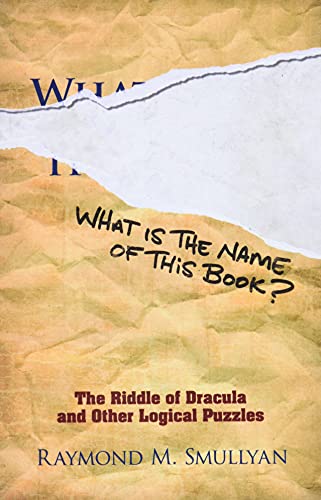
⭐This classic recreational mathematics title, based on logic problems dates back to 1978, though it feels as if it might have been written forty years earlier from the type of humour it features, a feeling enhanced by the publisher’s decision to reprint it by scanning an old edition, rather than resetting it.There is some excellent material in here, some familiar, others still with a novel edge today. There are some basic challenges – for example we’re looking at a picture and told ‘Brothers and sisters have I none, but this man’s son is my father’s son’ and asked whose picture it is, plus some catch-you-out puzzles such as asking in which country you’d bury the survivors of a plane that crashes right on the border of the US and Canada. But the meat and drink of the book is a whole slew of puzzles where we are required to deduce something from a set of logical statements.Many of these puzzles are based on variants of a situation where there are two different kinds of people, one type who who always lies and the other type who always tells the truth (sometimes there is a third kind who might do either). These problems come in all sorts of variants featuring knights and knaves, Dracula, zombies and more, but the basic principles are aways the same, though the combinations become more and more convoluted. There are also a very similar feeling set of puzzles where a number of statements are put against each other, such as caskets with labels on that indicate between them where treasure is located. And we also get some consideration of the extremes where logical statements become meaningless, such as ‘This statement is false.’The truth/lie problems take up significantly more than half of the book, and after the first few I did find these too much like work rather than fun and couldn’t be bothered to work them out. The fun in mathematical puzzles and diversions comes from novelty – when you are presented with one problem after another that is just a variant on the previous one, it becomes hard to retain much enthusiasm.There were also some examples of logic problems that suffer very badly from the ‘only one solution’ fallacy, which can be a failing in mathematicians. One that’s in the book involves a person who every day leaves his flat on (say) the 25th floor and every evening comes home but gets out on (say) the 23rd floor. Why? Raymond Smullyan gives us the traditional ‘right’ answer – but I’ve used this as an exercise in creativity sessions and had more than 20 right different, equally valid, right answers proposed. This is the difference between problems set in the real world and those in a mathematical world where you can have someone who ‘always lies’.There’s also something of an oddity in that Smullyan repeatedly asks us through the book ‘What is the name of this book?’ I was expecting some kind of clever-clever response like ‘What’ (because ‘What’ is the name of this book), although the question mark at the end of the title rather precludes it being a statement. But Smullyan responds ‘Well, the name of the book is “What is the Name of This Book?”. Since that is what’s printed on both the cover and the spine, it’s hard to be surprised. I can only guess that, since the illustration has most of the title ripped off, that the original version didn’t also have the full title printed on it. Otherwise it’s a very limp ending.Overall, there’s some excellent material here, but if you stripped out the dated humour and the repetition of variants on the same problem, what’s left is probably not much more than a long magazine article.
⭐I wish i could live in the same world as Raymond Smullyan! How does he get the time to think up these conundrums? Well, mostly it is his day job, and he gets paid to chat about these things to other academics. But what conversations! How i would love to be there. All of these problems are about language and how we use it, especially the words “true” and “false” and “lie”, and about how complicated things can get if you think about those words hard enough — while being far from dryasdust. you are drawn into a world where you have to think of a way of checking that your travelling companion is not a vampire, where you have a logical proof that Santa Claus exists, and Inspector Craig of Scotland Yard shows you how to analyse the meagre facts you have on suspects. My advice is buy this book, and lend it to nobody.
⭐Many years ago I used to own Smullyan’s excellent book “What is the mane of this book” which was an introduction to logic explained via logic problems. I lost this book so I ordered its again Even though it was the same author and title this is a different book! Still quite fun but not as instreuctive.
⭐A great problem solving book. A good brain work out
⭐Excellent book. It scales perfectly until you acquire a strong background on logic riddles.
Keywords
Free Download What Is the Name of This Book?: The Riddle of Dracula and Other Logical Puzzles (Dover Recreational Math) in PDF format
What Is the Name of This Book?: The Riddle of Dracula and Other Logical Puzzles (Dover Recreational Math) PDF Free Download
Download What Is the Name of This Book?: The Riddle of Dracula and Other Logical Puzzles (Dover Recreational Math) 2011 PDF Free
What Is the Name of This Book?: The Riddle of Dracula and Other Logical Puzzles (Dover Recreational Math) 2011 PDF Free Download
Download What Is the Name of This Book?: The Riddle of Dracula and Other Logical Puzzles (Dover Recreational Math) PDF
Free Download Ebook What Is the Name of This Book?: The Riddle of Dracula and Other Logical Puzzles (Dover Recreational Math)