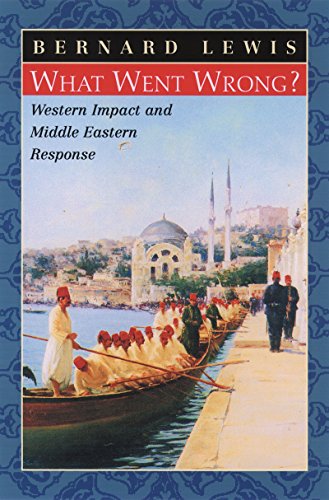
Ebook Info
- Published: 2002
- Number of pages: 188 pages
- Format: PDF
- File Size: 2.15 MB
- Authors: Bernard Lewis
Description
For many centuries, the world of Islam was in the forefront of human achievement–the foremost military and economic power in the world, the leader in the arts and sciences of civilization. Christian Europe, a remote land beyond its northwestern frontier, was seen as an outer darkness of barbarism and unbelief from which there was nothing to learn or to fear. And then everything changed, as the previously despised West won victory after victory, first in the battlefield and the marketplace, then in almost every aspect of public and even private life.In this intriguing volume, Bernard Lewis examines the anguished reaction of the Islamic world as it tried to understand why things had changed–how they had been overtaken, overshadowed, and to an increasing extent dominated by the West. Lewis provides a fascinating portrait of a culture in turmoil. He shows how the Middle East turned its attention to understanding European weaponry and military tactics, commerce and industry, government and diplomacy, education and culture. Lewis highlights the striking differences between the Western and Middle Eastern cultures from the 18th to the 20th centuries through thought-provoking comparisons of such things as Christianity and Islam, music and the arts, the position of women, secularism and the civil society, the clock and the calendar.Hailed in The New York Times Book Review as “the doyen of Middle Eastern studies,” Bernard Lewis is one of the West’s foremost authorities on Islamic history and culture. In this striking volume, he offers an incisive look at the historical relationship between the Middle East and Europe.
User’s Reviews
Reviews from Amazon users which were colected at the time this book was published on the website:
⭐I bought this book after the horrific events of September 11 caused me to wonder how any faith, no matter how militant, could justify the murder of innocents. I am a retired lawyer and, when I had the time, pursued the study of history as a hobby. I do that a lot now. I understand this country’s strengths and weaknesses, and found it beyond belief that we could be hated with such intensity, and that any religion or political philosophy could endorse such obscene behavior. Professor Lewis answers this question with his recognized expert understanding of a failed civilization. While Europe foundered into the dark ages following the fall of Rome, education, much of it from the far east, flourished in the Muslim world. But Western Civilization, largely as a result of the religious wars of the 16th and 17th centuries, secularized government. The Muslim world has not done so to this very day, nor has it pursued scientific inquiry, music or literature, as was the case in the West. Lewis points out that other than seeking to learn about the West’s military techniques after suffering a chain of defeats, science,technology, music and the arts were not important to a people who centered their lives on a medieval, militant religion. One of the first collisions between Islamic thought and that of the West arose from the latter’s elimination of the slave trade. Slavery, to Islamic ways, was approved by Allah, and thus was not an evil practice.It was a troubling collision of ideas to the East, which has not been fully resolved to date. Lewis helps us to understand that this same antiquated thinking collides with Western enlightenment with respect to the status of women. It is in the area of personal rights and status that brings this failed belief system into profound conflict with Westernism. This is a powerful little book. Nomatter how much one may enjoy certain cultural aspects of the Middle East, the tension and hostility will not be eliminated easily. When one combines the frustration of a failed civilization seeking to return to a glory that has not existed for centuries, a religion that is based on and immured in medieval philosophy, and a substantial number of people who believe that any action against the “infidel” (that’s us, folks), no matter how horrific, is morally good, there results a recipe for disaster. Thinking Americans should read and re-read this book. Understanding promotes good decision making, and as our nation moves further into its war on terrorism, our society has a real need for thinking Americans, both as decision makers, and as voters who elect them.
⭐I finished this book in about a week (it’s only 161 pages not including notes and index), but the vital information it conveys to understanding the rise and fall of the Ottoman Empire and the rest of the Middle Eastern off-shoot empires is phenomenal. Negative reviewers of this book probably don’t want to take an honest look at this situation despite their praise for Bernard Lewis’ other works, and have fallen victim to cultural relativism. Highly recommended.
⭐This is a brilliant book by a renowned expert, Bernard Lewis. He is a professor of Near Eastern studies at Princeton University. And, so it may surprise some readers to discover just how readable this, his most recent book, is.Although this was written prior to 9/11, it could not be timelier. This is a timely read if you want if know about the culture that expanded from its roots in Mecca and Medina to one that ruled the Mid East, northern Africa, Spain, and Portugal and finally knocked at the gates of Vienna, not once, but twice. It is a history that we are dealing with today. Bernard Lewis presents a compelling argument that as military failures occurred, one explanation that took root in the Islamic world was that God was displeased because Muslims were not leading lives in accordance with God’s wishes. Religious leaders became more powerful, and culture became more insulated. They seem to have been disinterested in Europe.This is a timely read, if you want to know about the culture that saw no rights for slaves, infidels, and women in the 7th century, and sees not need to change that stance even in the 21st century.This is a timely read if you want to understand just what questions are being asked and answered. Is the question “What went wrong?” or is it “Who did this to us?” One answer leads to taking corrective actions and implementing change, the other answer leads to blaming others. I think that Professor Lewis does address what went wrong. What he does not do is this… he does not present us with a solution of how to fix it. He does not tell us how we can survive together… or even if we can.I highly recommend this book.
⭐…”The book is just a re-hashing of some lectures”. Yes, indeed it feels that way, by slightly disjointed manner in which chapters follow each other. But Lewis never hides it! On contrary, he puts it right up front in the book. And what’s wrong with well-edited and prepared lectures, that are , by the way, very good?”He doesn’t answer the question he poses”. Well… Dear fellow readers, we are looking at a subject of two mighty, over-millenium-old cultures in conflict. If someone expected easy answers to that – they were mistaken. I took this book for what it is – food for thought (a lot of it, to be sure). Read more, and more, and more; talk to other people; think. Then the answers may start coming to you.”Lewis is a mouthpiece of Turkish government”. Unless Lewis uses some code language in his book, that makes many innocent- (or informative-) looking words and phrases take an entirely new meaning – I did not notice _any_ of that. He seems to be objective and fair, dedicating a great deal of time to discussing how those same Turks (represented by Ottoman Empire in those days) played large role in Muslim world’s losing contest to the West.After answering these – I feel I’ve got nothing more to add…Four stars instead of five – this collection of lectures is several notches down from being brilliant enough to rank equal with a well-conceived and executed book.
⭐Good book with tons of details. S/he has good knowledge about Islam.
⭐It may come as a surprise to some but the Arab Empire was at a time at the forefront of civilisation and science when Europe was going throughits Dark Ages. Moreover, cities such as Cairo were once known for their tolerance and sexual permissiveness, a far cry from what the situation is today.The book seeks to explain why a civilisation which reached such heights is today at this sorry state. It does so convincingly.
⭐A comprehensive look at the decline of the power of the Middle Eastern countries from a position of dominance to one of having fallen behind Western countries and what is needed go cast off the shackles of some types of thought
⭐I think I now know why Islamic nations are so out of step with the western world even though they once led it.
⭐Must buy MUST READ
⭐Excellent oversights, with plenty of historical background.
Keywords
Free Download What Went Wrong?: Western Impact and Middle Eastern Response 1st Edition in PDF format
What Went Wrong?: Western Impact and Middle Eastern Response 1st Edition PDF Free Download
Download What Went Wrong?: Western Impact and Middle Eastern Response 1st Edition 2002 PDF Free
What Went Wrong?: Western Impact and Middle Eastern Response 1st Edition 2002 PDF Free Download
Download What Went Wrong?: Western Impact and Middle Eastern Response 1st Edition PDF
Free Download Ebook What Went Wrong?: Western Impact and Middle Eastern Response 1st Edition