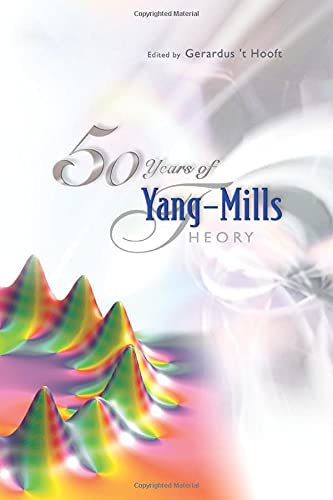
Ebook Info
- Published: 2005
- Number of pages: 498 pages
- Format: PDF
- File Size: 25.06 MB
- Authors: Gerard ‘T Hooft
Description
It was a brilliant idea to signal the 50th birthday of Yang-Mills theory by gathering together a wide range of articles by leading experts on many aspects of the subject. The result is a most handsome tribute of both historical and current interest, and a substantial addition to the existing literature …This unusual and elegant festschrift is a treat for theorists.CERN CourierOn the 50th anniversary of Yang-Mills theory, this invaluable volume looks back at the developments and achievements in elementary particle physics that ensued from that beautiful idea.During the last five decades, Yang-Mills theory, which is undeniably the most important cornerstone of theoretical physics, has expanded widely. It has been investigated from many perspectives, and many new and unexpected features have been uncovered from this theory. In recent decades, apart from high energy physics, the theory has been actively applied in other branches of physics, such as statistical physics, condensed matter physics, nonlinear systems, etc. This makes the theory an indispensable topic for all who are involved in physics.An international team of experts, each of whom has left his mark on the developments of this remarkable theory, contribute essays or more detailed technical accounts to this volume. These articles highlight the new discoveries from the respective authors’ perspectives. The distinguished contributors are: S Adler, F A Bais, C Becchi, M Creutz, A De Rújula, B S DeWitt, F Englert, L D Faddeev, P Hasenfratz, R Jackiw, A Polyakov, V N Popov, R Stora, P van Baal, P van Nieuwenhuizen, S Weinberg, F Wilczek, E Witten, C N Yang. Included in each article are introductory and explanatory remarks by the editor, G ‘t Hooft, who is himself a major player in the development of Yang-Mills theory.
User’s Reviews
Editorial Reviews: Review .,.” provides an excellent historical survey of the development of Yang-Mills theory, written by those most involved in its creation.”
Reviews from Amazon users which were colected at the time this book was published on the website:
⭐Before the non-Abelian aspects of gauge theory took center stage in Y-M (Abelian reduces to Maxwell’s electrodynamics), the editor of this one of a kind volume (‘t Hooft) was central in linking chiral anomalies to the standard model, providing foundations for evaluating Yang-Mills self consistency. His numerous contributions since then also are legendary, and the stuff of Nobel prizes. And so it goes… ALL the authors of the monographs in this historic volume were center stage in refining, developing, and extending Yang-Mills. (Gauge in this context refers to Lagrangian degrees of freedom, symmetries, Lie groups, etc.).Half a century ago, the topics touched by Y-M might actually have been coverable in a book of 500 pages– today, only the briefest summary or introduction to the ubiquitous applications of gauge theory is possible in that space. Some authors (Sternberg, for example) claim that Y-M is as significant to particle physics as general relativity! Adding Dirac probably makes his view a good bet given where all aspects of gauge theories have now gone, even in pure math, let alone explaining three of the four big question marks in the standard model (QED/strong and weak with gravity soon to follow, hopefully!).The somewhat strange thing about those who are beginning to attribute many aspects of a unified theory to Y-M plus Dirac is that at one point the Greeks believed that Geometry explained the entire universe. What comes around goes around? The topological and geometric aspects of Y-M speak of a pattern of cosmic irony– making those of us who think we’ve advanced so far since then do a double take about geometry– now not only in molecular structure, but in the tiniest and most energetic particles as well as their quantum models, from supergravity to gauge/string duality, twistor space, etc.Because of the topic, the book is naturally a zoology of particles, including much of the very most recent experimental designs, lattices, etc. The math is very abbreviated for the sake of coverage, and much is PhD level, but far from being wholly calculative, many articles describe accelerator and detector experiments and results, giving an amazing trail of validation to Y-M that couldn’t have been imagined only a few decades ago. In fact, the early skepticism (a “boson???”) of many have been silenced with the amazing array of particle and decay results predicted and proven. Some of the monographs have 80 to 100 references each, many to recent publications. There is no master index, so this is truly a “pick and choose” cornucopia of Y-M topics the reader can select as interest dictates.If you’re going into particle physics, this book is a must. In one place, it gives not only the history of the most important idea since QED and GRT, but also the people who have and are expanding Y-M to places no one imagined just a couple decades ago. Instead of looking up citation scores, this one book will give you the whos who of today’s most current research in one place! The math is daunting and not for undergrad level, but if you’re specialized in an area, the presentation is thorough enough to follow, with many ideas for where the next stages of research in that area are trending. Y-M itself, because of its nature, requires advanced tensor calc, deep facility with Fourier methods and manifolds, and of course topology. As dimensions get higher, Y-M just seems to get better and better.Perhaps the Greeks were right about Geometry being the key to the Universe after all, just not the Geometry they imagined!! One quote that particularly highlights this, and tickled me, is a well known Physicist who, after giving numerous mathematical underpinnings and copious accelerator and detector results, says: “In fact, this is even seen in Nature…” And you think YOU live in a world of your own!!! Is this anything like looking over a vast landscape of Natural beauty, seeing a number of parallel lines, and assuming “people must be here?” Straight lines are common in particle physics, but the eyes seem to prefer fractals at our everyday level! Perhaps Y-M’s magical linearization of certain curves does offer even deeper mysteries to explore.
⭐I was disappointed in this book as it is mostly just a reprinting of papers published over the last 50 years.
Keywords
Free Download 50 Years Of Yang-Mills Theory in PDF format
50 Years Of Yang-Mills Theory PDF Free Download
Download 50 Years Of Yang-Mills Theory 2005 PDF Free
50 Years Of Yang-Mills Theory 2005 PDF Free Download
Download 50 Years Of Yang-Mills Theory PDF
Free Download Ebook 50 Years Of Yang-Mills Theory