Ebook Info
- Published: 2006
- Number of pages: 208 pages
- Format: PDF
- File Size: 1.71 MB
- Authors: Lee Alan Dugatkin
Description
In a world supposedly governed by ruthless survival of the fittest, why do we see acts of goodness in both animals and humans? This problem plagued Charles Darwin in the 1850s as he developed his theory of evolution through natural selection. Indeed, Darwin worried that the goodness he observed in nature could be the Achilles heel of his theory. Ever since then, scientists and other thinkers have engaged in a fierce debate about the origins of goodness that has dragged politics, philosophy, and religion into what remains a major question for evolutionary biology.The Altruism Equation traces the history of this debate from Darwin to the present through an extraordinary cast of characters-from the Russian prince Petr Kropotkin, who wanted to base society on altruism, to the brilliant biologist George Price, who fell into poverty and succumbed to suicide as he obsessed over the problem. In a final surprising turn, William Hamilton, the scientist who came up with the equation that reduced altruism to the cold language of natural selection, desperately hoped that his theory did not apply to humans.Hamilton’s Rule, which states that relatives are worth helping in direct proportion to their blood relatedness, is as fundamental to evolutionary biology as Newton’s laws of motion are to physics. But even today, decades after its formulation, Hamilton’s Rule is still hotly debated among those who cannot accept that goodness can be explained by a simple mathematical formula. For the first time, Lee Alan Dugatkin brings to life the people, the issues, and the passions that have surrounded the altruism debate. Readers will be swept along by this fast-paced tale of history, biography, and scientific discovery.
User’s Reviews
Editorial Reviews: From Publishers Weekly If evolution involves a competition for survival, then how can we explain altruism? Biologist Dugatkin (Cheating Monkeys and Citizen Bees: The Nature of Cooperation in Animals and Humans) splendidly narrates a fast-paced tale of scientific breakthrough, genius and intellectual history as he examines the lives of seven scientists—from T.H. Huxley through Richard Dawkins and E.O. Wilson—whose groundbreaking work attempts to answer this question. Darwin’s “bulldog,” T.H. Huxley, believed altruism was rare, and that blood kinship provided the key to an evolutionary understanding of altruism. The Russian anarchist Prince Pyotr Kropotkin, on the other hand, believed altruism was widespread and unrelated to kinship. But the idea of the kinship link won out, and in the 1960s, William Hamilton developed a cost-benefit analysis to explain the genetic basis of altruism: “If a gene for altruism is to evolve, then the cost of altruism must somehow be balanced by compensating benefits to the altruist.” Stephen Emlen of Cornell has found remarkable evidence of Hamilton’s Rule in his studies of bee eaters in Kenya. The impact of Hamilton’s Rule “on evolutionary biology has been as great as the impact of Newton’s laws of motion on physics,” says Dugatkin. This superb tale of scientific discovery is required reading for everyone interested in the nature of human morality. (Oct.) Copyright © Reed Business Information, a division of Reed Elsevier Inc. All rights reserved. Review “If evolution involves a competition for survival, then how can we explain altruism? Biologist Lee Dugatkin splendidly narrates a fast-paced tale of scientific breakthrough, genius and intellectual history as he examines the lives of seven scientists . . . whose groundbreaking work attempts to answer this question. . . . This superb tale of scientific discovery is required reading for everyone interested in the nature of human morality.” ― Publishers Weekly”Exhilerating. . . . [This] is an engaging book with devoted enthusiasm for the ideas of the main protagonist, William Hamilton. . . . Dugatkin’s . . . account offers much to think about.”—Caroline Ash, Science”Dugatkin’s biographical sketches . . . are entertaining and insightful. . . . [T]here is little doubt that efforts to explain altruism and morality in formal scientific terms are heavily influenced by the cultures and personal histories of their proponents.”—David Sloan Wilson, American Scientist”Dugatkin tells the story . . . with clear prose and poise. In doing so he celebrates the internal consistencies of science and the beauty of clear thinking. Written for a general audience, this book provides vignettes featuring the lives of key thinkers, which foster an understanding of how the social context of the times influences the advance of scientific understanding.” ― Choice”The Altruism Equation is very well written and extremely informative. Dugatkin’s immense enthusiasm shines through every page. . . . Because the scientific concepts are explained so clearly, concisely and engagingly, newcomers to sociobiology will find The Altruism Equation an enlightening read. At the same time, it will be of interest to connoisseurs of the literature who wish to gain a panoramic view of the altruism debate. . . . The Altruism Equation is a splendid book.”—David Livingstone Smith, Evolutionary Psychology”This is a tale not only about the majesty of science, but also about the hubris of scientism. One of the greatest projects of modernity is to explain to the public where science does and does not matter, and altruism is a valuable example.”—Oren Harman, The New Republic”The Altruism Equation is a pleasure to read. Dugatkin’s explanation of the relevant science is clear and comprehensible. He also blends the scientific views of these seven scientists with their personal and professional lives in a way that enhances our understanding of both.”—David L. Hull, Isis”This book could he an especially interesting read for recent generations, who may see themselves as standing on the shoulders of their intellectual predecessors. . . . The material is carefully researched and written, and problematic issues are few.”—Daniel J. Kruger, Quarterly Review of Biology”The Altruism Equation is very good popular scientific history. It provides the non-scientist with a digestible overview of a lengthy and sometimes complex development, and offers ample leads to pursue. Most importantly, it brings science to life by showing the personalities of scientists involved as well as the background beliefs which motivated their pursuits. For those interested in jumping into this area of inquiry, there is probably no better book with which to start.”—Marc Baer. PhD, Metapsychology Online Reviews Review “The Altruism Equation is an important book in many different ways. It is important because it tackles a significant problem―namely, the levels at which natural selection operates. It is important because it tells a history never before revealed. And it is most important because the author’s analysis lets us all move forward on these issues, with new insights and tools of discovery. I recommend it very highly.”―Michael Ruse, Florida State University, author of The Evolution-Creation Struggle”This wonderfully written book tells the history of a conceptual revolution in evolutionary biology that fundamentally changed the way scientists think about behavior. Although I do have a slightly different perspective here and there, I enthusiastically recommend this book to everyone who wants to understand the evolutionary roots of altruism and family. This fascinating book is a page-turner for scientists and lay persons alike.”―Bert Hölldobler, author (with Edward O. Wilson) of the Pulitzer Prize-winning The Ants From the Inside Flap “The Altruism Equation is an important book in many different ways. It is important because it tackles a significant problem–namely, the levels at which natural selection operates. It is important because it tells a history never before revealed. And it is most important because the author’s analysis lets us all move forward on these issues, with new insights and tools of discovery. I recommend it very highly.”–Michael Ruse, Florida State University, author ofThe Evolution-Creation Struggle”This wonderfully written book tells the history of a conceptual revolution in evolutionary biology that fundamentally changed the way scientists think about behavior. Although I do have a slightly different perspective here and there, I enthusiastically recommend this book to everyone who wants to understand the evolutionary roots of altruism and family. This fascinating book is a page-turner for scientists and lay persons alike.”–Bert Hölldobler, author (with Edward O. Wilson) of the Pulitzer Prize-winningThe Ants From the Back Cover “The Altruism Equation is an important book in many different ways. It is important because it tackles a significant problem–namely, the levels at which natural selection operates. It is important because it tells a history never before revealed. And it is most important because the author’s analysis lets us all move forward on these issues, with new insights and tools of discovery. I recommend it very highly.”–Michael Ruse, Florida State University, author of The Evolution-Creation Struggle”This wonderfully written book tells the history of a conceptual revolution in evolutionary biology that fundamentally changed the way scientists think about behavior. Although I do have a slightly different perspective here and there, I enthusiastically recommend this book to everyone who wants to understand the evolutionary roots of altruism and family. This fascinating book is a page-turner for scientists and lay persons alike.”–Bert Hölldobler, author (with Edward O. Wilson) of the Pulitzer Prize-winning The Ants About the Author Lee Alan Dugatkin is Professor of Biological Sciences at the University of Louisville. He is the author of many books, including the popular Cheating Monkeys and Citizen Bees: The Nature of Cooperation in Animals and Humans and Model Systems in Behavioral Ecology (Princeton). Read more
Reviews from Amazon users which were colected at the time this book was published on the website:
⭐If you’ve ever wondered why parents do stuff for their children or why you feel responsible for people who you don’t know that well or just wonder why humanity in general works so damn well interacting with each other, then this is the book for you!It is very scientific and the stories and biographies that are told are interesting.
⭐A very nice summary of the quest to understand biological altruism form the early work of Darwin, to the mathematical modeling of Hamilton and others. The book captures the essence of the ideas behind the models and contains multiple, entertaining personal stories of these magnificent scientists. Overall, a terrific read, both on the scientific and human aspects of such profound question.
⭐An interesting collection of short related stories, but scarcely a mention of the actual equation, which is really trivial, or its development. Pity – a lost opportunity.A future edition could usefully include a few math appendices so the average scientist can see what all the fuss is about.
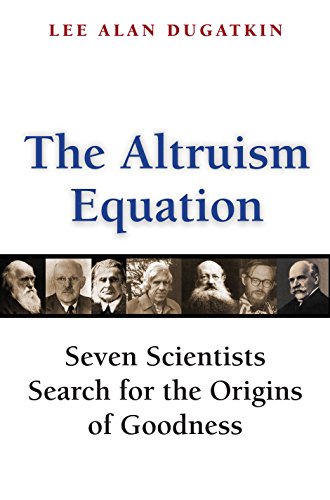
⭐The book has a fairly self-explanatory title. The Altruism Equation of the title is Hamilton’s rule – and there are seven scientists on the cover – namely Charles Darwin, Warder Clyde Allee, T.H. Huxley, William Hamilton, Petr Kropotkin, George Price and J.B.S. Haldane.The first six chapters are about these seven fellows – with the material on Huxley and Kropotkin being combined into one chapter.Then there’s three more chapters, one about the popularisation of science relating to altruism by Dawkins, Ed Wilson and others, one on extensions of Hamilton’s ideas by Emlen, Sherman and Reeve, and then the last chapter is on Robert Axelrod and his work with Bill Hamilton.The book is very readable and well written. However, the readability stems partly from the book’s use of personal narratives about the scientists involved. Personally, I really wanted less biography and more science. I ideally want a firehose presentation of the ideas involved – and this book isn’t like that – there’s quite a lot of history and biography in it.I read it because of my own interest in altruism and kin selection. I knew from the author’s previous book on imitation that he knew a few things about memes. I was interested to see how he linked memes and altruism – and memes and kin selection.However, the book isn’t a general book about altruism. It’s really a book about the history associated with Hamilton’s solution to the altruism issue involving kin selection. Though it discusses subsequent extensions of Hamilton’s ideas, the idea that kin selection and inclusive fitness theory might apply to memes as well as genes receives no coverage. Nor is there any coverage of the large effect of culture on altruistic behaviour. So: many of my hopes while reading the book were rather disappointed.I learned quite a few bits of history from the book. I already knew most of the material about Hamilton and Price, but I hadn’t even heard of Warder Clyde Allee before, and much of the unfamiliar material was interesting – it even made me expand my own thoughts about the reasons why organisms clump together.I felt as though the book had a bit of an identity crisis. It seemed as though it was a book on the general topic of altruism that had got scaled back part way through the project, so it only covered the material up to the 1970s. It wasn’t really all about kin selection – since it had a bunch of material about Axelrod, tit-for-tat and reciprocity – but then it just stopped. Since the book was written in 2006 quite a bit has happened since the 1980s – but most of that isn’t covered. I was left wondering whether there would ever be coverage of topics such as reputations, manipulation, tag-based cooperation and the impact of culture in a second volume.Anyway, despite the slight identity crisis, this is a fine and very readable book on the topic of altruism – and especially kin altruism.
⭐A beautiful gem. Short, passionate, lucid, and entertaining.This book does more than explain the history of proposed solutions to an important question. It details the personalities behind this history. One gains insights into the character of luminaries such as Huxley, Kropotkin, Price, and many others.What was the question, or puzzle?How could natural selection produce altruism in nature? It just does not seem to make sense. Intelligent Design loons are always saying as much.Fortunately, the answer has been known since 1964. The key is in William Hamilton’s ‘simple’ equation RxB-C>O.Dugatkin admirably discusses the history behind the equation and speculates as to why earlier theorists like Fisher, Haldane, or Wright did not think of it.For readers who love books like The Selfish Gene, Good Natured, or Moral Minds, this book makes a nice compliment. For those who hate math (myself!!) and want a gentle introduction to Hamilton’s rule, it is essential.If I may make one last point, I have to express some concern with the excessive obsession with quantification in some quarters. I really have not seen a difficult quantitative theory of human behavior that allowed any insights that could not be expressed in clear english. I might be wrong here, but I think the obsession with mathematical jargon keeps theorists from testing (or taking seriously) verbal arguments. Zahavi’s handicap principle is a great case in point. Nobody really put that much stock into it until Grafen mathematized the theory. Unfortunately, nobody, save a few, could understand his formulas. Well, it turns out that Grafen’s math may not be the best way to look at the problem (see Thomas Getty). So I think it wise that Dugatkin sticks to verbal exposition, and I encourage fledglings to think through their ideas with clear verbal logic before using esoteric math. If Dugatkin’s book showed me anything, it was that complex phenomena often have simple explanations. No need to make things more difficult than they need to be. (yes, I know it makes you look smart and cool to use differential equations and bayesian statistics, but cool does not mean correct.)
Keywords
Free Download The Altruism Equation: Seven Scientists Search for the Origins of Goodness in PDF format
The Altruism Equation: Seven Scientists Search for the Origins of Goodness PDF Free Download
Download The Altruism Equation: Seven Scientists Search for the Origins of Goodness 2006 PDF Free
The Altruism Equation: Seven Scientists Search for the Origins of Goodness 2006 PDF Free Download
Download The Altruism Equation: Seven Scientists Search for the Origins of Goodness PDF
Free Download Ebook The Altruism Equation: Seven Scientists Search for the Origins of Goodness