Ebook Info
- Published: 2014
- Number of pages: 274 pages
- Format: PDF
- File Size: 3.12 MB
- Authors: Tom Shachtman
Description
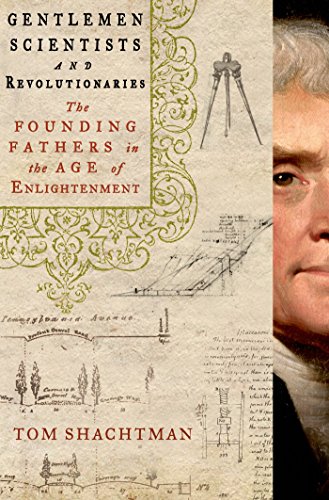
Science and experimentation were at the heart of the Founding Fathers’ philosophies and actions. The Founders relentlessly tinkered, invented, farmed by means of scientific principles, star-gazed, were fascinated by math, used scientific analogies and scientific thinking in their political writing, and fell in love with technologies. They conceived of the United States of America as a grand “experiment” in the scientific meaning of the word. George Washington’s embrace of an experimental vaccination for smallpox saved the American army in 1777. He was also considered the most scientific farmer in the country. John Adams founded a scientific society and wrote public support of science into the Massachusetts constitution. The president of another scientific society, Thomas Jefferson, convinced its leading lights to train Meriwether Lewis for the Lewis and Clark expedition; his Declaration of Independence was so suffused with scientific thinking that it was called Newtonian. Benjamin Franklin’s fame as an “electrician” gave him the status to persuade France to help America win the Revolutionary War. Thomas Paine invented smokeless candles, underwater bombs, and the first-ever iron span bridge. In Gentlemen Scientists and Revolutionaries, Tom Shachtman provides the full story of how the intellectual excitement of scientific discoveries had a powerful influence on America’s Founding Fathers.
User’s Reviews
Reviews from Amazon users which were colected at the time this book was published on the website:
⭐From this book, I learned that the Founders of our country were children of the Age of Enlightenment. They learned science in their classrooms, used an early form of smallpox vaccination (variolation) to protect the Revolutionary troops, and admired Isaac Newton (one of the founders of calculus).But I thought the most interesting topic was their view of nation-building as a science experiment. I describe this further with quotes from the book referenced by page numbers in parentheses.SCIENCE AND FAITHAmong the Founders, concurrent belief in a Deity and science was not unusual. They relied on both to understand the natural world, which included human nature, and to form a government compatible with human nature.“It is also important to note that the Founding Fathers’ science was in no way opposite to their religion. The notion that science and religion were antithetical is a nineteenth-century construct.” (p. xii)“”The Declaration’s preamble stated that the people of the new United States were assuming a station “to which the Laws of Nature and of Nature’s God entitled them.” These phrases have been variously interpreted. “Laws of Nature” is not the same thing as “natural law.” The reference to “Laws of Nature” is to rules that have emerged from observation of nature, in specific contrast to those obtained from the divinity – those laws of nature that Galileo, Newton, Boyle, Hooke, and other scientists had been discovering.””(p. 97)Shachtman also provided a quote from Carl Becker who wrote that by Jefferson’s time, God was considered “the final Cause, or Great Contriver, or Prime Mover of the universe [who revealed] his will indirectly through his creation. . . . There was no longer any way to know God’s will except by discovering the ‘laws’ of Nature, which would doubtless be the laws of ‘nature’s God,’ as Jefferson said.” (p. 97)That is, science might be a way to understand God.SCIENCE AND MORALITYScience might also be a path to understanding morality.In my Amazon review of the Great Courses video on “Natural Law and Human Nature,” I wrote that natural law seems to be an innate form of morality that was incorporated into the Declaration of Independence and Constitution, but that there may be no consensus on the source of natural law. Although Shachtman distinguishes “Laws of Nature” from “natural law,” I suspect that when analyzing human morality, “Laws of Nature” (from science) and “natural law” (from religion) may share common ground.“”As for the concepts that “all men are created equal, and endowed by their Creator with certain inalienable rights, among them life, liberty, and the pursuit of happiness,” each of these words and phrases had a basis for which scientific verity as well as legal precedent can be claimed. . . . As Boorstin suggests, “It is easy to forget that the assertion of human equality . . . was not a direct statement of a moral principle, but rather of a scientific and historical fact from which the principle [of equality] was supposed to follow.”” (p. 98)NATURAL LAW AND POSITIVE LAWI also wrote in the Great Courses review that natural law advocates believe that positive (i.e., human) law should be guided by natural law. Passages from Shachtman’s book support this.“”Jefferson . . . aligned his Declaration with the assertions about nature and its imperatives . . .”natural law” stood in opposition to laws made by man, including the monarchial system and the codification of rule by divine right.”” (p. 98)“Once men were understood to have been created equal – not born equal, but created equal by their Creator – it was logical to also believe that they possessed certain inherent and inalienable (or unalienable) rights, given to them when they were created, and not to be taken away by any human being.” (p. 98)WHERE DO WE GO FROM HERE?The materials that I reviewed in Amazon suggest that:1) science is a useful tool to better understand human nature (presumably one of God’s creations),2) a better understanding of human nature may help in the development of positive laws that are more compatible with human nature,3) this compatibility may facilitate the governed’s willingness to follow these positive laws,4) the governed want equality of conditions or fairness, and5) this innate desire for fairness is related to natural law.America’s success is based, at least partly, on reason balanced by faith and morality. In fact, Walter Isaacson (author of Steve Jobs, etc.) believes that we will benefit greatly from the intersection of the sciences and the humanities. Maybe the Founders were already there at the intersection (or before the divergence).My question is: where do we go from here?“”Washington explained to a learned friend: “Should the proposed government be generally and harmoniously adopted, it will be a new phenomenon in the political & moral world; and an astonishing victory gained by enlightened reason over brute force.”” (p. 162)Shachtman wrote: “The evidence-based spirit in which the Constitution had been constructed, the debates over its adoption, and the symbolism accompanying its acceptance all emphasized the process by which the old hypothesis about how the best government ought to work had been tested, the positive and negative results of experience incorporated into a revised theory, and that theory newly codified and promulgated. In the future, should the Constitution, that embodiment of the theory, not prove able to best govern the country, it would be similarly refined to take into account new facts – that was the way science proceeded, and it was to be the American way.” (p. 164)Today’s traditions were likely yesterday’s innovations. In my Amazon review of the Great Courses video on “The Great Debate: Advocates and Opponents of the American Constitution,” I wrote that the Federalists were innovators. They learned from the past; they did not live in it. Following in their footsteps, we will continue to learn, change, and improve because our collective human nature seems to naturally operate this way.
⭐I just started reading this book and have found it very enjoyable so far, I hope the rest is just as good
⭐This was a very interesting book with an interesting way of looking at the history of the American Revolution. It was a bit dry and failed to follow any individual very well so suffers from a lack of focus but was otherwise a good book and a nice read.
⭐Good book. It is rather difficult to read in places at first because it attempts to include details on a large number of significant people, but over the course of the book the general trends become apparent. The topic is clearly important and so it is a timely reminder of how scientific knowledge and effective management of real life situations can be directly related. Long live the scientific revolution.
⭐Emphasizes a facet of the founding fathers not often treated in conventional histories.
⭐Extremely interesting book.
⭐Good delivery, good condition.A historical presentation of the wide scientific horizons of our revolutionary founders.They were active in the discovery, communication, and popularization of the world-class science and enlightenment philosophy of their day.Already a classic!
⭐Eventhough I have a pretty good knowledge of the formation of the Liberal State and the beginning of USA, the exposition and the information in this book was beyond my expectation.
Keywords
Free Download Gentlemen Scientists and Revolutionaries: The Founding Fathers in the Age of Enlightenment in PDF format
Gentlemen Scientists and Revolutionaries: The Founding Fathers in the Age of Enlightenment PDF Free Download
Download Gentlemen Scientists and Revolutionaries: The Founding Fathers in the Age of Enlightenment 2014 PDF Free
Gentlemen Scientists and Revolutionaries: The Founding Fathers in the Age of Enlightenment 2014 PDF Free Download
Download Gentlemen Scientists and Revolutionaries: The Founding Fathers in the Age of Enlightenment PDF
Free Download Ebook Gentlemen Scientists and Revolutionaries: The Founding Fathers in the Age of Enlightenment