Ebook Info
- Published: 2011
- Number of pages: 123 pages
- Format: PDF
- File Size: 2.36 MB
- Authors: Erich L. Lehmann
Description
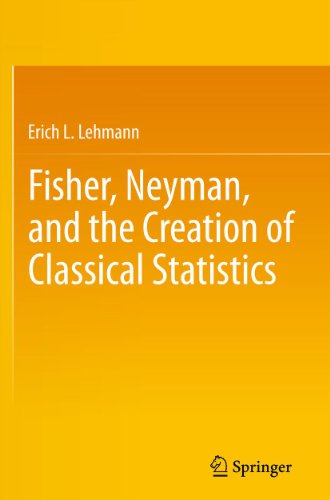
Classical statistical theory—hypothesis testing, estimation, and the design of experiments and sample surveys—is mainly the creation of two men: Ronald A. Fisher (1890-1962) and Jerzy Neyman (1894-1981). Their contributions sometimes complemented each other, sometimes occurred in parallel, and, particularly at later stages, often were in strong opposition. The two men would not be pleased to see their names linked in this way, since throughout most of their working lives they detested each other. Nevertheless, they worked on the same problems, and through their combined efforts created a new discipline.This new book by E.L. Lehmann, himself a student of Neyman’s, explores the relationship between Neyman and Fisher, as well as their interactions with other influential statisticians, and the statistical history they helped create together. Lehmann uses direct correspondence and original papers to recreate an historical account of the creation of the Neyman-Pearson Theory as well as Fisher’s dissent, and other important statistical theories.
User’s Reviews
Reviews from Amazon users which were colected at the time this book was published on the website:
⭐If you need to contextualize the statistics for the social sciences this is a necessary book. I openly recommend it.
⭐Great summary of the classical statisticians.. should be read by all new Statisticians.
⭐As a statistics teacher I thought this book sounded interesting, delving into the history behind many of the now standard methods of inference from the point of view of Neyman and Fischer back in the 20’s and 30’s. But for me this book is almost too heavy on just discussing the vagaries of how their views differed without a bit more actual math to show how they each felt things like significance/hypothesis tests should be done. Rare is the math book where someone calls for MORE math to be included, but I’m halfway through the book (admittedly not all finished) and would like to better see how these two actually DID their tests to be able to compare to how I teach it today. Much of the writing refers to actual letters and communications from the statisticians themselves and then the author of the book tries to summarize the gist of what they were writing about, debating, how their views differed, etc. I guess I’d like the book to have more clearly showed how what is taken as the “standard” method for doing, say, a 1 or 2 sample T test today differs from one, or both, of Neyman’s or Fischer’s view of how it should be done with actual examples and numbers. Maybe this would be clearer to someone who already better knows how they differed in the first place and just wants to read about how these early statisticians thought about these ideas in their infancy.
⭐Fascinating read almost in the first person.
⭐great
⭐It helped me understand a lot about the founders of Modern Statistics. Great Book! Very complete! It’s just what I needed.
⭐good book, nce format, interesting content
⭐This monograph is good at what it sets out to do—trace the progress of ideas in which Fisher and Neyman laid the foundations for twentieth century statistics. It assumes a thorough knowledge of statistical theory and does not really intend to provide any further insights into disputed concepts such as hypothesis testing, the validity of Bayesian methods, etc.In this I was a little disappointed but that may be more because I did not carefully review the book’s intent before purchasing. I was hoping to gain a deeper understanding of the views of both Fisher and Neyman on such questions. Instead I got a one hundred page treatise on the history of statistical concepts.Even so, you cannot really fault a book for being what the author wanted to write. If you are interested in a history of the fundamentals of twentieth century statistics you will find the book well-researched, well-written and concise. If you are looking to understand these concepts in greater depth you will need to turn to another source.
⭐After Reading many technical books about statistics I wanted to learn more about the lives of the greatest statisticians of the 20th century. Well this book tells about the relationship between Fisher and Neyman (less about E. Pearson), starting as very collaborative and getting worse and worse through the years. I found It so interesting that I read It in a couple of days
⭐Ce livre montre superbement comment la théorie statistique moderne, dite “classique”, est née au coeur d’un petit réseau d’analystes fondateurs aussi géniaux que difficiles à vivre. Le plus sympa, c’est “Student”, nom d’emprunt de William Gosset, qui travaillait au contrôle de qualité à la brasserie Guiness. Sans être académique ou universitaire, il a trouvé le test le plus souvent utilisé en recherche appliquée. J’ai toujours trouvé que le “t” de Student avait une petite odeur de bière… Très imbu de sa personne, Ronald Fisher faisait beaucoup d’efforts pour essayer d’humiler Jerzy Neyman, immigré polonais qui prenait sans doute un malin plaisir à énerver le maître, au moins pendant la période où ils travaillaient dans le même immeuble. Mais, sans les intuitions géniales de Fisher et les démonstrations rigoureuses de Neyman, nous ne profiterions probablement pas des outils statistiques indispensables à nos recherches. La beauté pure de la science s’enracine dans les petites médiocrités des chercheurs comme les beaux arbres dans les terrains bien enrichis de fûmier.
⭐
Keywords
Free Download Fisher, Neyman, and the Creation of Classical Statistics 2011th Edition in PDF format
Fisher, Neyman, and the Creation of Classical Statistics 2011th Edition PDF Free Download
Download Fisher, Neyman, and the Creation of Classical Statistics 2011th Edition 2011 PDF Free
Fisher, Neyman, and the Creation of Classical Statistics 2011th Edition 2011 PDF Free Download
Download Fisher, Neyman, and the Creation of Classical Statistics 2011th Edition PDF
Free Download Ebook Fisher, Neyman, and the Creation of Classical Statistics 2011th Edition