Ebook Info
- Published: 2005
- Number of pages: 800 pages
- Format: PDF
- File Size: 5.00 MB
- Authors: Erich L. Lehmann
Description
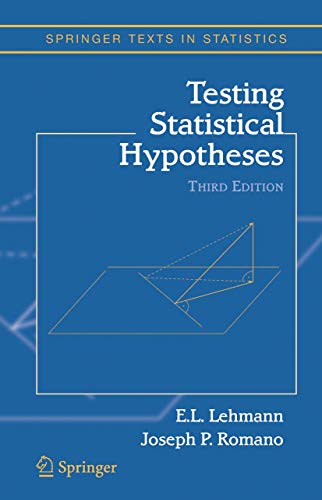
The third edition of Testing Statistical Hypotheses updates and expands upon the classic graduate text, emphasizing optimality theory for hypothesis testing and confidence sets. The principal additions include a rigorous treatment of large sample optimality, together with the requisite tools. In addition, an introduction to the theory of resampling methods such as the bootstrap is developed. The sections on multiple testing and goodness of fit testing are expanded. The text is suitable for Ph.D. students in statistics and includes over 300 new problems out of a total of more than 760.
User’s Reviews
Editorial Reviews: Review From the reviews of the third edition:”This new edition of the classic and fundamental text on the theory of testing hypotheses is an essential addition to the bookshelf of mathematical statisticians.” Short Book Reviews of the International Statistical Institute, December 2005″What I like much about this book is its illustrative language and the numerous examples that make it easier to understand the complex matter presented. The comprehensible notation and the excellent structure further add to the readability of this book.”Biometrics, March 2006″The third edition of TSH retains much of the same focus as the second edition…The quality of the new material alone justifies the publication of a third edition to a book already well suited. As readers of the earlier editions have come to expect, TSH contains an enormous number of examples, problems, and ideas. The writing and presentation are excellent.” Journal of the American Statistical Association, June 2006″This is the third edition of a famous book which was first published in 1959. The first rigorous exposition to the theory of testing for any student of statistics has been invariably through this masterpiece. … Needless to say, this book continues to be the benchmark in the rigorous treatment of testing of hypothesis. The new chapters on the asymptotic behaviour of most of the popular tests is a true value addition.” (Arup Bose, Sankhya, Vol. 67 (4), 2005)”This is a revised and expanded version of the well-known second edition from 1986 … . The exposition is clear and sufficiently rigorous. … With this edition ‘Testing Statistical Hypothesis’ will undoubtedly continue to be the standard graduate level textbook on statistical testing.” (R. Schlittgen, Zentralblatt MATH, Vol. 1076, 2006)”This monograph under review is the third edition … of Erich L. Lehmann’s classical graduate text on ‘Testing statistical hypotheses’. … the second edition from 1986 has comprehensively been reorganized … . Additional insight into the historical background and recent developments is given … . More than 1,000 original references are provided. … an excellent and demanding treatment of modern statistical test theory. There is no doubt that it remains and will even more be used as a standard monograph … .” (J. Steinebach, Metrika, Vol. 64, 2006) Review From the Back Cover The third edition of Testing Statistical Hypotheses updates and expands upon the classic graduate text, emphasizing optimality theory for hypothesis testing and confidence sets. The principal additions include a rigorous treatment of large sample optimality, together with the requisite tools. In addition, an introduction to the theory of resampling methods such as the bootstrap is developed. The sections on multiple testing and goodness of fit testing are expanded. The text is suitable for Ph.D. students in statistics and includes over 300 new problems out of a total of more than 760.E.L. Lehmann is Professor of Statistics Emeritus at the University of California, Berkeley. He is a member of the National Academy of Sciences and the American Academy of Arts and Sciences, and the recipient of honorary degrees from the University of Leiden, The Netherlands and the University of Chicago. He is the author of Elements of Large-Sample Theory and (with George Casella) he is also the author of Theory of Point Estimation, Second Edition.Joseph P. Romano is Professor of Statistics at Stanford University. He is a recipient of a Presidential Young Investigator Award and a Fellow of the Institute of Mathematical Statistics. He has coauthored two other books, Subsampling with Dimitris Politis and Michael Wolf, and Counterexamples in Probability and Statistics with Andrew Siegel. About the Author E.L. Lehmann is Professor of Statistics Emeritus at the University of California, Berkeley. He is a member of the National Academy of Sciences and the American Academy of Arts and Sciences, and the recipient of honorary degrees from the University of Leiden, The Netherlands and the University of Chicago. He is the author of Elements of Large-Sample Theory and (with George Casella) he is also the author of Theory of Point Estimation, Second Edition.Joseph P. Romano is Professor of Statistics at Stanford University. He is a recipient of a Presidential Young Investigator Award and a Fellow of the Institute of Mathematical Statistics. He has coauthored two other books, Subsampling with Dimitris Politis and Michael Wolf, and Counterexamples in Probability and Statistics with Andrew Siegel. Read more
Reviews from Amazon users which were colected at the time this book was published on the website:
⭐Seeing people commenting on this book, and either saying it is hard to read or something is missing. Honestly, every author has a point to start, and has a unique scope of knowledge. Currently, his book is probably the most encyclopedic in the field of statistical testing. Probably you will find it hard to read, but yes I admit that, reading it was and will always be a pain. Balancing between the idea in statistical decision theory and the details is hard, especially the audience of this book is not even professional statistical workers. Only when you need to dig deep into the theoretical development of statistics, this has no use to you, even if you are a faculty member teaching or researching in data science field.Reading through the books after you learn the topic will make you feel the beauty and the idea lies behind the statistics. I remembered when I read the first few sections of chapter 3 over 20 times when I learn this topic. It’s hard, but precise, and I don’t know if anyone else could explain it any better. So this book deserves your endeavor, not only your passion.Finally, as other people said, not too much detail, and some topics, are missing. However, to my belief, the topics included represents the history, that’s when they actually put statistical testing into great use, and these are the topics that has been thoroughly discussed and studied. So maybe that’s why it is a little outdated. But classic is always classic. And undoubtedly the best book to read.
⭐Lehmann and Romano is a wonderful, beautiful, necessary book for the shelf of every serious statistician, but in a few ways it is not quite right. Some important topics are omitted. At least one important topic is much more important than the book says. At least one statement, while correct, may be read incorrectly by beginners. At least one proof is unreadable.An omission is heteroskedasticity. The usual tests for 2-samples and k-samples are wrong in its presence. The same is true for the usual test for blocks and treatments. However, for all these there do exist tests which are conservative in the presence of heteroskedasticity. For 2-samples and for two treatments there are exact tests. Another omission is Doob’s inequality for nonnegative martingales, which connects up some Bayes tests with some frequentist tests.Simpson’s paradox (page 132 bottom) is treated at length in the book, but the treatment does not suffice, and there might not be any treatment which could suffice. The paradox strikes at nearly all of what statisticians do. The book ought to use big bold-face type for the statement of the paradox. Also, the book ought to include an example, not just give a reference.The account of Monte Carlo tests (page 442) may seem to suggest that Monte Carlo gives only an approximation and that its accuracy depends on how many random numbers are used. The reader is not told that Monte Carlo tests are commonly exact tests for small samples. (And where in the book is the word “exact”?)On page 353 I am entirely unable to follow the (very short) proof of Theorem 9.1.3. The complexity of the notation is perhaps responsible.
⭐This book is one of the books that every statistician regardless of Bayesian or frequentist reasoning should have and fully understand. This book is originally written by Late Eric Lehmann and is a fantastic book. I have the second edition of this book but the third edition has a lot more stuff such as goodness of fit and theory of large sampling. It is definitely worth buying the third edition. This book is one of the textbooks for the intermediate statistics course I teach.
⭐Every professional statistician should have a copy of this book. I lent my copy of the first edition to somebody I can’t remember and of course never got it back–no surprise since it is absolutely indispensable. So I purchased this third edition. It’s worth it. The book is a classic and Erich Lehmann is a genius.
⭐I found this book hard to read & maneuver around in. Maybe I should’ve gotten an earlier edition.
⭐good
⭐This text was commonly used as a graduate text in mathematical statistics in the 1970s when I was a graduate student at Stanford University. It was the best and most detailed text on the theory of hypothesis testing. Over the years it remained so and twenty years after publication, when it was outdated by research advances it was revised by Professor Lehmann. The second edition originally published by Wiley went out of print but has now been reprinted by Springer-Verlag. This is a great book for any statistician to have on his bookshelf, a must have reference!
⭐This is a textbook for theoretical statistics,which has more content than 2nd edition while the 2nd edition is concise and pointed. If it is not required to have third edition, I would rather buy the 2nd edition.I received the book after 5 days of purchase. It is pretty new and clean.
⭐Excellent book, I found everything I need.
⭐Amazing textbook, however, Ink is faint in this 3rd edition compared to the 2nd – making more difficult to read.
Keywords
Free Download Testing Statistical Hypotheses (Springer Texts in Statistics) 3rd Edition in PDF format
Testing Statistical Hypotheses (Springer Texts in Statistics) 3rd Edition PDF Free Download
Download Testing Statistical Hypotheses (Springer Texts in Statistics) 3rd Edition 2005 PDF Free
Testing Statistical Hypotheses (Springer Texts in Statistics) 3rd Edition 2005 PDF Free Download
Download Testing Statistical Hypotheses (Springer Texts in Statistics) 3rd Edition PDF
Free Download Ebook Testing Statistical Hypotheses (Springer Texts in Statistics) 3rd Edition