Ebook Info
- Published: 2009
- Number of pages: 318 pages
- Format: PDF
- File Size: 2.17 MB
- Authors: Henry P. Stapp
Description
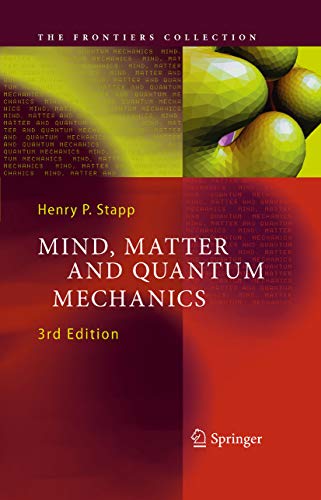
“Scientists other than quantum physicists often fail to comprehend the enormity of the conceptual change wrought by quantum theory in our basic conception of the nature of matter,” writes Henry Stapp. Stapp is a leading quantum physicist who has given particularly careful thought to the implications of the theory that lies at the heart of modern physics. In this book, which contains several of his key papers as well as new material, he focuses on the problem of consciousness and explains how quantum mechanics allows causally effective conscious thought to be combined in a natural way with the physical brain made of neurons and atoms. The book is divided into four sections. The first consists of an extended introduction. Key foundational and somewhat more technical papers are included in the second part, together with a clear exposition of the “orthodox” interpretation of quantum mechanics. The third part addresses, in a non-technical fashion, the implications of the theory for some of the most profound questions that mankind has contemplated: How does the world come to be just what it is and not something else? How should humans view themselves in a quantum universe? What will be the impact on society of the revised scientific image of the nature of man? The final part contains a mathematical appendix for the specialist and a glossary of important terms and ideas for the interested layman. This third edition has been significantly expanded with two new chapters covering the author’s most recent work.
User’s Reviews
Reviews from Amazon users which were colected at the time this book was published on the website:
⭐This book is clearly written and for a general audience. Stapp presents not only his own ideas but those of other esteemed scientists in a well organized way. There are a number of anecdotes that are interesting and give insight into how the differing points of view on the quantum measurement problem developed.The question of how to interpret quantum mechanics is not resolved and Henry Stapp has taken an approach toward it that is meant to address the question of efficacious free will and the mind/body problem. His approach is inspired by the work of John von Neumann and is neither reductionist nor solipsistic.Some very thought provoking questions are addressed in this well written book geared for an audience with some background in science.
⭐Henry Stapp has become my new favorite author in the area of quantum mechanics. I’ve read and reread the book and enjoy it tremendously. He has the ability to write lucidly and come to the point quickly. I learned more from Stapp on this topic than I learned in my previous 15 years of reading on this topic.
⭐Though there is a fair amount of redundancy in this collection of papers originally published from the late 1960s to about 1990, I found the redundancy useful in coming to grips with the novel interpretations posited by Stapp. His primary thesis — stunning in its simplicity — is that consciousness can be usefully construed as the collapse of a superposition of brain states. Unlike the more mystical folks writing on quantum physics and consciousness, Stapp provides a number of highly technical examples of exactly how this process might work neurophysiologically. Essentially, his ideas are an explicit working-out of Heisenberg’s ontology joined with William James’ concepts. This brilliant and difficult book well rewards the effort necessary to master its ideas. It is, I believe, the most sophisticated attempt yet to explain consciousness in quantum mechanical terms, far superior to more naive dualist attempts such as those by Eccles and Popper.
⭐Awesome. Mind blowing concepts.
⭐Henry Stapp is an American physicist, well-known for his work in quantum mechanics.He states in the Preface to this 1993 book, “This volume brings together several works of mine that aim to answer the question: How are conscious processes related to brain processes? My goal differs from that of most other quantum physicists who have written about the mind-brain problem. It is to explain how the content of each conscious human thought, as described in psychological terms, is related to corresponding processes occuring in a human brain, as described in the language of contemporary phyical science.”Here are some representative quotations from the book:”The commitment here is, I believe, to the appropriateness, in quantum theory, of a classical description of the experimental conditions, rather than to the fundamental accuracy of classical ideas at the macroscopic level. This position is in complete accord with pragmatism.” (Pg. 63)”Man’s free will is no illusion. It constitutes his essence. And it rests upon the law of necessity. Any play of chance would falsify the idea that I, from the ground of my essential nature, make a true choice.” (Pg. 91)”The second problem is that, owing to a failure of an essential condition of isolation, quantum theory, as developed for the study of atomic processes, does not apply to biological systems, such as brains.” (Pg. 147)”Science this provides man with at least the rudiments of a cohesive view of nature in which his own thoughts and actions are integral parts of a universe that generates meaningful options via the laws of nature, but is not rigidly controlled by these laws.” (Pg. 196)
⭐Henry P. Stapp fasst in diesem Buch einige Aufsätze und Artikel über Quantentheorie und Bewusstsein zusammen, die er im laufe der Jahre zu verschiedenen, nicht immer leicht im Original zugänglichen Publikationen beigesteuert hat.Um es vorweg zu nehmen: Für mich als hoch interessierten, mathematisch nicht völlig unbeleckten, aber keinesfalls in Quantentheorie bewandertem Leser war vieles durchausch schwere Kost, Teile blieben unverständlich. Trotzdem arbeitete ich mich mit Gewinn durch dieses Buch. Stapp fasst meist zu Beginn eines Kapitels oder eines Abschnitts in leichtfasslichen Worten die Grundlagen zusammen. Dies gibt oft einen hervorragenden, präzisen und wissenschaftlich wasserdichten Ansatz zum Verständnis.Allerdings sei nicht verschwiegen, dass der Autor manchmal neue Symbole in Gleichungen einführt, ohne sie zu erklären, wohl in der Annahme, auch der dümmste Leser müsse z.B. wissen, was “tr” in einer Gleichung bedeute. Oder es werden mit der Formulierung “Nun sind ja …” irgendwelche Zusammenhänge hergestellt, die offenbar schlicht vorausgesetzt werden, die ich aber als aus der Luft gegriffen empfand. Hier zeigen sich die Limiten von Stapp als populärwissenschaftlichem Autor (und die Limiten des Ökonomen zum Verständnis Quantentheoretischer Grundgleichungen…).Ich habe das Buch gekauft, weil ich am Zusammenhang von “mind” und “Gehirn” interessiert bin und verschiedene Quellen hier die Quantenphysik ins Spiel bringen. Dafür hat es sich gelohnt.Insgesamt eine gemischte Erfahrung. Jedenfall: Wenn Sie nicht hart im nehmen sind, dürften Sie wenig Freude an dem Buch haben.
⭐
⭐通常、この類のテクニカルな本は、もしそれが世の学者の注目を浴びたものならば、ブックカバー(裏表紙)にその賞賛の辞が複数書かれる。しかし、この本にはそれがない。その意味ではこの本の内容に賛同した著名な学者はいないのだろう。しかし、この本には歴史的に貴重な資料が含まれている。それは、量子力学の生みの親の一人、ハイゼンベルグと著者の、この本のテーマに関しての私信が含まれていること。私はこの本を必要があって読んだ。最近、技術論文を或る科学誌に投稿した際に、審査員からコメントがあり、それに応えるために題記のテーマに関わる調査が必要になった。このテーマの科学的知見の現状を知る上では役にたった。しかし、読んでみて、この本の章構成は、読者には大変混乱を与える。その理由はおそらく、この本の初版が1993年に書かれ、これが第3版(2009年)であることにあるのだろう。著者(カリフォルニア大ローレンスリバモア研所属)は、健在ならば、おそらく80歳台の後半にあり、本の新たな構成が困難なのだろう。量子力学の解釈は、ニールス・ボーアによる世に言うコペンハーゲン解釈以来、議論の多いテーマで、アインシュタインの「EPRパラドックス」、シュレディンガーの「猫のパラドックス」の論文を生んだ。これらのパラドックスに応えようとして、1957年プリンストン大のPh.D.候補(Everett)が書いた論文「Many-Worlds Interpretation」は、「並行宇宙論(パラレルユニバース)」を生むきっかけとなった。これらの事情から、私は4つ星に評価した。
⭐
Keywords
Free Download Mind, Matter and Quantum Mechanics (The Frontiers Collection) 3rd Edition in PDF format
Mind, Matter and Quantum Mechanics (The Frontiers Collection) 3rd Edition PDF Free Download
Download Mind, Matter and Quantum Mechanics (The Frontiers Collection) 3rd Edition 2009 PDF Free
Mind, Matter and Quantum Mechanics (The Frontiers Collection) 3rd Edition 2009 PDF Free Download
Download Mind, Matter and Quantum Mechanics (The Frontiers Collection) 3rd Edition PDF
Free Download Ebook Mind, Matter and Quantum Mechanics (The Frontiers Collection) 3rd Edition