Ebook Info
- Published: 2007
- Number of pages: 210 pages
- Format: PDF
- File Size: 2.04 MB
- Authors: Henry P. Stapp
Description
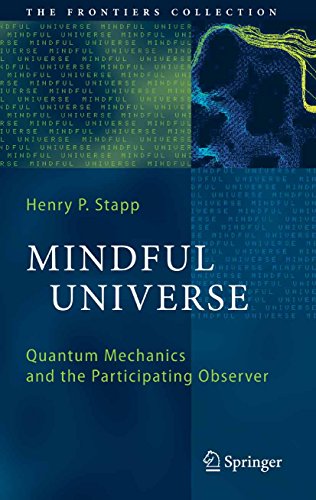
The classical mechanistic idea of nature that prevailed during the eighteenth and nineteenth centuries was essentially mindless: the physically described aspects of nature were asserted to be completely determined by prior physically described aspects alone, with conscious experiences entering only passively. In the last century these classical concepts were found inadequate. In the new quantum mechanics theory, conscious experiences enter into the dynamics in specified ways not fixed by physically described aspects alone.
User’s Reviews
Reviews from Amazon users which were colected at the time this book was published on the website:
⭐The book takes for granted that the Copenhagen Interpretation (CI), a probabilistic interpretation of quantum mechanics, is the only true interpretation, regardless of the fact that quantum mechanics is per-se deterministic. In order to explain, using the CI, certain non-local quantum phenomena, like quantum entanglement, free-will and the concept of mind become necessary boundary conditions to a theorem, Bell’s Theorem, that somewhat suggests that if reality is made of causally-disconnected events, then entanglement does not need superluminal transfers of information. The concept of mind is thought and explained as some sort of intrinsic will that quantum particles have, and that for some reason allows humans to directly understand and measure reality: or in other words, some sort of super-power that we possess, which is to the very least a matter of religious, rather than scientific debate. Overall, it’s a book that wants to indoctrinate people by drawing bold, want-to-be-scientific conclusions that cannot truly be drawn because of the inevitably flawed experimental settings aimed to prove the correctness of the desired hypotheses.
⭐A book that is pretty scientific in essence inquiring new limits in our knowledge and question materialism in a both empirical and rational way, every penny worth it, There’s a lot of physicists with idealistic trends, Böhr, Schrödinger, Heisenberg, Pauli, Wigner, Neumann, Wheeler, Davies, Linde and so onPS: Pretty sad and above all uninformed comment about the guy that thinks this is not scientific at all and doesnt question any metaphysical assumption, a naive realism, not a drop of skepticism and materialist dogmatism
⭐Henry Stapp delivers important ideas that should be shouted out from the roof tops. He gives a scientific explanation on how free will can operate and make decisions with the physical brain as a tool. While most scientists are stuck in an obsolete world view based on classical physics from the 19th century, Stapp shows how quantum physics offers explanations on the relationship between the mind and the physical brain. Too bad that much of the content is wrapped up in difficult language. I guess other scientists on the same level as Stapp will understand it, but I had a hard time with the long sentences. But I got the message, and hopefully some authors will popularize the ideas put forth by this eminent scientist.
⭐With apologies to string theory, what many of us are really looking for in buying physics books is a coherent, comprehensible ontology of quantum mechanics, the bedrock of the field. Since quantum mechanics radically alters our relationship to nature, including to our own minds, we want to know what’s going on not with material phenomenology so much as ontological implications; we want at least the basis of a quantum philosophy.Stapp delivers in this book: “The quantum concept of man, being based on objective science available to all, rather than arising from special personal circumstances, has the potential to undergird a universal system of basic values suitable to all people, without regard to the accident of their origins.” (p. 140) He clads his studies in iron by working exclusively within orthodox quantum mechanics–John von Neumann’s mathematical treatise on the subject published in 1932. There are other books out there that use the von Neumann treatment to coax ontological meaning out of the mathmatics: “The Self-Aware Universe” by Amit Goswami perhaps being the most well-known. But no one else who is doing this has Stapp’s pedigree as a deeply experienced quantum physicist who worked with the likes of Wolfgang Pauli and Heisenberg himself.Within their context in this book are evaluations and ideas you can’t find anywhere else, and I await anxiously Stapp’s next book.
⭐Outstanding! Henry Stapp is a leader in pushing the boundaries of science research and classical physics to describe highly subjective states of consciousness and neural correlates.
⭐For a physicist, Stapp is an amazingly clear writer. Something needs to account for the collapse of the wave function. Stapp believes the universe has a mind. As of this moment, this hypothesis is as good as any.
⭐I have found this book to be very well written and thought provoking. I love a book that makes you think and that brings up points of view that perhaps you haven’t considered before. This book certainly makes you ponder how your thoughts actually affect the Universe, excuse me, Multiverse. No longer are we just passive bystanders but rather hopeful co-creators. This is on a grand scale as well as a micro scale. So go ahead…stretch your brain a little…it might hurt at first to use muscles that you might not have used in a long while (trust me I know!) but you’ll thank me later!(lol)
⭐as expected. good book, fast delivery service. recommended.
⭐This has been one of the clearest explanations of quantum mechanics that I have ever read, and the now obvious inclusion of consciousness as a fundamental aspect of quantum mechanics. Great book and a great read. Highly recommended.
⭐There is currently an emerging discipline bringing together neuroscience and quantum mechanics to answer that age-old question: what is the mind, and how does it relate to matter? This emerging discipline, known as ‘quantum theories of mind’, is currently split between various propositions about how quantum physics relates to the mind, one major proposition being the ‘interactive dualism’ proposed by Henry Stapp and described in this book. (If you are interested in other approaches, I recommend ‘The Emperor’s New Mind’ and ‘Shadows of the Mind’ by Roger Penrose, ‘Quantum Brain Dynamics and Consciousness: An Introduction’ by Mari Jibu and Kunio Yasue, and ‘Wholeness and the Implicate Order’ by David Bohm.)Stapp’s theory focuses on the orthodox Copenhagen interpretation of quantum mechanics and, specifically, its mathematical reformulation by von Neumann, the basic idea of which is that the position and momentum of a microscopic particle at the Planck scale (and perhaps, in principle, the whole of reality) can only be described in terms of probabilities until the ‘wave function’ is ‘collapsed’ by observation or measurement. He argues that this makes consciousness itself a crucial aspect of our explanation of the everyday reality in which we live, since a conscious observer is required for the probabilistic quantum reality described by the Schrodinger equation to collapse into the ordinary, classical reality in which we spend our day-to-day lives. While there are flaws in his theory, and while the above description is necessarily a vast oversimplification of Stapp’s thought, the above ideas are crucial reading for anybody interested in the mind-body problem in philosophy, in physics or in neuroscience.It doesn’t necessarily matter if you don’t have any background knowledge in or understanding of quantum mechanics before picking up this book, since Stapp’s style is simple enough to follow, if you’re willing to put a bit of thought into it. I’ll admit that, although I have a background understanding of quantum theory (though not nearly at an advanced level), there were some chapters that I found challenging; however, this is said in a thoroughly positive way- I can see myself picking this book up many times again in the future just to go back to those challenging chapters when I feel my mind needs something meaty to chew on. In particular, I found his chapter on nonlocality to be one of the most thorough accounts I’ve read so far in popular literature, his treatment of rival quantum theories of mind to be most illuminating regarding their faults, and his chapter on the potential role of quantum effects in calcium ions at the nerve terminals of the brain as the basis of a quantum account of the brain to be most stimulating for future research.So why only three stars?Firstly, the chapters are very short and, especially near the end, very repetitive- you get the feeling that this was not written as a book, but rather as a loose collection of separately written articles thrown together haphazardly. The inclusion of interviews with Stapp written in other publications and copied word-for-word in this book adds to the feeling that this book could have been assembled with more effort and originality- even if the ideas within the interviews are often insightful, both with regard to Stapp’s theory itself and criticism of it by others.Secondly, as alluded to at the end of the last sentence, although the ideas presented in this book will certainly add to your current understanding of quantum physics (assuming you pick this book up as an interested layperson, as I did) and will give you much food for thought, they will not leave you shouting ‘eureka!’ because you’ve finally found the ultimate truth, the final answer to what David Chalmers calls the ‘Hard Problem’ of philosophy of mind. There are plenty of flaws in Stapp’s ideas, as you will find out if you pick up this book; they can represent nought but a hopeful step in the right direction.This book is similar in scope to Amit Goswami’s ‘The Self-Aware Universe’; however, although the latter is, admittedly, an easier read for the uninitiated, I would recommend buying Stapp’s book instead as it gives a much more thorough and plausible account of much the same idea.
⭐He leido solo unas 40 paginas y he de decir que es un gran libro en sus cotenidos. Leer de primera mano las exposiciones sobre mecanica cuantica de un cientifico que trabajo y aprendio directamente de los fisicos que iniciaron los descubrimientos en este campo es un placer asi como una fuente de riqueza intelectual
⭐
⭐I thoroughly enjoyed reading all the aspects of quantum physics and gaining a much better understanding of how this applies to health and wellness. An excellent resource to add to my collection.
Keywords
Free Download Mindful Universe: Quantum Mechanics and the Participating Observer (The Frontiers Collection) 1st Edition in PDF format
Mindful Universe: Quantum Mechanics and the Participating Observer (The Frontiers Collection) 1st Edition PDF Free Download
Download Mindful Universe: Quantum Mechanics and the Participating Observer (The Frontiers Collection) 1st Edition 2007 PDF Free
Mindful Universe: Quantum Mechanics and the Participating Observer (The Frontiers Collection) 1st Edition 2007 PDF Free Download
Download Mindful Universe: Quantum Mechanics and the Participating Observer (The Frontiers Collection) 1st Edition PDF
Free Download Ebook Mindful Universe: Quantum Mechanics and the Participating Observer (The Frontiers Collection) 1st Edition