Ebook Info
- Published: 2006
- Number of pages: 480 pages
- Format: PDF
- File Size: 33.29 MB
- Authors: Andrew Whitaker
Description
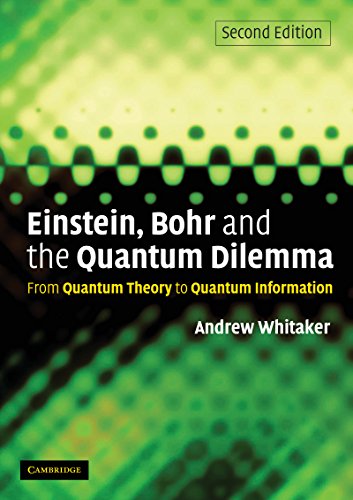
Quantum theory, the most successful physical theory of all time, provoked intense debate between the twentieth century’s two greatest physicists, Niels Bohr and Albert Einstein. Quantum information theory has emerged from intensive study of the structure and interpretation of quantum theory to become one of the fastest growing areas of twenty-first century science. This second edition has been extensively revised and updated to cover recent developments, including the findings of papers published since the well-received first edition. A substantial new chapter is devoted to the development and structure of quantum information theory. Developments in the experimental and theoretical study of Bell’s Theorem are also covered in detail, and the accounts of ongoing work have been brought up to date. A fascinating account of the development of quantum theory, this book will appeal to anyone with an interest in the fundamental questions of physics, its philosophy and its history.
User’s Reviews
Reviews from Amazon users which were colected at the time this book was published on the website:
⭐See my review in the listing for the first edition.It is still true that for a book explicitly about physics more than about history, there is too much about hidden variables and the Copenhagen Interpretation, in comparison to Many Worlds and its variants. However the treatment of Many Worlds is also excellent. It is not the author’s fault that the views of Shrodinger and Heisenberg themselves were ignored for so long.This is the best source I have encountered in the 60 years while I have been thinking about this subject, off and on.The chapter “Round-up of recent developments” appears to show that progress in this field is still slow, in comparison to the amount that is published about it.In particular, many people seem confused about decoherence. This is not necessary, because it can be studied in classical optics and electromagnetics, where it is free of the difficulties of quantum mechanical measurement. High frequency approximations for waves involve stationary phase path integrals, with negligible wave propagating in directions without this constructive interference. Some people seem to confuse that with random phase approximations, which are weaker, and that explain why incandescent light and beans in “math lab” both add arithmetically.In any case, there are too many approaches to say much about in one chapter.
⭐Note that there is a 1996 and a 2006 edition of this book. The one I have read is the 2006 version. The listing has not always appeared consistent to me.The trouble with this book is that it concentrates on the views of Einstein and Bohr and their followers, Bohm and Bell. I am afraid that this distracts readers from the of the actual discoverers of quantum mechanics, Schrodinger and Heisenberg and their followers Everett and Wheeler.Most of the book is written from the half hearted semi-classical point of view that quantum mechanics must be connected to classical mechanics in some way. The author persists in calling the EPR effect “non-local”, it only appears non-local from a classical point of view. Many physicists have always, since qm was discovered and a bit before, held the contrary view that classical physics is no longer a theory in its own right, but only a class of approximations to quantum mechanics. The founders naturally wanted to believe that they had replaced the classical view of reality. There is an excellent presentation of the “many worlds” literal interpretation, but it seems to me to short and too near the end of the book. It does conclude that both Bohr’s and Einstein’s views were flawed.This is, none the less, an excellent book. It appears to be readable by a diligent non-scientist but has considerable detail and precision. I was especially interested that von Neuman was the originator of the idea that measurement causes wave function collapse. This follows, in the usual cases, from Everett’s analysis.It seems to me that it must take a special personality or mood (as well as genius of course) to see that the way everyone else perceives reality is wrong and that you are the one who can discover what the world is really like, and then go ahead and do it. Einstein and Bore displayed something of this character, but Heisenberg and Schrodinger are the two true revolutionaries of reality. So Bore and Einstein struggled with how quantum relates to classical, without quite ever saying that classical physics and therefore the so called interpretations are at most approximations to quantum mechanics.Apparently both Heisenberg and Schrodinger believed or at least hoped from the beginning that their discovery included everything, without keeping any classical physics in its own right. Their interpretations, in the sense of intuitive understanding, were drastically different, but since their theories are equivalent, their actual physics was the same.
⭐For students of physics, professional physicists and interested lay persons this is undoubtedly the most complete and objective overview of the many ‘interpretations’ of quantum mechanics as of today. For those interested in looking “behind the mathematical formalism of QM” an absolute must read.One minor point of critique though: this book explicitly addresses lay persons (which is supposedly why you won’t find many equations in the book). Although in chapters 2 – 4 prof Whitaker splendidly epitomizes the evolution of classical (with a glance at relativity) and quantum mechanics, I fear those readers not already familiar with physics may find this a little too terse (a lot of ground is covered in very few pages). Chapters 5 – 7 explaining the Bohr-Einstein debate and Bell’s theorem are simply splendid reading for everyone. Chapter 8, rounding up recent developments, is very comprehensive, but again, the average lay person may find the summaries of quite a number of recent articles a bit tedious in the end (but ideal for students or physicists). Chapter 9 introduces quantum information theory, again a very good overview, but in my opinion a bit out of place and surely a subject that is worthy of a book on its own.All in all, there are many good popular science books out there explaining one or two QM interpretations, but this one covers them all, and it’s absolutely the best explaining the Bohr-Einstein debate and the impact of Bell’s theorem on this debate.
⭐This book is an excellent introduction, summary of and history of the debate on interpretation of quantum theory, a subject which demands careful reading. As such, it may be read to profit by those interested in some of the twists and turns of “received opinion”. It is not for those who might like their pages covered in equations (- the text discusses J S Bell’s elucidation of Von Neumann’s errors on the subject of hidden variable theories – a clear case where the mathematics concealed rather than revealed). The book is widely referenced which should have enough range of material to satisfy and extend readers at all levels. In my top ten on the subject area.
⭐This is not a textbook; it is a combined history and introduction to modern physics. It is clear, well written and a good starting point for anyone interested in Relativity or Quantum Theory.
⭐This is a good book about the Einstein and Bohr debates and doesn’tdelve into complex math but you won’t find any great insights intothings.John
Keywords
Free Download Einstein, Bohr and the Quantum Dilemma: From Quantum Theory to Quantum Information 2nd Edition in PDF format
Einstein, Bohr and the Quantum Dilemma: From Quantum Theory to Quantum Information 2nd Edition PDF Free Download
Download Einstein, Bohr and the Quantum Dilemma: From Quantum Theory to Quantum Information 2nd Edition 2006 PDF Free
Einstein, Bohr and the Quantum Dilemma: From Quantum Theory to Quantum Information 2nd Edition 2006 PDF Free Download
Download Einstein, Bohr and the Quantum Dilemma: From Quantum Theory to Quantum Information 2nd Edition PDF
Free Download Ebook Einstein, Bohr and the Quantum Dilemma: From Quantum Theory to Quantum Information 2nd Edition