Ebook Info
- Published: 2007
- Number of pages: 224 pages
- Format: PDF
- File Size: 12.05 MB
- Authors: Virginia Burrus
Description
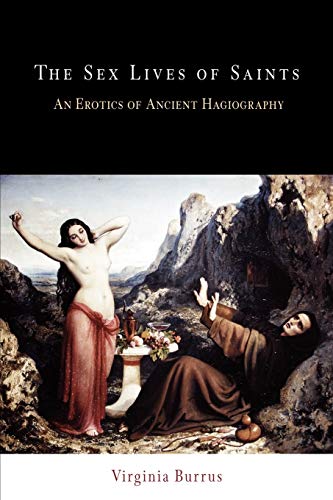
Has a repressive morality been the primary contribution of Christianity to the history of sexuality? The ascetic concerns that pervade ancient Christian texts would seem to support such a common assumption. Focusing on hagiographical literature, Virginia Burrus pursues a fresh path of interpretation, arguing that the early accounts of the lives of saints are not antierotic but rather convey a sublimely transgressive “countereroticism” that resists the marital, procreative ethic of sexuality found in other strands of Christian tradition.Without reducing the erotics of ancient hagiography to a single formula, The Sex Lives of Saints frames the broad historical, theological, and theoretical issues at stake in such a revisionist interpretation of ascetic eroticism, with particular reference to the work of Michel Foucault and Georges Bataille, David Halperin and Geoffrey Harpham, Leo Bersani and Jean Baudrillard. Burrus subsequently proceeds through close, performative readings of the earliest Lives of Saints, mostly dating to the late fourth and early fifth centuries—Jerome’s Lives of Paul, Malchus, Hilarion, and Paula; Gregory of Nyssa’s Life of Macrina; Augustine’s portrait of Monica; Sulpicius Severus’s Life of Martin; and the slightly later Lives of so-called harlot saints. Queer, s/m, and postcolonial theories are among the contemporary discourses that prove intriguingly resonant with an ancient art of “saintly” loving that remains, in Burrus’s reading, promisingly mobile, diverse, and open-ended.
User’s Reviews
Editorial Reviews: Review Brilliant and important. . . . From page one she challenges approaches to hagiography that dismiss ascetic desire as the sublimation of sexuality and a pathological hatred of the body. ― Theological StudiesThis fine book detects a vibrant eroticism in tales of fourth- and fifth-century saints. Rather than read ancient saints’ lives as anti-erotic, or, worse, an-erotic, Burrus reveals a flourishing ars erotica. ― Journal of ReligionBurrus’s interweaving of ancient and modern voices is as meditative as it is analytical, but the overall effect is to induce the reader into an alternative view of what constitutes the allure of the saintly life. . . . After The Sex Lives of Saints hagiography will never be the same. ― Journal of Early Christian StudiesAn engrossing, thought-provoking, and thoroughly enjoyable read.” ― Journal of the History of Sexuality Book Description Virginia Burrus argues that the early accounts of the lives of saints are not anti-erotic but rather convey a sublimely transgressive “counter-eroticism” that resists the marital, procreative ethic of sexuality found in other strands of Christian tradition. About the Author Virginia Burrus is the Bishop W. Earl Ledden Professor of Religion at Syracuse University. She is author of Ancient Christian Ecopoetics and Saving Shame: Martyrs, Saints, and Other Abject Subjects, both available from the University of Pennsylvania Press. Read more
Reviews from Amazon users which were colected at the time this book was published on the website:
⭐I found this book very useful in my work on early modern attitudes towards suffering (
⭐). Burrus discusses the saints of the early Christian period, but it got me thinking about how the accounts of these saints were received in the early modern period.The passages Burrus chooses for selection certainly display the ‘exuberant eroticism’ she sets out to demonstrate. The Jerome passage about a Christian who (to destroy his soul and not merely his body) is taken into a beautiful garden and bound and left on a soft bed, is particularly striking. The Christian is approached by a prostitute, who begins to caress and arouse him. As she mounts him and bends to kiss him, lacking any other way to preserve his virtue, he bites off his tongue and spits it in her face.Not for the squeamish, these pages take a refreshing look at the role of sexuality in early hagiography. Much recommended.
⭐I found this book very useful in my work on early modern attitudes towards suffering (
⭐Pain, Pleasure and Perversity: Discourses of Suffering in Seventeenth-Century England
⭐). Burrus discusses the saints of the early Christian period, but it got me thinking about how the accounts of these saints were received in the early modern period.The passages Burrus chooses for selection certainly display the ‘exuberant eroticism’ she sets out to demonstrate. The Jerome passage about a Christian who (to destroy his soul and not merely his body) is taken into a beautiful garden and bound and left on a soft bed, is particularly striking. The Christian is approached by a prostitute, who begins to caress and arouse him. As she mounts him and bends to kiss him, lacking any other way to preserve his virtue, he bites off his tongue and spits it in her face.Not for the squeamish, these pages take a refreshing look at the role of sexuality in early hagiography. Much recommended.
⭐Fascinating Re-vision of the relationship between spirituality and sexuality of the saints from a queer theory perspective.
⭐I bought it in the framework of my research on monasticism. It is quite an interesting overview of this aspect.
Keywords
Free Download The Sex Lives of Saints: An Erotics of Ancient Hagiography (Divinations: Rereading Late Ancient Religion) in PDF format
The Sex Lives of Saints: An Erotics of Ancient Hagiography (Divinations: Rereading Late Ancient Religion) PDF Free Download
Download The Sex Lives of Saints: An Erotics of Ancient Hagiography (Divinations: Rereading Late Ancient Religion) 2007 PDF Free
The Sex Lives of Saints: An Erotics of Ancient Hagiography (Divinations: Rereading Late Ancient Religion) 2007 PDF Free Download
Download The Sex Lives of Saints: An Erotics of Ancient Hagiography (Divinations: Rereading Late Ancient Religion) PDF
Free Download Ebook The Sex Lives of Saints: An Erotics of Ancient Hagiography (Divinations: Rereading Late Ancient Religion)