

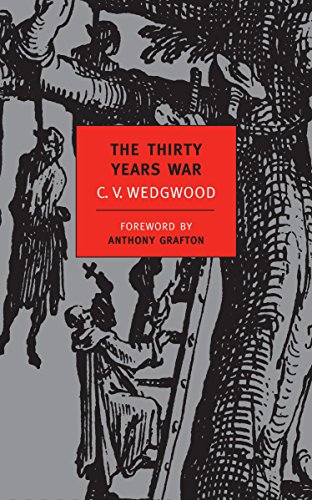
Ebook Info
- Published: 2016
- Number of pages: 540 pages
- Format: PDF
- File Size: 15.78 MB
- Authors: C. V. Wedgwood
Description
Europe in 1618 was riven between Protestants and Catholics, Bourbon and Hapsburg–as well as empires, kingdoms, and countless principalities. After angry Protestants tossed three representatives of the Holy Roman Empire out the window of the royal castle in Prague, world war spread from Bohemia with relentless abandon, drawing powers from Spain to Sweden into a nightmarish world of famine, disease, and seemingly unstoppable destruction.
User’s Reviews
Reviews from Amazon users which were colected at the time this book was published on the website:
⭐For too long the Thirty Years War has been for me little more than a name from history. I knew it occurred sometime in the seventeenth century (its actual dates were 1618 to 1648), that it was waged in Central Europe, and that it was devastating to the indigenous population. But that was the extent of my knowledge. I didn’t even know who was fighting whom. Somewhere along the way I picked up that THE book on the Thirty Years War was the prosaically entitled THE THIRTY YEARS WAR written in 1938 by a twenty-eight-year-old English woman, C. V. Wedgwood (a descendent of the potter who founded the Wedgwood Company).So it was to Wedgwood’s THE THIRTY YEARS WAR that I turned for my education on that slice of history. I learned more than I had anticipated. The book contains about 500 pages of detailed text. I set myself a goal of reading 50 pages per day, a target I managed to attain perhaps only every other day. I began to feel (obviously, facetiously) that reading THE THIRTY YEARS WAR was as interminable as was living through it for the few inhabitants of what is now Germany who did manage to live through it.Still, I am glad I read Wedgwood’s account. It is history on a grand scale, magisterially written (the book brings to mind Edward Gibbon and his “The Decline and Fall of the Roman Empire”). In his Foreword to this edition, Anthony Grafton calls Wedgwood “the greatest narrative historian” of the twentieth century. If by “narrative historian” Grafton means to refer to something other than the magisterial prose, I don’t quite know what that would be. Perhaps he is alluding to another of his points about Wedgwood: that, as opposed to the “Why” histories of professional academics, she set out to write “How” history — “detailed, vivid narratives that eschewed any effort to provide structural or social or economic explanations.”Nonetheless, THE THIRTY YEARS WAR is not devoid of structural or social or economic considerations. Nor is it devoid of analysis. To be sure, though, primarily the book is a detailed account of what happened, in roughly chronological sequence. Included are profiles of the key players — such as the Holy Roman Emperors of the German Nation Ferdinand II and his son Ferdinand III, John George of Saxony, Maximilian of Bavaria, Elector Frederick V of the Palatinate, Albrecht von Wallenstein, King Gustavus Adolphus of Sweden, and Cardinal Richelieu. Also included are moderately detailed accounts of the major battles (along with schematic maps) — namely, Breitenfeld, Lützen, Nördlingen, Rocroy, and Jankau.The Thirty Years War was in part a religious war — Protestants versus Catholics (and each of those religious factions was itself internally divided). It was in part a political war among shifting alliances of the various states of German-speaking peoples. It also was a political war between the Hapsburgs and the Bourbons, and as such it was a European war fought primarily on German soil. For Wedgwood, it is best summed up as an unnecessary, meaningless war:”The war solved no problem. Its effects, both immediate and indirect, were either negative or disastrous. Morally subversive, economically destructive, socially degrading, confused in its causes, devious in its course, futile in its result, it is the outstanding example in European history of meaningless conflict. The overwhelming majority in Europe, the overwhelming majority in Germany, wanted no war; powerless and voiceless, there was no need even to persuade them that they did. The decision was made without thought of them.”
⭐Rather than an analytical approach that examines the deeper “forces” behind events, this book describes what individuals did, what they were probably thinking, and what the impacts of their actions were. It offers a cool, if vivid, feel for the cataclysmic events of 1618-1648, the so-called “last” war of religion in Europe, very much more from the heart than the head. That is exactly what I wanted, having reading several more abstruse books written for academics.The war started in 1618 with the rigid catholicizing policy of Ferdinand II in Bohemia (a Habsburg), appointing ideologically pure Catholics into a number of traditionally lay or tolerant offices. This led to the defenistration of some of these characters and brought Frederick II down from the Palatine to claim the area in the name of protestant freedoms, though he didn’t mind gaining the territories and titles. Both were limited characters of spirit but mediocre minds, who refused to apologize and move on once the lands changed hands again in a few years and when the whole thing might have blown over as a minor territorial skirmish.This irresolution brought in some new players, including Maximilian of Bavaria, Gustavus Adolphus of Sweden, then a bit later Philip IV of Spain (a Habsburg) and the ruthless Richelieu, representing Bourbon interests, which were opposed to their Habsburg cousins for nationalist considerations. Finally, there were the many bit players – petty nobility in a plethora of German territories – as well as the Dutch, who were in an independence war with Spain and an ascendant trading power. They created a mix of shifting alliances, autonomous mercenaries who easily switched sides, and ambitious nobles (like Wallenstein) who benefited from the confiscations of lands in accordance with religious criteria.The result was a war as complex as any imaginable. The principal victims were the peasants, who had no skin in the game other than supplying occupying armies that plundered, raped, and murdered them with abandon. Whole cities were wiped off the map in genocidal action, thousands of refugees depopulated entire regions, and disease took care of the others. Though it is impossible to know what percentage of the population died in Germany, it is clear that it could be up to 60%.Whenever peace could have been imposed in this multi-polar scenario, the principal actors failed to do so when the opportunity arose, pursuing instead their own selfish interests, which were as diverse as each individual or state. In other words, it was a mix of religious fanaticism, ideology, issues of princely autonomy, geopolitics, and simple greed or the pursuit of glory, territory, an elector’s seat or whatever. Thus, the war dragged on for more than a generation, sucking everything into its void.Eventually, generational changes forced the players’ hands, e.g. Ferdinand III took over for the Austrian Habsburg Empire, mostly from naked exhaustion or death. Dutch independence was won, Austria was permanently alienated from playing the role of uniting power for the rest of Germany, Spain entered its final decline, Sweden and Bavaria withdrew in exhaustion, and France emerged as the Continent’s great new power.When Wedgwood takes up what it all means, her reasoning appears a bit dated. She was writing in the 1930s, with the Great War in mind and fearing that a new war was brewing with Hitler’s Germany. She concludes that the war solved nothing and that war only leads to more war. Clearly, smashing Hitler was the next thing the international community needed to do to ensure the survival of western civilization. I’m sure many thought the same thing in 1618, even if they were wrong in that context. Furthermore, with the breakdown of the nation-state as some are predicting (e.g. Van Creveld), the 30 Years War may serve as a cautionary tale to the world we are creating today. Once again, this catastrophe is relevant with a chilling immediacy.Aside from all that, this is a really fun read. It is elegantly written, intelligent, and deep. I loved it. Recommended so long as the reader knows its limitations.
⭐This is a rip-roaring read! It’s pacey and informed, yet easy for the amateur history buff to absorb and understand. It’s also full of interesting facts, for example, did you know that the phrase ‘is the pope a catholic, originated during the 30 years war? Me neither! The book is littered with Latin phrases, which I didn’t understand. But, with the Internet nowadays, it’s no hindrance to the enjoyment of the book. Once you get your head round the factions; the similar names (Frederick/Ferdinand); and the constant switching of sides, you will enjoy this tale of woe, pestilence and wanton destruction. If the 30 years war has a modern equivalent, you can see it in the rise of IS and AQ, or perhaps in Syria. If it was a warning from history on the pointlessness of unnecessary conflict, it hasn’t, IMHO, been heeded.
⭐This book, despite having been written in the 1930s shows no signs of age. Despite more recent scholarly works (and I have no wish to disparage Peter Wilson’s magisterial account of the wars) there is no book which more clearly sets out the events of this European tragedy. Wedgwood is quite clear that this was not simply a ‘religious war.’ and she presents the whole tapestry with writing of great power and sympathy. Anyone with any interest in this European war fought on German soil should read this book. It is difficult to imagine that it will ever be surpassed.
⭐Would *definitely* recommend to anyone! Caroline Wedgwood makes the whole period come to life; anyone reading this would have thought she was actually there. A rare blend of first class scholarship of wide-ranging appeal, which mixes well-researched facts with a strong moral approach to the vicissitudes and horrors of the war. Wedgwood is equally skilled at microscopic analysis of battlefield movements and diplomatic exchanges as she is at zooming right out and providing a God’s eye view of the whole 30 year period, its causes in the previous century, and its lasting echos down to the Europe of her own day.
⭐Wedgewood had an innate talent for finding the drama in any event. The Thirty Years War, a combination of numerous religious, political and economic factors, was probably the most defining moment in European history until the First World War, and so it should be ripe with royal drama, thrilling exploits, military spectacles and political intrigue. Wedgewood exposes all of these elements into a thrilling read, steeped in historical significance and weighty writing, which still maintains the informative aura of a well-researched scholarly effort on a key historical event. Anyone interested in the War and it’s background should start with this book first, it’s the middle-ground between storytelling and teaching.
⭐Probably one of the most arcane, uninspiring and boring books I’ve ever read. Reads like a telephone directory. I think the author must have been given a topic to write about which he hated. It certainly feels like it. Have to admit, I only made it 2/3 the way through. Its SOLID!The charity shop got it… With my apologies.
Keywords
Free Download The Thirty Years War (New York Review Books Classics) in PDF format
The Thirty Years War (New York Review Books Classics) PDF Free Download
Download The Thirty Years War (New York Review Books Classics) 2016 PDF Free
The Thirty Years War (New York Review Books Classics) 2016 PDF Free Download
Download The Thirty Years War (New York Review Books Classics) PDF
Free Download Ebook The Thirty Years War (New York Review Books Classics)