

Ebook Info
- Published: 2019
- Number of pages: 512 pages
- Format: PDF
- File Size: 16.50 MB
- Authors: Jeremy Blum
Description
The bestselling beginner Arduino guide, updated with new projects!Exploring Arduino makes electrical engineering and embedded software accessible. Learn step by step everything you need to know about electrical engineering, programming, and human-computer interaction through a series of increasingly complex projects. Arduino guru Jeremy Blum walks you through each build, providing code snippets and schematics that will remain useful for future projects. Projects are accompanied by downloadable source code, tips and tricks, and video tutorials to help you master Arduino. You’ll gain the skills you need to develop your own microcontroller projects! This new 2nd edition has been updated to cover the rapidly-expanding Arduino ecosystem, and includes new full-color graphics for easier reference. Servo motors and stepper motors are covered in richer detail, and you’ll find more excerpts about technical details behind the topics covered in the book. Wireless connectivity and the Internet-of-Things are now more prominently featured in the advanced projects to reflect Arduino’s growing capabilities. You’ll learn how Arduino compares to its competition, and how to determine which board is right for your project. If you’re ready to start creating, this book is your ultimate guide! Get up to date on the evolving Arduino hardware, software, and capabilitiesBuild projects that interface with other devices—wirelessly!Learn the basics of electrical engineering and programmingAccess downloadable materials and source code for every projectWhether you’re a first-timer just starting out in electronics, or a pro looking to mock-up more complex builds, Arduino is a fantastic tool for building a variety of devices. This book offers a comprehensive tour of the hardware itself, plus in-depth introduction to the various peripherals, tools, and techniques used to turn your little Arduino device into something useful, artistic, and educational. Exploring Arduino is your roadmap to adventure—start your journey today!
User’s Reviews
Editorial Reviews: From the Inside Flap “Jeremy’s easy-to-understand style and depth of content about the Arduino. . . will not only allow digital beginners to get their footing but will also allow the old guard of hardware to dip a toe into the hobbyist-friendly end of the swimming pool and start connecting their devices.” — Chris Gammell, Co-host of the Amp Hour PodcastARDUINO CAN TAKE YOU ANYWHERE. THIS BOOK IS THE ROADMAP.Exploring Arduino??shows how to use the world’s most popular microcontroller to create cool, practical, artistic, and educational projects. Through lessons in electrical engineering, programming, and human computer interaction, this book walks you through specific, increasingly complex projects, all the while providing best practices that can apply to your own projects once you’ve mastered these. You’ll acquire valuable skills—and have a whole lot of fun. Explore the features of several commonly used Arduino boardsUse the Arduino to control very simple tasks or complex electronicsLearn principles of system design, programming, and electrical engineeringDiscover code snippets, best practices, and system schematics you can apply to your original projectsMaster skills you can use for engineering endeavors in other fields and with different platformsConnect your projects to the internetExpands on the first edition with updated projects, all new topics like wireless connectivity and stepper motors, and more deep dives into electrical engineering and product design topicsFind schematics, tutorial videos, code downloads, and more at the companion website: www.exploringarduino.com.CONVENIENT COMPONENT KITS Component kits are available for this book! Visit exploringarduino.com/kits. From the Back Cover “Jeremy’s easy-to-understand style and depth of content about the Arduino. . . will not only allow digital beginners to get their footing but will also allow the old guard of hardware to dip a toe into the hobbyist-friendly end of the swimming pool and start connecting their devices.” — Chris Gammell, Co-host of the Amp Hour PodcastARDUINO CAN TAKE YOU ANYWHERE. THIS BOOK IS THE ROADMAP.Exploring Arduino??shows how to use the world’s most popular microcontroller to create cool, practical, artistic, and educational projects. Through lessons in electrical engineering, programming, and human computer interaction, this book walks you through specific, increasingly complex projects, all the while providing best practices that can apply to your own projects once you’ve mastered these. You’ll acquire valuable skills—and have a whole lot of fun. Explore the features of several commonly used Arduino boardsUse the Arduino to control very simple tasks or complex electronicsLearn principles of system design, programming, and electrical engineeringDiscover code snippets, best practices, and system schematics you can apply to your original projectsMaster skills you can use for engineering endeavors in other fields and with different platformsConnect your projects to the internetExpands on the first edition with updated projects, all new topics like wireless connectivity and stepper motors, and more deep dives into electrical engineering and product design topicsFind schematics, tutorial videos, code downloads, and more at the companion website: www.exploringarduino.com.CONVENIENT COMPONENT KITS Component kits are available for this book! Visit exploringarduino.com/kits. About the Author Jeremy Blum is an electrical engineer known for his series of educational YouTube videos that have taught engineering concepts to millions of people around the world. Previously as a hardware engineer at Google [X] and currently as director of engineering at Shaper Tools, he spends every day creating complex electromechanical products. He has designed and built solar trackers, prosthetic arms, truss-traversing robots, musical theremins, gesture controllers, home automation systems, augmented reality hardware, and more. Read more
Reviews from Amazon users which were colected at the time this book was published on the website:
⭐I have reviewed dozens if not hundreds of Arduino titles (not kidding, I really have). And this is one of the two books I purchased. This is one is a cut above all the rest. If you have only a little room on your bookshelf or budget for only a small number of Arduino books — make this one of them.
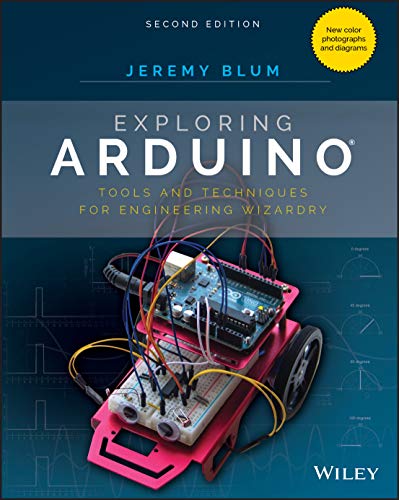
⭐I preordered this book several months ago, which was supposed to come out in September, but the wait was worth it. I was looking for a book to learn Arduino, and this book was recommended to me by an engineer. Although I am far from finishing the book (at the time that I wrote this review) I will talk about it in the little time that I’ve had it.This book is easy to follow. It assumes that you have some or very little knowledge about electronics/programming, an example of that is when it explains how to pick an LED resistor, which is of course pretty basic stuff. Nonetheless, this doesn’t get boring at all for those who already have some experience as each chapter gets more challenging and encourages you to apply what you have learned on each exercise. And at the end of chapter 4, you will know how to make a light driven robot! (As a matter of fact, it’s pictured on the cover of the book) As we progress throughout the book, the author introduces technical terms, baud rate or duty cycle for instance, however, he explains them in a very easy way in terms of practicality.At the beginning of each chapter, there is a list of the parts that you need to complete each exercise as well as a short overview of what to expect further ahead. Likewise, the author advises you to check his website to find extra resources and updates to the book. The latter is important since he explicitly states that there could be errors in the book that were missed. However, with time I guess they will be fixed in new printings. I personally haven’t had any problems with the code so far. I have to mention that the color diagrams are definitely a huge help since they are easy to follow and make the learning process more enjoyable.Overall this is a great book that I wish I had when I was younger. I definitely will be buying more books from this author.Contents in the book:- PART I: Arduino Engineering Basics1 – Getting Started and Understanding the Arduino Landscape.2 – Digital Inputs, Outputs, and Pulse-Width Modulation.3 – Interfacing with Analog Sensors- PART II: Interfacing with Your Environment4 – Using Transistors and Driving DC Motors5 – Driving Stepper and Servo Motors6 – Making Sounds and Music7 – USB Serial Communication8 – Emulating USB Devices9 – Shift Registers- PART III: Communication Interfaces10 – The I2C Bus11 – The SPI Bus and Third-Party Libraries12 – Interfacing with Liquid Crystal Displays.- PART IV: Digging Deeper and Combining Functions13 – Interrupts and Other Special Functions14 – Data Logging with SD Cards.- PART V: Going Wireless15 – Wireless RF Communications16 – Bluetooth Connectivity17 – Wi-Fi and the CloudAppendix A: Deciphering Datasheets and Schematics.
⭐This book has guided me through my intro to Arduino. I have learned a great deal about H-bridges, voltage regulators, motors and more from this book. There have been many times that this book has been my last read before bed. Great work and extremely helpful.
⭐Better than the first book
⭐This book is for those who want hands on learning experience in embedded systems. Working through the programs and building the circuits in each chapter provides quite a fun (and sometimes aggravating) learning experience. Jeremy Blum’s 2nd edition Book is a very well thought out experience through the arduino ecosystem and practical interface to the external world. It is an embedded systems class for the maker, and for engineering students as well.Each chapter leads the reader through successive hands on steps (labs or experiments) to build to the final project of each chapter.Even better, Jeremy’s website provides the software code, parts lists and references for each chapter.I purchased several copies from some of my closest friends and we are working through the chapters together. I rarely write book reviews, but compelled to on this book. The book is great, as many of the other reviewers have stated so much better than i.
⭐Amazon dropped the ball on shipping, in a box loose with other items, looks like a used book as a result. Not enough to return, but very disappointed.The book is great for me, learning the hardware end for the first time. Thorough explanations of why things are done without blowing my mind.Looking forward to spending good time working on projects.
⭐For a dummy like me who never had any formal electronics training, this is ideal. The circuitry and the code you implement can be easily applied to machines and languages other than Arduino and Python. This book is a real gem.
⭐The first edition of this book has been most helpful to me over the years, having referenced and even cited the same in my YouTube channel on using Arduino for environmental monitoring. I needed to order a second copy to replace one that I loaned to a colleague at work. In doing so, I can vouch for the color photos and revisited themes as being well worth the upgrade. Many of the topics covered in the first edition have been thoughtfully revisited and edited. This edition isn’t just an added paragraph here or there to justify selling more books, rather it is a thoughtful revisit of the topic with timely updates and edits. Well done Mr. Blum. I don’t often write reviews, but was impressed enough with this edition that I felt it was worth it to take time for the same.
⭐Seems an excellent book, clear, well written, 500 pages, caters for pretty much all levels of reader, including those new to electronics, programming, and Arduino. The various chapters cover the various uses for an Arduino, like driving motors, comms modes including USB, reading sensors, to name just a few. The chapters are quite in-depth compared to other books I have, include clear code snippets, and useful explanatory boxes. There’s even a chapter covering the use of interrupts, which I’ve never seen in the other books. Layout and print quality of the publication is first class, like all Wiley books I have; excellent value for money.
⭐Having already bought and enjoyed reading the 1st edition of this book, decided to get the updated 2nd edition and it doesn’t disappoint. Even more projects, colour illustrations, which helps a lot, a fantastic read and aid to getting the most out of the Arduino. Well recommended.
⭐Gives great information and 13 year old loves the layout
⭐Cracking book and support. Book is comprehensive with easy to understand explanations and guidance.
⭐If you like this type of music, then it’s great
Keywords
Free Download Exploring Arduino: Tools and Techniques for Engineering Wizardry 2nd Edition in PDF format
Exploring Arduino: Tools and Techniques for Engineering Wizardry 2nd Edition PDF Free Download
Download Exploring Arduino: Tools and Techniques for Engineering Wizardry 2nd Edition 2019 PDF Free
Exploring Arduino: Tools and Techniques for Engineering Wizardry 2nd Edition 2019 PDF Free Download
Download Exploring Arduino: Tools and Techniques for Engineering Wizardry 2nd Edition PDF
Free Download Ebook Exploring Arduino: Tools and Techniques for Engineering Wizardry 2nd Edition