

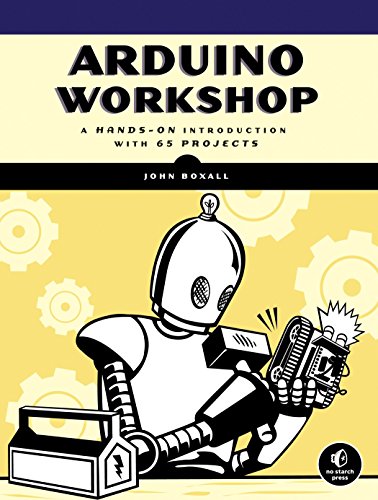
Ebook Info
- Published: 2013
- Number of pages: 392 pages
- Format: PDF
- File Size: 16.19 MB
- Authors: John Boxall
Description
The Arduino is a cheap, flexible, open source microcontroller platform designed to make it easy for hobbyists to use electronics in homemade projects. With an almost unlimited range of input and output add-ons, sensors, indicators, displays, motors, and more, the Arduino offers you countless ways to create devices that interact with the world around you.In Arduino Workshop, you’ll learn how these add-ons work and how to integrate them into your own projects. You’ll start off with an overview of the Arduino system but quickly move on to coverage of various electronic components and concepts. Hands-on projects throughout the book reinforce what you’ve learned and show you how to apply that knowledge. As your understanding grows, the projects increase in complexity and sophistication.Among the book’s 65 projects are useful devices like:– A digital thermometer that charts temperature changes on an LCD–A GPS logger that records data from your travels, which can be displayed on Google Maps– A handy tester that lets you check the voltage of any single-cell battery– A keypad-controlled lock that requires a secret code to openYou’ll also learn to build Arduino toys and games like:– An electronic version of the classic six-sided die– A binary quiz game that challenges your number conversion skills– A motorized remote control tank with collision detection to keep it from crashingArduino Workshop will teach you the tricks and design principles of a master craftsman. Whatever your skill level, you’ll have fun as you learn to harness the power of the Arduino for your own DIY projects.Uses the Arduino Uno board
User’s Reviews
Editorial Reviews: About the Author John Boxall has been writing Arduino tutorials, projects, and kit and accessory reviews for several years at http://www.tronixstuff.com. Arduino Workshop is his first book.
Reviews from Amazon users which were colected at the time this book was published on the website:
⭐I purchased this book twice. One for me and one for my nephew. Learned what I needed to build a project I had in mind.
⭐No Starch is my favorite publisher. I bought this used and the first edition. From what I read the 2nd edition didn’t change much. The first edition is still very much relevant. Just use plain ole common sense. In the technology world, things change within weeks/months. It’s hard to keep any book up-to-date. You just need to use common sense on some of the stuff that changed. Other than that this book is packed with info. From the basics to the advanced. I’m a computer developer. I use Raspberry Pi’s daily. I love my Rasp’s but I wanted to drive into the world of Arduino’s. If you have never worked with an Arduino or just want to learn some new skills this book is for you!
⭐At first I thought I wasted my money, that was because the book starts out in the beginning, and gives a lot of basic training on Arduino. After I got past the first 100 pages things started to get more interesting for me. The book is a great way to get into Arduino, and it will not only introduce you to Arduino, it will help make you a good programmer, and learn to do some pretty useful things with Arduino. The book has lots of projects that start out very basic, and go all the way up to putting your arduino on the internet and sending tweets from it. The book does not just toss the programs out for you to copy, it explains the process used to complete each project. The book is laid out very well. In most projects, he starts by explaining the goal, as in what he is going to teach you with the current project, then is outlines the hardware used in a hardware list, then the schematic where he explains what is done and why, then the program, where he explains each line of code so you can put it all together in your head. The book leads to firm understanding for the student. If you want to use this book as a study aid to learn the most, you should start by getting a quiet place to work, get all the parts used in the book, and start reading. I have a lot of books on Arduino, but this one is by far one of the very best.
⭐My son received an Arduino for Christmas last year and while we tinkered with it here and there we never really got it out and made something. After attending the Google Maker camp at our local library where one of the weeks was working with the Arduino as well Little Bits, I decided to grab a few entry level books to start brushing up on the various aspects of the Arduino as well learning how to write sketches.This is laid out in an easy to follow manner starting with the how to find/install the software needed as well as going over the various types of Arduino’s and their features and intended/best suited uses. From there it moves in to electricity and electrical components, such as LED’s, Resistors, Transistors, Diodes etc…, their individual functions as well how they function and how to determine exactly what type of each part you would need for various projects depending on your desired outcome.The projects are easily understood and start with a list of what each will need, an explanation of the algorithm, a sketch that you can use and a schematic to help you put the project together. The layout of the book is such that subsequent chapters build on the knowledge gained over the previous portions of the book and sometimes one project will have several following that build on what that one started.Overall this is written in easy to understand language without techno-speak to leave one scratching their head wondering what they just read. A perfect idea for father/son looking for a challenging hobby to work on together.
⭐I have never worked with an Arduino let alone having almost no experience with reading schematics for electronics. Though I wish there was a little more explanation on how the schematics translate onto a breadboard (hence the 4/5 stars) I think this is a great tool for beginners. I’ve been working my way through the book, and have so far made working buttons that turn on LEDs to more complicated circuits like simulating a traffic light. I would advise anyone picking up this book to get a decent Arduino starter kit (with stuff like resistors, input buttons, LEDs, etc.) since most of the time the local Radioshack is either A.) out of business or B.) doesn’t have the right parts.The book also teaches you the basics (and the more complicated syntax/commands) of Arduino’s programming language. Essentially, you get the fundamental building blocks of knowing exactly how to talk to your Arduino. It’s exciting, especially as a person new to programming and circuits, to be able to manipulate digital inputs/outputs and work with electricity.Aside from wanting a little more when it comes to reading schematics (it does tell you what the symbols mean) this is a great book for beginners.
⭐This is a great for a beginner just getting started with Arduino but with some technical knowledge. It starts with basics giving a good overview of Arduino before moving onto projects of increasing complexity. Unlike some books the projects are interesting and give scope for expansion once knowledge has been gained. What I like about it is how well the object lesson for the project is explained in clear language and how the code works. Schematics are good which though for a beginner might seem daunting the explanation at the beginning how to read them us good. In fact preferable to the breadboard graphics other books use. Given many projects online use scheme it is a good skill the book teaches.Parts lists are clear too.I would certainly recommend this book to someone looking to get into Arduino and a variety of projects to learn from.
⭐This is a great starting point giving entry into the wonderful world of Arduino. If you are the kind of person who wants to make things that can do amazing things in the real world, then Arduino is for you, and this book takes you from the basics through a whole series of fascinating projects. Even if you don’t build many of them, you will be able to see the exciting possibilities within the grasp of the hobbyist.Whether just interested in the Arduino, or having already bought a kit, buy this book! It is well written, and presents its information clearly. Worth every penny.
⭐This book is great.It arrived today and Im through chapter 7 without a pause, its that good.I know my way around programming and electronics and have played with Arduino, Netduino and Raspberry Pi a little. This however has been the 1st book to actually get me doing something useful and motivating me to learn.I’m not sure what it is, whether its the style, the information or it just brings everything together. Either way it works.Looking forward I can see it will cover some of the more difficult, challenging but in the end most fun parts of the Arduino and its application.I can see myself developing all sorts of gadgets around the house and for fun with this book. The 1st of many to do so in the many years I have been looking. I’ll also be getting my 12 year old to do the same I think.I usually buy on Kindle, but in this case, along with other technical tomes I think the paperback is actually better.Buy it if you have even a passing interest and I guarantee you’ll be hooked, just like I am.
⭐I’m just starting off with Arduino and this is the best book I have found so far. It gives a nice, hands-on and structured introduction to the capabilities of these little boards and it’s already proven to be useful (… I’m running a research lab and Arduino boards are a cheap way to integrate different bits of optical equipment).I haven’t finished yet, but so far so good.
⭐This is a superb book for someone like myself who wanted to start tinkering with an Arduino and do some physical computing. The projects are well explained with a wiring diagram and the sample program. I was soon listing components to buy and dying for them to arrive so that I could move on to the next project. Works well as a Kindle book that I can have open on my Mac whilst I program using the Arduino IDE.
Keywords
Free Download Arduino Workshop: A Hands-On Introduction with 65 Projects in PDF format
Arduino Workshop: A Hands-On Introduction with 65 Projects PDF Free Download
Download Arduino Workshop: A Hands-On Introduction with 65 Projects 2013 PDF Free
Arduino Workshop: A Hands-On Introduction with 65 Projects 2013 PDF Free Download
Download Arduino Workshop: A Hands-On Introduction with 65 Projects PDF
Free Download Ebook Arduino Workshop: A Hands-On Introduction with 65 Projects