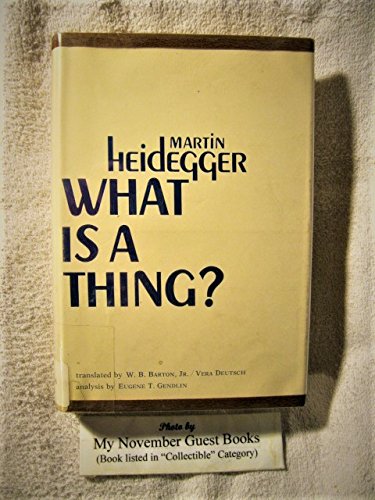
Ebook Info
- Published: 1967
- Number of pages: 310 pages
- Format: PDF
- File Size: 14.01 MB
- Authors: Martin Heidegger
Description
User’s Reviews
Reviews from Amazon users which were colected at the time this book was published on the website:
⭐Kant never effectively addressed the question of the independent reality of “things” (thing in itself). He supplied an outline of the epistemologic structure of human thinking that, based as it was on forms and concepts that were transcendental i.e. universal and necessary and therefore a priori, gave as close as he believed we could get to objective “truth”. Because we are hardwired to apply the pure forms of intuition (space and time) and the schematized pure concepts of the understanding (rules by which we make judgments, in conjunction with the pure forms of intuition and empiric intuitions and concepts from sensibility) to “experience” our world, we are able to engage in a meaningful discourse with others of our type who share the same hard wiring. This means that space and time and the schematized pure concepts, such as cause and effect, may have no independent reality. We can never know since we can never travel beyond the limitations our minds impose upon us. Of course this means that “things”, as they really are, are closed off to knowing. So how does Heidegger make use of Kant to come to what is a “thing”? In fact Heidegger would be much like a transcendental idealist if he were concerned with the term. It is his orientation that is different. For Heidegger the issue is not the epistemic makeup of humans but the ontological structure of human Being (Dasein). If Kant is simply turned upside down he is the perfect compliment. Kant is describing the structure of Dasein’s knowing, and is saying that we have access to this, through logic and the necessary character of the transcendental forms and concepts, that we can never have to the external world (one can argue whether the pure forms of intuition and the pure concepts of the understanding are really “things” in themselves and if so why can we know them). Kant is therefore describing an aspect of Dasein’s ontologic structure. This same privileged access to self knowledge is what Heidegger would like to say about Dasein’s exploration of its Being. We have an immediate access to it that we cannot necessarily have to other things. The “things” of the world take their importance and relevance, for us, from their relationships to Dasein’s projects. Their independent reality is not as important or is not knowable. The importance of “things in themselves” lies in their importance to Dasein- not in their reality independent of Dasein. This finishes the circle then. Kant says we can know the truth of the basic epistemic structure of human Being (one of its ontologic characteristics) but not the truth of other beings. Heidegger says we can know other ontologic aspects of human Being and that the importance of other beings is settled in what they say about Dasein and not in themselves. This book gives a fair picture of Kant’s basic theory from the Critique of Pure Reason, but through a Heideggerian lens. I personally would not read it to understand Kant, it is at once too simplified and too eccentric in its view. Its importance is in demonstrating how the thinking of the two philosophers meshes when their emphasis is so far apart.
⭐Thank you!!
⭐Martin Heidegger (1889-1976) was an influential and controversial German philosopher, primarily concerned with Being, and phenomenology—who was widely (perhaps incorrectly) also perceived as an Existentialist. His relationship with the Nazi party in Germany has been the subject of widespread controversy and debate [e.g.,
⭐,
⭐,
⭐,
⭐, etc.] He wrote many other books, such as
⭐,
⭐,
⭐,
⭐,
⭐,
⭐, etc.He wrote in the Preface, “This work presents the text of a lecture which was held in the winter semester, 1935-36, at the University of Freiburg. The lecture was entitled, ‘Basic Questions of Metaphysics.’”He observes, “Usually philosophers tell each other that the truth is something which is valid in itself, which is beyond time and is eternal, and woe to him who says that truth is not eternal. This means relativism, which teaches that everything is only relatively true, only partly true, and that nothing is fixed any longer. Such doctrines are called Nihilism. Nihilism, nothingness, philosophy of anxiety, tragedy, unheroic, philosophy of care and woe—the catalog of these cheap titles is inexhaustible. Contemporary man shudders at such titles, and, with the help of the shudder thus evoked, the given philosophy is contradicted. What wonderful times when even in philosophy one need no longer think, but where someone somewhere, occasionally, on higher authority, cares to provide shuddering! And now the truth should even depend on a draft! Should it? I ask whether perhaps it is not so.” (Pg. 29)He explains, “What then is a thing? Answer: A thing is the existing (vorhanden) bearer of many existing (vorhanden) yet changeable properties. This answer is to ‘natural’ that it also dominates scientific thought, not only ‘theoretical’ thought but also of intercourse with things, their calculation and evaluation.” (Pg. 34)He summarizes, “If we survey all that characterizes the answer to our question ‘What is a thing?’ then we can establish three aspects: 1. The definition of the thing as the bearer of properties results quite ‘naturally’ out of everyday experience. 2. This definition of thingness was established in ancient philosophy, obviously because it suggests itself quite ‘naturally.’ 3. The correctness of this definition of the essence of the thing is finally proved and grounded through the essence of truth itself, which essence of truth is likewise intelligible of itself, i.e., is ‘natural.’” (Pg. 38)He again summarizes, “The question has been characterized in two essential respects: What is put in question and how it is questioned. First, with regard to WHAT is in question—the thing—with an admittedly very poor light we have searched the horizon in which, according to tradition, the thing and the determination of its thingness stand. We reached a double result: first, the frame of the thing, time-space, and the thing’s way of encountering, the ‘this,’ and then the structure of the thing itself as being the bearer of properties, entirely general and empty: to form the one for a many. Second, we tried to characterize the question in regard to the manner in which it must be asked. It turned out that the question is historical. What is meant by that has been explained.” (Pg. 53)He observes, “The most difficult learning is to come to know all the way what we already know. Such learning, with which we are here solely concerned, demands sticking rather closely to what appears to be nearest at hand; for instance, to the question of what a thing is. We steadfastly ask, concerning its usefulness, THE SAME obviously useless question of what a thing is, what tools are, what man is, what a work of art is, what the state and the world are.” (Pg. 73)He argues, “Mathematical logic is not even logic of mathematics in the sense of defining mathematical thought and mathematical truth, nor could it do so at all. Symbolic logic is itself only a mathematics applied to propositions and propositional forms. All mathematical logic and symbolic logic necessarily place themselves outside of every sphere of logic, because, for their very own purpose, they must apply … the assertion, as a mere combination of representations, i.e., basically inadequately. The presumptuousness of logistic in posing as the scientific logic of all sciences collapses as soon as one realizes how limited and thoughtless its premises are. It is also characteristic for logistic to consider everything that reaches beyond its own definition of assertion as a connection of representations, as a matter of ‘finer distinctions’ which don’t concern it.” (Pg. 156)He concludes the first part of the book, “The question ‘What is a thing?’ is the question ‘Who is man?’ That does not mean that things become a human product but, on the contrary, it means that man is to be understood as he who always already leaps beyond things, but in such a way that this leaping-beyond is possible only while things encounter and so precisely remain themselves—while they send us back behind ourselves and our surface. A dimension is opened up in Kant’s question about the thing which lies between the thing and man, which reaches out beyond things and back behind man.” (Pg. 244)He notes, “The task of philosophy differs from that of science, for, unlike science, philosophy examines not our conclusions but the basic conceptual models we employ—the KIND of concepts and ordering patterns we use. Philosophy concerns not the explanation of this or that but questions such as ‘What, really, is an explanation?’” (Pg. 248)This book will be of great interest to anyone studying Heidegger, and the development of his thought.
Keywords
Free Download What Is a Thing? in PDF format
What Is a Thing? PDF Free Download
Download What Is a Thing? 1967 PDF Free
What Is a Thing? 1967 PDF Free Download
Download What Is a Thing? PDF
Free Download Ebook What Is a Thing?