Ebook Info
- Published: 1996
- Number of pages: 216 pages
- Format: PDF
- File Size: 6.92 MB
- Authors: M. G. Calkin
Description
This book takes the student from the Newtonian mechanics typically taught in the first and the second year to the areas of recent research. The discussion of topics such as invariance, Hamiltonian Jacobi theory, and action-angle variables is especially complete; the last includes a discussion of the Hannay angle, not found in other texts. The final chapter is an introduction to the dynamics of nonlinear nondissipative systems. Connections with other areas of physics which the student is likely to be studying at the same time, such as electromagnetism and quantum mechanics, are made where possible. There is thus a discussion of electromagnetic field momentum and mechanical “hidden”; momentum in the quasi-static interaction of an electric charge and a magnet. This discussion, among other things explains the “(e/c)A”; term in the canonical momentum of a charged particle in an electromagnetic field. There is also a brief introduction to path integrals and their connection with Hamilton’s principle, and the relation between the Hamilton Jacobi equation of mechanics, the eikonal equation of optics, and the Schrödinger equation of quantum mechanics. The text contains 115 exercises. This text is suitable for a course in classical mechanics at the advanced undergraduate level.
User’s Reviews
Editorial Reviews: Review I like the book because of the clear precision with which it expresses the results it eventually arrives at, the straightforward ways in which it illustrates the use of these results, and the sets of nontrivial end-chapter exercises that provide a rich opportunity to verity one s own grasp of the methods to which one is introduced in the text. –Am. J. Phys.It is a nice and well-written book … there is a good supply of exercises and worked examples that render this little handbook a useful tool for all those who would like to learn and understand something about mechanics. –Mathematics Abstracts
Reviews from Amazon users which were colected at the time this book was published on the website:
⭐Since Amazon doesn’t have “See Inside” activated for this book, here is a quick rundown of its table of contents:Chapter 1 – Newton’s Laws Newton’s Laws Free fall Simple harmonic oscillator Central force Gravitational force: qualitative Gravitational force: quantitative Parameters of earth’s orbit Scattering Coulomb scattering ExercisesChapter 2 – The Principle of Virtual Work and D’Alembert’s Principle Constraints Principle of virtual work D’Alembert’s principle and generalized coordinates Lever Inclined plane Plane pendulum ExercisesChapter 3 – Lagrange’s Equations Lagrange’s Equations Plane pendulum Spherical pendulum Electromagnetic interaction Interaction of an electric charge and a magnet ExercisesChapter 4 – The Principle of Stationary Action or Hamilton’s Principle Principle of stationary action Calculus of variations Geodesics Examples Path integral formulation of quantum mechanics ExercisesChapter 5 – Invariance Transformations and Constants of the Motion Invariance Transformations Free particle (a) Infinitesimal transformations Free particle (b) Space time transformations Spatial displacement Spatial rotation Galilean transformation Time displacement Covariance, invariance, and the action ExercisesChapter 6 – Hamilton’s Equations Hamilton’s equations Plane pendulum Spherical pendulum Rotating pendulum Electromagnetic interaction Poisson brackets ExercisesChapter 7 – Canonical Transformations One degree of freedom Generating functions Identity and point transformations Infinitesimal canonical transformations Invariance transformations Lagrange and Poisson brackets Time dependence Integral invariants ExercisesChapter 8 – Hamilton-Jacobi Theory Hamilton’s principal function Jacobi’s complete integral Time-independent Hamilton-Jacobi equation Separation of variables Free particle, in cartesian coordinates Central force, in spherical coordinates Hamilton-Jacobi mechanics, geometric optics, and wave mechanics ExercisesChapter 9 – Action-Angle Variables Action-angles variables Example: simple harmonic oscillator Example: central force Adiabatic change ExercisesChapter 10 – Non-Integrable Systems Surface of section Integrable and non-integrable systems Perturbation theory Irrational tori Rational tori ExercisesIndexThe exposition is of high quality throughout and is supplemented by over 80 figures. In addition, the exercises are excellent and form an essential part of the text, although they tend to be algebraically laborious. I would recommend that anyone using this book for self study also acquire
⭐as this book often provides efficient tricks for solving these types of problems that are good to know.One of the outstanding features of this book are some of its supplementary discussions such as the one on the Electromagnetic Field and field momentum in chapter three, the discussion of time dilation in general relativity and the path integral formulation of quantum mechanics in chapter four, the connections between Hamilton-Jacobi mechanics, geometrical optics and quantum mechanics in chapter 8, and essentially all of chapter 10.A few of the things I didn’t care for were the occasional shady handling of infinitesimals and differential forms, and the odd omission of any mention of chaos in chapter 10.Regardless though, diligent study of this book will definitely bring your classical mechanics up to the level where it needs to be for grad school.Enjoy!
⭐This text, using the simplist possible methods, very carefully covers the details of Analytical Mechanics that are very hard to find elsewhere. The other books on the subject either do not cover the details, or if they do, they do so using unnecessarily more advanced techniques. For example, Calkin’s book derives in the clearest and most straight-forward way the invariance of Poisson and Lagrange Brackets under canonical transformations. (A derivation that even Goldstein got wrong in the first edition of his now classic text — see the footnote on integral invariants in the second edition of his book.)Regrettably, Calkin doesn’t cover Lagrange multiplier techniques, the Routhian, and relativistic Analytical Mechanics. Otherwise Calkin’s book is probably the best elementary introduction to Lagrangian and Hamiltonian Mechanics available in english.
⭐This is worth buying for its clear explanation of d’Alembert’s Principle. Comparable in breadth to Landau & Lifshits and to Herbert Goldstein, but has its own unique arc of argumentation. Exceptionally easy to read. I look forward to working the problems.
⭐Easy to learn, math is simple.
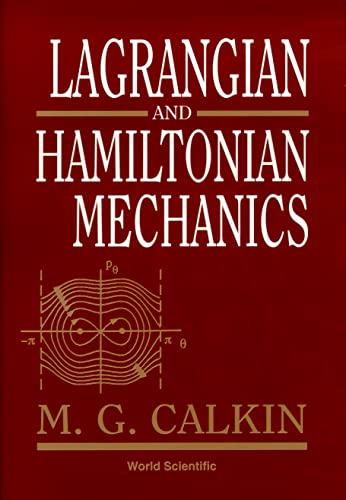
⭐Contains only the book cover. Don’t buy it.
⭐Nice modern introduction to classical mechanics, despite the somewhat picky review by R. Weinstock in Am. J. Phys. 66(3), 261-262 (1998). The text goes in the same spirit of the superb text by F. Gantmacher, ”
⭐” (Mir Publishers, Moscow, 1975), to which it serves as an apt introduction. The ~210 pages of Calkin together with the ~250 pages of Gantmacher make a thorough, modern introduction to classical mechanics — IMHO, a much better, shorter and more modern course of study than the one offered by the standard textbook of Goldstein.
⭐So i haven’t read the entire thing but i can say this much. While it is concise and clear, it is by no means a step-by-step presentation to the point where you can study by yourself without having a very rigid grasp of mathematics, including vectors, integral calculus and even matrixes
⭐I read physics books in my spare time, and what I’ve found are the best ones are short, good books: if they’re short you stand a chance of getting through them, and then if they’re good you can pick up the essentials of the subject quickly.This book is both. If you’re looking for a primary textbook, you might be looking for something different, but for a reference to the concepts it’s short and sweet: eg. what are canonical transformations, why are they defined the way they are and what is their importance.What’s particularly mind-blowing is the 5 page discussion of field momentum. That’s the qA term in the hamiltonian for a charge q in a magnetic field (vector potential A). This form of the hamiltonian always puzzled me: Calkin explains the meaning of the qA term beautifully. The book is worth getting for this alone.
Keywords
Free Download Lagrangian and Hamiltonian Mechanics in PDF format
Lagrangian and Hamiltonian Mechanics PDF Free Download
Download Lagrangian and Hamiltonian Mechanics 1996 PDF Free
Lagrangian and Hamiltonian Mechanics 1996 PDF Free Download
Download Lagrangian and Hamiltonian Mechanics PDF
Free Download Ebook Lagrangian and Hamiltonian Mechanics