

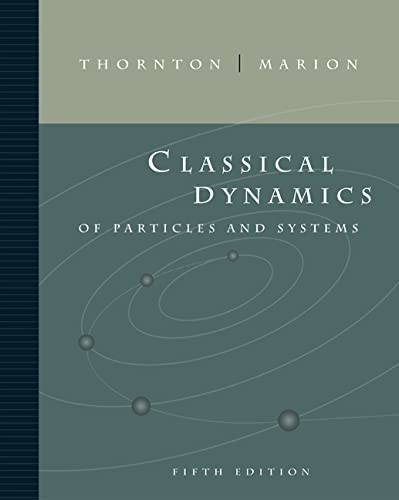
Ebook Info
- Published: 2003
- Number of pages: 660 pages
- Format: PDF
- File Size: 66.12 MB
- Authors: Stephen T. Thornton
Description
This best-selling classical mechanics text, written for the advanced undergraduate one- or two-semester course, provides a complete account of the classical mechanics of particles, systems of particles, and rigid bodies. Vector calculus is used extensively to explore topics.The Lagrangian formulation of mechanics is introduced early to show its powerful problem solving ability.. Modern notation and terminology are used throughout in support of the text’s objective: to facilitate students’ transition to advanced physics and the mathematical formalism needed for the quantum theory of physics. CLASSICAL DYNAMICS OF PARTICLES AND SYSTEMS can easily be used for a one- or two-semester course, depending on the instructor’s choice of topics.
User’s Reviews
Editorial Reviews: Review “An excellent balance of basic and advanced level classical mechanics, ideal for a junior level Physics courses.””I like the order of topics: the early discussion of linear and non-linear oscillations and the early presentation of Lagrangian/Hamiltonian dynamics. I also like the problems at the end of the chapters.””Good discussion of classical subjects.” About the Author Stephen Thornton is Emeritus Professor of Physics at the University of Virginia. He has published over 130 research articles in experimental nuclear physics and has done research at several accelerator facilities in the United States and Europe. He has directed research for 25 graduate students and has held two U.S. Senior Fulbright-Hays Fellowships and a Max-Planck Fellowship to do research at the Max Planck Institute for Nuclear Physics in Heidelberg, Germany on two occasions. He was the founding Director of the University of Virginia Institute of Nuclear and Particle Physics. He has published three college textbooks for physics: “Classical Dynamics,” “Modern Physics, ” and “Physics for Scientists and Engineers. He was Director of the Master of Arts in Physics Education program at the University of Virginia, which has graduated more than 150 high school physics teachers. He is a Fellow of the American Physical Society and a member of several organizations including American Association of Physics Teachers, American Association for the Advancement of Science, National Science Teachers Association, Virginia Association of Science Teachers (past President), and the Virginia Math and Science Coalition. He was awarded the Pegram Award by the Southeastern Section of the American Physical Society for �Excellence in Physics Education in the Southeast.� He has developed multiple courses for undergraduate students and high school physics teachers.
Reviews from Amazon users which were colected at the time this book was published on the website:
⭐I am using this book to study for a graduate-level physics assessment exam, so I am not going through it in the natural order of the chapters. I will update this review once I have finished going through the book.From what I’ve read so far, this is my new favorite mechanics book. In general, I have not been satisfied with any of the mechanics textbooks I’ve read so far, with my previous favorite being the Landau/Lifshitz mechanics text.As an undergraduate, I used lecture notes my professor wrote supplemented with Taylor’s Classical Mechanics. I thought Taylor’s book was very accessible, but was disappointed that it did not cover the material on a deeper level. However, the worked out examples were very helpful.In my Master’s program, I used Goldstein’s Classical Mechanics, and supplemented it with the Landau/Lifshitz book. Goldstein covered the material in more depth, but I felt like I was understanding the mathematics and missing out on some of the bigger connections between the mathematics and the physics. I also felt like I understood the material in the narrow context it was used, but that was about it. Goldstein also does not have very many worked out examples throughout the text, and that made learning some of the topics difficult. Landau/Lifshitz book provided me with much more insight into what was physically going on in these systems, and the repercussions of the math behind the systems. The L/L book is very terse, which can be both an advantage and disadvantage at times. The worked out problems usually do not include all of the steps, but enough is provided such that a student could write out the complete derivation on their own.So far I have really enjoyed Thorton & Marion. Here are the things I like about the book:-The authors are fairly thorough when it comes to these concepts. I think they even go into more depth than Goldstein on many of them. From reading these sections I feel like I have a much stronger understanding of the material than I did while reading any of the other books.- The use of language is very precise, and they are careful to say when and how the concepts they discuss are applicable. One of the biggest pet peeves of mine is when an author makes a vague or general statement than has room for interpretation.- I feel like I have a broader understanding of how these concepts are relevant both to other mechanical systems as well as outside of what is typically considered Classical Mechanics. There are plenty of references to how these concepts do or don’t apply to e&m systems, atomic systems, etc.The books is not perfect. Here are what I think are the drawbacks:- I think that if this were my first exposure to the material, I would not find this book as helpful. I would not recommend it as an introductory text. Covering the material in this much detail on my first exposure would probably have made it difficult to keep track of the context as to why the author was covering this material, as well as where the authors were heading.- While many of the solved problems are helpful, I did not think the computational solved problems were helpful. Providing the code used would have been nice, as the author really doesn’t provide that much on how the computational results were obtained. However, I do a lot of programming so maybe this would be helpful to me but not to most of the students reading this book.- Sometimes steps are skipped or choices are taken in the solved problems without a clear explanation of why the authors are solving the problems in this way. In one of the earlier problems I did not understand why the authors arbitrarily multiplied both sides by velocity to solve a differential equation, when I saw a much easier way of doing it.In summary: This is a very good textbook for an advanced undergraduate or early graduate physics student. If you are using for your first Classical Mechanics course, you may find it to be as helpful as I did. I can’t speak about the appropriateness of the end-of-chapter problems, but for the most part the worked out problems are useful. As a reference or a review, I would definitely recommend this book.
⭐The shipping and book price are too expensive, it should be have of this price, the quality and material of the book is good, the content and the explanation is not that much.
⭐I know this is a reprint and I was worried it would be junk like so many cheap paperback versions of these books are, but so as far as the actual binding and such goes, its pretty good quality. Came slightly dented from shipping, but this is a cheap toss around into-the-backpack copy, not something I intend on putting in a library.In terms of the actual material of the book, I really like it. This was one of about six “recommended” texts for a class with no “required” texts, and I regret not getting it until just before the first test. It is set up very similar to Griffith’s E&M book, however there are more examples and those examples are worked out in more detail. Each chapter has probably ~40-50 problems with example and problem sets. Clear and concise structure and formatting, I have yet to find any typo’s or incorrect problems, etc. This is not really sufficient for graduate level study, but for undergrad I think it’s perfect.
⭐+ : Mathematically rigorous; a “classical” treatment. A lot of example problems in Chapters. Solution manual available. Lagrange and Hamiltonian Formalism.- : Very few physical concepts. Often complicates concepts. End of chapter problems can be unnecessarily tedious. Special relativity is presented poorly.I would say this book is a good way of training yourself to “read” physics texts. The long computations may benefit some, while frustrate others. I don’t think this text does a good job of providing physical concepts or stressing what is important; it’s up to the reader to figure that out which makes the text a difficult read if one is unaccustomed to such a style. It certainly has a colder “classical” feel to it, which may be appealing to some, and unappealing to others. I often found myself researching the physical “insights” the authors would mention and felt dissatisfied with their explanations. This text may prove to have helped me more in the long run, but I feel unsatisfied with the amount of “physics” information I extracted from this book.
⭐I’m not reviewing the quality of the subject of the book, but rather the book itself. The copy I got is licensed for sale only in India, Pakistan, Bangladesh, Nepal and Sri Lanka. I suppose I’ll be fine, and I understand that the sellers do need to make a living, but it’s slightly worrying owning a copy with those warnings on them. I’m keeping it because I need it for the course I’m taking and my course has already started.Btw, it also has four blank pages. And they’re not blank with the text continuing on the next printed page. They are actually missing text!
⭐The book is well formatted and pleasant to read, especially the chapters on, Oscillations, variational calculus and Lagrangian Mechanics. The explanations are quite clear, but the math notation and formulations are annoying. I guess this is to be somewhat expected in a physics textbook, especially coming from a math background, but I found it distracting. The definition of a vector and scalar for example was very non standard. The problems are nearly impossible to do compared with the examples in the text. They almost always seem to rely on some sort of math trick or gimmick, rather than demonstrating how a physics concept is applied.
⭐quality brilliant and worth the money
⭐This book on Classical Mechanics is pitched at the correct level to appeal to most students at both UG and PG levels. A large number of problems and illustrations together with discussion of interesting applications makes it easily digestible.
⭐Es un libro que tiene un buen curso de dinámica clásica, empieza desde lo básica hasta llegar a un poco de dinámica relativista, los temas están muy bien explicados y tiene buen nivel el curso. Es muy recomendable para los que quiere aprender del tema.En cuestión a la calidad del libro, es muy buena, pasta dura y con hojas premium. El precio es elevado pero vale la pena.
⭐
⭐Very nice for its explanation and conceptual.
⭐Un libro que tiene lo necesario para un curso de mecánica clásica
⭐
Keywords
Free Download Classical Dynamics of Particles and Systems 5th Edition in PDF format
Classical Dynamics of Particles and Systems 5th Edition PDF Free Download
Download Classical Dynamics of Particles and Systems 5th Edition 2003 PDF Free
Classical Dynamics of Particles and Systems 5th Edition 2003 PDF Free Download
Download Classical Dynamics of Particles and Systems 5th Edition PDF
Free Download Ebook Classical Dynamics of Particles and Systems 5th Edition