Ebook Info
- Published: 1987
- Number of pages: 240 pages
- Format: PDF
- File Size: 11.98 MB
- Authors: Donald S. Lopez Jr.
Description
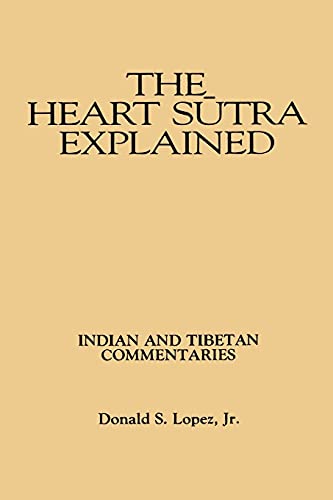
Renowned for its terse declaration of the perfection of wisdom, the Heart Sutra is the most famous of Buddhist scriptures. The author draws on previously unexamined commentaries, preserved only in Tibetan, to investigate the meanings derived from and invested into the sutra during the later period of Indian Buddhism.The Heart Sutra Explained offers new insights on “form is emptiness, emptiness is form,” on the mantra “gate gate paragate parasamgate bodhi svaha,” and on the synthesis of Madhyamika, Yogacara, and tantric thought that characterized the final period of Buddhism in India. It also includes complete translations of two nineteenth century Tibetan commentaries demonstrating the selective appropriation of Indian sources.”It makes a major contribution to Buddhist studies by bringing forth new and important material to contextualize one of the most beloved and well-known Buddhist texts, the Heart Sutra. It does so in a manner that is both scholarly and readable.” — Anne C. Klein, Stanford University
User’s Reviews
Editorial Reviews: Review “It makes a major contribution to Buddhist studies by bringing forth new and important material to contextualize one of the most beloved and well-known Buddhist texts, the Heart Sutra. It does so in a manner that is both scholarly and readable.” — Anne C. Klein, Stanford University
Reviews from Amazon users which were colected at the time this book was published on the website:
⭐Received the book a day earlier than expected and excellent condition. I bought the book expecting “Used-Like New,” to be slightly used but no…..this book was immaculate. It was wrapped in cellophane, then wrapped again in bubble wrap before being sealed into the mailer. Excellent weather protection.
⭐This is a seriously academic book, a bit of a heavy read, but the information, especially on Indian and Tibetan sources and commentary on the Heart Sutra is absolutely vital, much of it unavailable elsewhere.
⭐Great translation
⭐Even though it is only a single page in length, the Heart Sutra is probably the most famous Buddhist sutra. The Heart Sutra dates from about 350 A.D., by best estimates, and is part of the broad school of Buddhism known as the Mahayana, as distinguished from the earlier tradition known as the Theravada. The Heart Sutra is a distillation of a series of Mahayana texts known as the “Perfection of Wisdom” sutras some of which consist of as much as 100,000 stanzas. (The Diamond Sutra is the other well known Perfection of Wisdom sutra) The Heart Sutra thus is difficult in its brevity almost as much as in the profundity of its teachings.Professor Donald Lopez is a well-known academic Buddhist scholar whose books tend to take a historical, almost naturalistic approach to Buddhism. His early book, “The Heart Sutra explained” consists of the brief text of the Heart Sutra together with an introduction and a commentary. The commentary is not modern in character. Instead, Professor Lopez’ commentary is based upon the work of seven classical commentators on the Heart Sutra from medieval India written between about 750 and 1050 A.D. Professor Lopez also provides in full two Tibetan commentaries on the Heart Sutra dating from the 19th Century.Following the introduction, the first part of the book is a detailed commentary on the text of the Heart Sutra, beginning with the title. The commentary focuses on the two most famous parts of the Sutra, the difficult statement that “Form is emptiness; emptiness is form”, and the mantra near the conclusion of the Sutra, which is generally translated as “Gone, gone, gone beyond, gone completely beyond, enlightenment.”Lopez discusses the comments of the Indian and Tibetan commentators on each section of this text and also offers his own explanatory background information. The book is a difficult reading, of a difficult text and difficult commentaries. The book did help me with the text and helped me understand Mahayana Buddhism. The Heart Sutra presupposes in its readers a basic understanding of the earlier form of Buddhism and its teachings.The second part of a book consists of commentaries on the Heart Sutra by two 19th century Tibetan teachers. Both are lengthy and difficult. The first commentary is rationalistic in character, I think, while the second commentary is longer and takes a tantric approach to the text.I thought the title of Professor Lopez’ book, “The Heart Sutra Explained” was something of an overstatement, in that the Heart Sutra may be a text that resists and denies explanation. This notwithstanding, I learned from the book and feel better able to approach the Heart Sutra.There are many books available on Buddhism, but relatively few are based strictly on the Buddhist texts themselves and fewer still offer the reader the opportunity to approach the texts through ancient commentaries. Professor Lopez’ book does both. Although difficult, I think this textual approach is the best way to understand Buddhism for the serious student.Robin Friedman
⭐The page-long Heart Sutra is one of the most popular Buddhist texts, and this book is a scholarly examination of seven Indian commentaries (8th-11th centuries) and two Tibetan commentaries (18th-19th centuries) on the Heart Sutra.I’m a Zen practitioner and a Ph.D. student in religion, and I’ve wanted to know more about the Heart Sutra, but this book is so dense and thoroughly academic that it sat on my shelves mostly unread for several years. When I finally read it because it was assigned in a class, I found it rewarding and learned a lot about the Heart Sutra and Mahayana Buddhist thought more generally.If you’re a scholar of Buddhism or a Buddhist teacher preparing a talk on the Heart Sutra, you might find this a helpful and interesting book. Otherwise, I’d recommend one of these books instead, written by Zen teachers for Zen students: Thich Nhat Hanh’s ”
⭐,” Hakuin’s ”
⭐,” or Albert Low’s ”
⭐,” which includes a chapter on the Heart Sutra. Two other commentaries by Zen teachers (I haven’t read these): Sheng-yen’s ”
⭐” and Bernie Glassman’s ”
⭐.” There are also lots of commentaries available by Tibetan Buddhist teachers.
⭐Book gives a in depth investigation using many commentaries from Tibetan and Indian masters which is great for study and casual reader.
⭐Tough English. Not easily understandable.
Keywords
Free Download The Heart Sutra Explained (Suny Series in Buddhist Studies) in PDF format
The Heart Sutra Explained (Suny Series in Buddhist Studies) PDF Free Download
Download The Heart Sutra Explained (Suny Series in Buddhist Studies) 1987 PDF Free
The Heart Sutra Explained (Suny Series in Buddhist Studies) 1987 PDF Free Download
Download The Heart Sutra Explained (Suny Series in Buddhist Studies) PDF
Free Download Ebook The Heart Sutra Explained (Suny Series in Buddhist Studies)