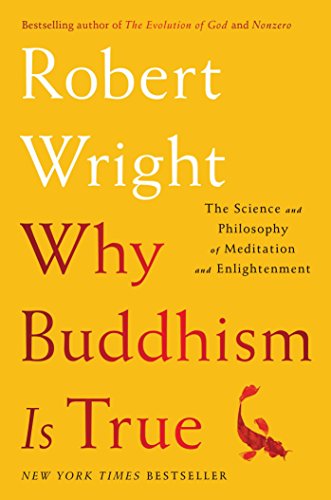
Ebook Info
- Published: 2017
- Number of pages: 336 pages
- Format: PDF
- File Size: 2.03 MB
- Authors: Robert Wright
Description
New York Times Bestseller From one of America’s greatest minds, a journey through psychology, philosophy, and lots of meditation to show how Buddhism holds the key to moral clarity and enduring happiness.Robert Wright famously explained in The Moral Animal how evolution shaped the human brain. The mind is designed to often delude us, he argued, about ourselves and about the world. And it is designed to make happiness hard to sustain. But if we know our minds are rigged for anxiety, depression, anger, and greed, what do we do? Wright locates the answer in Buddhism, which figured out thousands of years ago what scientists are only discovering now. Buddhism holds that human suffering is a result of not seeing the world clearly—and proposes that seeing the world more clearly, through meditation, will make us better, happier people. In Why Buddhism is True, Wright leads readers on a journey through psychology, philosophy, and a great many silent retreats to show how and why meditation can serve as the foundation for a spiritual life in a secular age. At once excitingly ambitious and wittily accessible, this is the first book to combine evolutionary psychology with cutting-edge neuroscience to defend the radical claims at the heart of Buddhist philosophy. With bracing honesty and fierce wisdom, it will persuade you not just that Buddhism is true—which is to say, a way out of our delusion—but that it can ultimately save us from ourselves, as individuals and as a species.
User’s Reviews
Editorial Reviews: Review “A sublime achievement.” —Adam Gopnik, The New Yorker“Provocative, informative and… deeply rewarding…. I found myself not just agreeing [with] but applauding the author.” —The New York Times Book Review“This is exactly the book that so many of us are looking for. Writing with his characteristic wit, brilliance, and tenderhearted skepticism, Robert Wright tells us everything we need to know about the science, practice, and power of Buddhism.” —Susan Cain, bestselling author of Quiet“I have been waiting all my life for a readable, lucid explanation of Buddhism by a tough-minded, skeptical intellect. Here it is. This is a scientific and spiritual voyage unlike any I have taken before.” —Martin Seligman, professor of psychology at the University of Pennsylvania and bestselling author of Authentic Happiness“A fantastically rational introduction to meditation…. It constantly made me smile a little, and occasionally chuckle…. A wry, self-deprecating, and brutally empirical guide to the avoidance of suffering.” —Andrew Sullivan, New York Magazine “[A] superb, level-headed new book.” —Oliver Burkeman, The Guardian“Robert Wright brings his sharp wit and love of analysis to good purpose, making a compelling case for the nuts and bolts of how meditation actually works. This book will be useful for all of us, from experienced meditators to hardened skeptics who are wondering what all the fuss is about.” —Sharon Salzberg, cofounder of the Insight Meditation Society and bestselling author of Real Happiness “Wright’s mix of conceptual ambition and humbly witty confiding makes for a one-of-a-kind endeavor—instead of a formulaic how-to book, a fascinating why-not-give-it-a-try book.” —The Atlantic“What happens when someone steeped in evolutionary psychology takes a cool look at Buddhism? If that person is, like Robert Wright, a gifted writer, the answer is this surprising, enjoyable, challenging, and potentially life-changing book.” —Peter Singer, professor of philosophy at Princeton University and author of Ethics in the Real World“Delightfully personal, yet broadly important.” —NPR“Rendered in a down-to-earth and highly readable style, with witty quips and self-effacing humility that give the book its distinctive appeal and persuasive power.” —America Magazine“[Why Buddhism is True] will become the go-to explication of Buddhism for modern western seekers, just as The Moral Animal remains the go-to explication of evolutionary psychology.” —Scientific American“Cool, rational, and dryly cynical, Robert Wright is an unlikely guide to the Dharma and ‘not-self.’ But in this extraordinary book, he makes a powerful case for a Buddhist way of life and a Buddhist view of the mind. With great clarity and wit, he brings together personal anecdotes with insights from evolutionary theory and cognitive science to defend an ancient yet radical world-view. This is a truly transformative work.” —Paul Bloom, professor of psychology at Yale University and author of Against Empathy: The Case for Rational Compassion“[Written] with such intelligence and grace.” —Patheos“What a terrific book. The combination of evolutionary psychology, philosophy, astute readings of Buddhist tradition, and personal meditative experience is absolutely unique and clarifying.” —Jonathan Gold, professor of religion at Princeton University and author of Paving the Great Way: Vasubandhu’s Unifying Buddhist Philosophy“Joyful and insightful… both entertaining and informative.” —Publishers Weekly (starred review)“A light, accessible guide for anyone interested in the practical benefits of meditation.” —Vox“A well-organized, freshly conceived introduction to core concepts of Buddhist thought…. Wright lightens the trek through some challenging philosophical concepts with well-chosen anecdotes and a self-deprecating humor.” —Kirkus Reviews“[Wright’s] argument contains many interesting and illuminating points.” —The Washington Post“Amusing and straight-forward…. Anyone… can safely dip their toes in the water here.” —BookFilter“Regardless of their own religious or spiritual roots, many open-minded readers who accompany [Wright] on this journey will find themselves agreeing with him.” —Shelf Awareness About the Author Robert Wright is the New York Times bestselling author of The Evolution of God (a finalist for the Pulitzer Prize), Nonzero, The Moral Animal, Three Scientists and their Gods (a finalist for the National Book Critics Circle Award), and Why Buddhism Is True. He is the co-founder and editor-in-chief of the widely respected Bloggingheads.tv and MeaningofLife.tv. He has written for The New Yorker, The Atlantic, The New York Times, Time, Slate, and The New Republic. He has taught at the University of Pennsylvania and at Princeton University, where he also created the popular online course “Buddhism and Modern Psychology.” He is currently Visiting Professor of Science and Religion at Union Theological Seminary in New York. Excerpt. © Reprinted by permission. All rights reserved. Why Buddhism is True Read more
Reviews from Amazon users which were colected at the time this book was published on the website:
⭐I loved this book. It was the final nail in the coffin of Buddhism for me. Along with Sam Harris’ “Waking Up” and Owen Flanagan’s “Bodhisattva’s Brain,” it broke the spell of secular mysticism. Because these books are written by brilliant, honest and diligent people, their attempts to create a secular, therapeutic Buddhism actually do a great job of outlining why the project is, if not pointless, then merely a hobby. Hobbies can be locally salutary for the hobbyist, but little more.This narrowest slice of the Buddhism cake out of which Wright wants to make a worldwide meal — secular, Western, Theravada, Vipassina — seems to be a popular diversion for the aging atheist who wants a late-in-life grand project and some intellectual cover for wishful thinking. Trying to repackage, say, Catholicism, wouldn’t be exotic and inspiring enough. Instead, Wright enjoys the convert’s blindspots to an old (yet new) religion. Being a first gen Buddhist, he is unburdened by parents who serve as painful counterexamples. (Yup, I’m a second gen guy).My biggest gripe with Wright is that he takes this narrowly defined notion, coats it in the novice’s zeal and then prescribes this “red pill” to the world. Yup, “The Matrix” is the best philosophical metaphor he can muster for the idea that “things are not what they seem.” Rather than a red pill, I’d see this as a red flag, a warning that the author can overlook some glaring and outlandish plot holes. (In the Matrix, the robot overlords use humans as batteries! They can create fine-grained illusory worlds, but can’t come up with better batteries than humans? Also, Keanu’s acting is about as lush and fruitful as a Zen rock garden.) I think Wright overlooks similarly large plot holes in the arcane, but sticky, spiderweb of Buddhist thought.As far as I can see after reading this book, there really is no workable meditative practice (beyond the minimal self help version) that doesn’t rely on either 1) a personal preference that shouldn’t be universalized or 2) explicit or implicit supernatural beliefs. I’m pretty sure that, if there were a workable secular Buddhism, Wright would have found it.He sure thinks he found it. In fact he thinks he’s found nothing less than personal and global salvation. Tribalism, he feels, is the “biggest problem facing humanity.” And meditation is supposedly the end of that. But he’s too good a writer, and too rigorous a scholar not to reveal the holes in his own argument.I’m not saying I’m going to surprise him with any of my objections. He’s done his homework. He’s even bravely interviewed quite a few “enlightened” meditators on his vlog. (Once they stop claiming to have quiet DMN and egoless minds, they describe what sounds like very normally middle class American lives.)My whole argument is nothing new to Wright. Just as he remains enchanted with the “hard problem,” I’m sure he will not be swayed by my arguments. Instead, I’m hoping the astute reader will drink the last drop of skepticism that Wright cannot let pass his lips. Wright veers off at the last moment, losing a game of chicken with the truth. Excuse my armchair psychoanalysis, (he offers these anecdotes up in his book, so fair game) he loses his atheist nerve because he can’t disavow the memory of his mother and his own innate yearning for Jesus-style salvation.The greatest counter examples to Wright’s most ambitious hope (the end of tribalism) are the millennia of Buddhist societies. Buddhist cultures are, on the whole, no better (though probably no worse) than any other culture. Certainly Buddhism and the Vedic traditions have proven themselves very compatible with war, tribalism, classism (Caste system!) and the oppression of women. The Tibetan word for “woman” literally mean “of inferior birth.” Also, Buddhism has not been a great incubator for science. Though the Dalai Lama is fond of science, it should be noted that he’s has to fly the scientists to him.The move Wright makes to avoid this mountain of historical evidence is to narrowly define his project as “Western Buddhism.” It’s new and improved Buddhism! And it’s all about the mindfulness. Wright must slice the cake this thinly because, “Two of the most common Western conceptions of Buddhism—that it’s atheistic and that it revolves around meditation—are wrong; most Asian Buddhists do believe in gods, though not an omnipotent creator God, and don’t meditate.”By focusing on mindfulness and on the individual benefits of that practice, Wright can claim to rescue the baby from the historical bath water. In other words, rather than answer the question of why most Buddhists don’t want to meditate (not a great endorsement), and why most Buddhist cultures are equally flawed to non-buddhist, he takes shelter in the idea that those Buddhist cultures are flawed because they are full of the wrong type of Buddhists. If you meditate, then you are on the right path, he says.But even amongst those who do meditate, there are plenty examples of jerks.Examples of evil meditators are shockingly common. Wright has to deal with the “Zen Predator.” Sexual exploitation of students by masters is so common — around 30% of US Zen schools have had public sex scandals. Wright (and Sam Harris) have both had to awkwardly wrestle with these all too frequent violations. Bless them both for at least admitting that this problem exists.There are two main strategies to deal with the Buddhist version of the “problem of evil” — what I call The Problem of the Evil Meditator. You either bite the bullet and admit that 1) enlightenment is indifferent to morality or 2) adopt incrementalism. The second is Wright’s main move. These evil masters just haven’t meditated enough, or they neglected to meditate broadly enough. Just as Wright claims (wrongly in my opinion) that evolution tends towards greater complexity, he also claims that meditation tends to lead one toward a more moral life. Hmmm.Most traditional Buddhist will use the universal spackle of reincarnation to cover these cracks. You don’t like to meditate? You’re molesting your meditation students? You just haven’t lived enough lives. But the secular Buddhist can’t avail themselves of this dodge. So Wright shrinks down the reincarnation dodge to an ideal on the horizon. You are on a path defined by an unattainable end. It’s the journey not the destination. Masters are more ideals than reality. (Stoicism uses the sage as the same escape hatch.) I’m not buying it. The ideal end doesn’t justify the failed means.Okay, you say, what about all the people whose lives have been improved by meditation? What about all this fMRI studies that show they are happier, more self-controlled? Well, Wright himself doesn’t lean very heavily on this neuro-proof. Wright sidesteps the current batch of fMRI research, relying instead on his personal anecdote. This is a smart move, because nothing beats “this worked for me” testimonials and they are by their nature beyond debunking.So why doesn’t he use the research? I think it’s because, there is a signal in the research, but it doesn’t yet amount to much more than the tautology that those who like meditating like to meditate. The most exhaustive meta studies (that Wright ignores) show very weak signals. And the research generally fails to make a very important comparison of meditation to other similar activities. For instance, if meditating about playing guitar brings benefit, wouldn’t actually playing bring even greater benefit?Regardless of the size of adept meditators’ PFC’s, it’s a fact that most Buddhist don’t meditate, and most people who start meditating stop. So if it’s a medicine, it’s a medicine few people want to take, and once you take it, you stop. It will be interesting to see how long Wright keeps it up.But wait (OMG, you’re still reading?) The greatest and perhaps most ambitious part of this book is that Wright is trying to place the Buddha in Darwin’s lap. This is Wright at his best, dropping some mad EvoPsych knowledge. He does a good job of showing how natural selection has not selected for happiness. So far so good. And the modal concept of mind is fascinating. This part alone was therapeutic to me in a CBT sort of way. But then he makes another false step. He implies that since the Buddha diagnosed the problem (I’m not sure that is true, but let’s grant it) then perhaps Buddhism has also found the cure. But why would that be the case? This is like trying to get the molecular structure of Dopamine by reading Democritus.So why does meditation help us understand that which the Buddha himself could not have known: The problem that natural selection doesn’t give a fig about our happiness; it only programs desires that lead not to happiness but to getting genes into the next generation? Wright suggests that by meditating on the nature of our consciousness we can get an essential added dimension of understanding, a better window into the exact way in which Evolution screwed us. It’s sort of a Mary’s Room of suffering. You can understand it intellctually, but you don’t grok it until you meditate.This is just unfounded. Even if you are just talking about our inner minds, there is no good reason to believe that meditation reveals anything more real than the meanderings of an unskilled mind. Wright makes the weaker claim that it only reveals something true about our consciousness. Mystic Buddhists on the other hand, including most who call themselves secular, implicitly make the claim that meditation is revealing something not just about the mind, but about the nature of reality, but Wright kinda demures on that point. However, to the extent that he is a mysterian about consciousness itself, when he claims that meditation reveals something fundamental about consciousness, he is making an implicit ontological claim. This is in my opinion a hidden mystical claim. Certainly the idea that merely examining subjective consciousness reveals something more than subjective consciousness is questionable.To show you why this is wrong, let me tell you something that happened to me during a guided meditation called a “body scan.” The instructor was focusing our attention on sensations in the body. Through her ignorance of anatomy, she suggested we should focus on the empty ventricles in our brains. There are no empty areas in the brain. But I felt them! I focused on them!Since then I’ve experimented. You can create all sorts of false sensations just by suggesting them to yourself. I’ve meditated on lungs in my forearm. Try it. You will feel them there too. Little lungs in your forearm expanding and contracting with each breath. This should lead you not only to be skeptical about the accuracy of focusing on sensations, but the viability of this project at all. If we are to escape illusion, how can more illusion get us there? If you can suggest a sensation that isn’t actually real, if you can feel things about your body that are demonstrably false, by what lights do you argue that merely reflecting on the subjective experience of consciousness will reveal something truer and more real about consciousness?It’s the qualia dodge, the idea that by focusing on a subjective experience you are ipso facto having a subjective experience. But in this case it actually works against itself. If it’s all false perception all the way down, on what foundation does your meditation instructor say “ah yes, you have entered the stream.” There is no standard by which you can prioritize the authenticity of one meditative experience over another. Why is one illusion more insightful than another?No, you say, the meditative focus is on something more primitive than this. You tune in to the field of consciousness itself. It supposedly exists between thoughts, between feelings, between sensations. You examine these entities to see that they are, like all of reality, not what they seem. And most importantly that there is no “self” doing the experiencing.Sorry, I’m not buying it. Wright is mixing up his types of seeming. Being a self is not the same sort of seeming as, to use a Sam Harris example, when you see a coiled rope and think it’s a snake. Upon further inspection you realize it’s just rope. This is not an illusion, it is a misperception. There is objective standards by which you can evaluate this concept. The sense of being a self, however, is not a misperception of this type. It is a locally valid — and irrefutable on its own terms — perception. Why? Because we have skin and skull. These are not arbitrary boundaries. We have cell membranes. There is a lot of chemical self-making going on in our bodies. It’s not an illusion. Beyond the Hume style intellectual interrogation of self, I don’t see how meditation can add anything.Yes, get bored enough at a month long silent retreat, and you can start to hallucinate that you don’t end at your skin or, in Wright’s personal example, that your foot tingling is as much a part of you as a bird singing. But this is like saying by spinning in circles long enough you can sense the intrinsic spin of the universe. Biology can explain why we have a sense of dizziness after spinning. We are not feeling the universe, we are feeling the fluid in our ear. Presumably, biology can also explain someday why meditators have fairly predictable experiences. But then it will be an explanation like, spin around in circles enough, and your inner ear will get confused.Being a self is not a misperception like mistaking a rope for a snake. It is an accurate perception like thinking the world is flat. You see, thinking the earth is flat is not actually an illusion. It is a perspectival truth. The earth is actually flat if you live on it. My cup stays on the table, the coffee stay in the cup. My level is level. It’s only if you want to look at Google earth, or launch a rocket, or wonder why you can see a ships mast over the horizon before the ship, etc. — it’s only under these situations that the world being round means something useful to you. But there is no normal human sensory input of the roundness of the earth, just as we can’t see molecules.Yes, the world is actually round, but when we see the world as flat we are not being fooled by our senses. It is, locally, actually truly flat. No amount of meditation on the actual roundness of the world will give you a vision of its actual roundness. There is no sense data for the roundness. You can meditate on the Earth’s roundness, you can conjure an image, but just like the lungs in my forearms, you will have “an experience”, but not really of the roundness. If you meditate on the Earth’s roundness, you are merely creating a suggested fantasy. This is exactly why there was no Buddhist science. The only reliable and productive way to see past seeming, to see past the Matrix, is not the red pill, it’s science. So sorry, you can’t escape the notion of self on an experiential level. You are just being a good little suggestible participant in a very old scam.We are stuck in our skull, like it or not. Buddhist meditation is simply replacing our perspectively valid sense of self with a hypnogogic implanted illusion. When meditators say they are experiencing that, they are certainly experiencing “something” and something that can be produced with reasonable frequency. However, they aren’t actually experiencing what they say.How do I make this claim? If you want there to be something being observed beyond the normal sensory welter, then it is actually on the Robert Wrights and the Sam Harrises of the world to explain what a brain can access that is getting into the skull. What exactly is the input? Sam Harris wants there to be a “field of consciousness” but then he’s participating in a slightly more nuanced version of Deepok Chopra’s “universal consciousness.” This is not the sort of stuff for serious people.In short, if everything is an illusion, how can you claim that the experience of “no self” isn’t also an illusion? Wright wants to say that you are having the experiential dimension of the Darwinian truth. I buy the Darwinian part, but I see no good reason to buy the claim that highly contrived brain states (most people cannot attain it) are any more authentic than, say, an acid trip.Most readers are reading this book for the more practical claims. For happiness and well being. If you love Buddhism and meditation, keep loving them. This book will preach wonderfully to your choir, though you might want to skim the parts where Wright whistles through the graveyard of spirituality. But If you do want to be a Buddhist, remember What Owen Flanagan makes beautifully clear in his book: if you want to be a Buddhist, you are having a mere preference for a type of happiness. It is not an ultimate, universal or superior happiness. It is a Buddhist definition of happiness. Actually, its only one type of Buddhism’s one definition of happiness.When Wright’s instructor cautioned him, “I think you may have to choose between writing this book and liberation.” Wright obviously chose writing the book. “I’m a writer” he says, “and I consider pretty much everything I do grist for the mill.” Turns out Wright doesn’t’ really want Buddhist Nirvana. Robert Wright’s nirvana involves writing books. It is no less of a Nirvana than his instructor’s, and I’m so glad that he didn’t let her talk him out of it. And I applaud him loudly when he says in the acknowledgments about his daughters, “If being enlightened would mean not seeing essence-of-wonderful-daughter when I look at them, I’m glad I haven’t attained enlightenment!” So please buy this book and read it carefully. Wright does a heroic job of trying to place the Buddha on Darwin’s lap. He lucidly explains the current understanding of evolutionary and neuro psychology. Where he fails is in his attempts to show that meditation is 1) a cure for the pains bestowed on us by natural selection and 2) a window into a deeper understanding of that world.Feel zero regret if you don’t like meditation. You will have to be strong in your convictions though, because we are in the midst of a culture-wide mindfulness onslaught. If you don’t want to meditate before class or a work meeting, you will be putting yourself at a distinct cultural disadvantage. This is, after all, the new salvation of the cognoscenti, so if you reject it, you are likely to be branded a philistine or a wanton.You should feel no more insult from these supercilious attitudes than you would from any hobbyist who condemns you for not enjoying their hobby. Wright doesn’t admit it (though I think he kind of does), but he likes Buddhism the way an avid ping pong player likes ping pong. It’s okay if ping pong is your thing (and should they ever do an fMRI study of ping pong nuts, they will see that their brains respond accordingly), but those of us who don’t like ping pong are off the hook.
⭐I should say as a preface that one of the things I need to work on is my tendency to be snarky about things that may be exactly what someone else needs, but that just don’t appeal to me where I am right now. Having said that, I expect that there will still be some snark below, but be assured that prior drafts were much worse.My main criticism of this book is that, in the service of making the case that Buddhism (or a subset of it) is compatible with science (or a subset of it), the book presents superficial, and in some cases misleading, pictures of both.Also the author drops a lot of names, which always annoys me. :)If you haven’t read the book yet, and are curious about Buddhism or doubtful that it could be true, I certainly wouldn’t discourage you from reading it! And you might want to read it first, and then come back and read this after, so that my problems with it don’t color your own reading of it.Now, onward to the content!Here is a sentence that captures in extremely compact form some of the things that I would critique in this book:”From the perspective that Einstein considered the truest perspective—the point of view from no particular point—feelings don’t even exist, and so essence doesn’t either.”Pretty much everything here is questionable.It rests on the notion that Einstein’s physics is based on some “point of view from no particular point”; but this is exactly backwards. The theory of Relativity came out of considering what it would be like if every measurement were seen as relative to its particular reference frame (point of view), and all reference frames were basically equal; there is no special Absolute, no “from no particular point”, no “truest perspective”.Even if Einstein’s physics had included some “view from no particular point”, I think we know enough about Einstein the person, to be confident that he would never have thought that in “the truest perspective”, “feelings don’t exist”. Because feelings obviously do exist, and any perspective that says that they don’t, is wrong, and therefore not “truest”.Feelings may be helpful or unhelpful, rational or otherwise, and so on; but they certainly exist.I found the treatment of “feelings” in the book to be problematic in general. In places they are rather casually identified with the Buddhist categories of clinging and aversion and attachment, but to my mind that is a mistake. Certainly some feelings are feelings of aversion or attachment, but others are just feelings; the cool of water, the joy at beauty, normal hunger and thirst, and those can exist just fine without our clinging to them, or to their absence.The book’s argument moves from noting that our feelings aren’t always reliable guides to right behavior (which is perfectly reasonable), and that Buddhism counsels not clinging to them or fleeing from them but just letting them be (also fine) to suggesting that feelings don’t actually exist, and that people further along the Buddhist path will have fewer of them.That last thing, I think, is confused in an important way. Elsewhere in the book, the author devotes a longish section to the worry that if Buddhist practice causes people to have fewer feelings, they will do less to help make the world a better place. We get somewhat wince-inducing sentences like”If full-on enlightenment means you quit making value judgments of any kind and quit pushing for change, then count me out.”to which (and I’m guessing it’s because early readers expressed concerns about that sentence) is attached a long footnote about how other people have worried about this, too, and after all”[T]here are people who follow the Buddhist path pretty far, and become happier people, with more equanimity than they had before—and this equanimity does indeed diminish their passion for making the world a better place.”(Are there, really? People who were doing good in the world, took up a Buddhist practice, and stopped doing as much good? I’d have to see some evidence for that; if true, I’d say they were Doing It Wrong. On the other hand, if they did more good in the world, but just didn’t have as much “passion”, how is that a problem?)He concludes that, oh well, most people aren’t advanced enough in Buddhism to have become sessile nihilists, and the few that have at least aren’t out there making things worse, so maybe it’s okay.Which seems like small comfort indeed!The answer to this concern seems very simple to me, and given the author’s friends and credentials, it seems odd to me that he doesn’t mention it. Maybe I’m wrong, but…Zen masters in stories are always saying things like “Chop wood, carry water”, and “When hungry eat; when tired, sleep”. No master ever says “Because I do not feel aversion for hunger, I do not eat; because I do not cling to cooking, I do not chop the wood.”The author appears in places to be claiming that the only reason for doing anything is that we have an aversion to the way that things are now, and we cling to the idea of them being different, and so we take an action to make a change.But the point of all these stories is that that isn’t it. I eat when I am hungry because that is the thing I do when I am hungry, not because I think or feel “oh, no, I am hungry again, I’d better eat!”. The monk chops the wood so the fire can be made and the dinner cooked, not because they cling to and identify with and obsess about the shape of the wood, or the making of the fire. It is just the thing that needs to be done.We work to save all sentient beings because that is the thing that we do; we work to feed the hungry because that is what we do when people are hungry, just like we eat to feed ourselves when we are hungry. It’s not because we cling to not-hunger, or because we feel aversion for hunger; it’s just because it’s what one does naturally.Someone far along the Buddhist path will not be burdened with aversion and clinging, and that can mean that they will be more, not less, effective in making the world a better place.In the inner rather than the outer world, the author notes that having fewer bad feelings is good, but we don’t want to have fewer good feelings! And that in fact meditation seems to help him enjoy the beauty of nature, while letting him be grouchy less, so maybe it somehow reduces bad feelings more than good.Here, too, I think the answer is that meditation and Buddhist practice aren’t about reducing “feelings” per se, at all; they are about reducing clinging to feelings (and to everything else).Reducing clinging helps with appreciating good feelings like beauty, because it quiets that voice that is bemoaning in advance the fact that the beauty is fleeting, and vainly wishing it would stay longer. And it helps in dealing with bad feelings because it helps us stay at just “owch”, rather than “owch that hurts, argh why won’t it stop, I hate pain, what if it hurts forever!?!?”.Okay, so that’s that. 🙂 Then there’s the “and so essence doesn’t either” part.The book spends quite a lot of time on “essence”. The idea is that one of the main ways that our senses (or our minds) fool us, is that we “see essence” in all sorts of things. It’s not obvious to me just what this is referring to, and there’s a footnote that acknowledges the obscurity in a way, by explaining that the meaning of “essence” in the book doesn’t correspond completely to how either psychologists or Western philosophers use the term, but instead is “focusing more on people’s ‘sense’ of essence” (where “sense” is both in quotation marks, and in italics), “– a sense that may be highly implicit”. He refers to “seeing essence-of-wonderful-daughter” when he looks at his daughters (and worries, as above, that attaining enlightenment might mean not seeing that anymore).Now I myself have a wonderful daughter, and a wonderful son, but when I look at them I don’t see some abstract concept involving essence-of-something; I just see them. And they are wonderful!My impression is that the author’s bringing up this notion of “essence”, as a sort of pre-Renaissance Luminiferous Aether, lets him more easily make sense of the various Buddhist claims about emptiness, about things not really existing, or not really being what we think we are. By first saying that we see Essence in everything, he can interpret those statements as saying that things are empty of Essence, and that they aren’t what we think we are because they don’t contain Essence, and so on.And this is very plausible, since Essence isn’t a thing at all, so if Buddhism says that things have no Essence, it’s true!Unfortunately (or fortunately), I don’t think it’s that easy. It’s not just that a chair doesn’t “contain essence-of-chair”; it’s that what we call a chair isn’t really a thing at all, in the way we tend to assume. “Chair” is just a convenient label that we use. There’s some heavy stuff here, both in the Diamond Sutra’s constant repetition of phrases like that, and in the modern physics sense that the only underlying “real thing” is the Universal Wave Equation, and everything else is just convenient but inaccurate shorthands. See also Wittgenstein on language as pragmatically-useful symbols that we make at each other, rather than some magical “correspondence to reality”.And in the more human realm, if I look at someone and think “oh, there is that mean guy”, just realizing “oh, the mean guy doesn’t contain essence-of-mean-guy!” isn’t going to help me as much as realizing “oh, that’s just a person like me, who is sometimes mean; like me!”.It’s possible, of course, that all this is exactly what the author means by “essence”, and I’m just finding the abstraction to be unhelpful and distracting in getting there; maybe someone else will find it helpful.The same general concern applies to “the modular model of the mind”, which the author discusses at some length. It’s a moderately interesting model itself, but it’s just a model rather than a theory, in that it gives us metaphors and ways of thinking about the mind, but doesn’t really make any predictions.It’s in the book here because one thing it proposes is that we think of the mind, not as a single unified thing, but as set of “modules” that have different goals and roles. It’s subtler than, but I have the impression similar to, Freud’s ego, id, and superego; and very reminiscent of Minsky’s Society of Mind.The author connects this not-unified model of the mind, to the Buddhist idea of not-self, the notion that the self, as a unified self-originating ongoing entity, doesn’t exist. The suggestion is that this is compatible with science, because science also says at least that the mind isn’t unified, because modular model.But again I don’t think this quite works. The Buddhist teaching isn’t just that the mind isn’t unified. The mind doesn’t exist as a set of distinct “modular” self-originating ongoing entities, either. Exactly what the Buddhist teaching of not-self means, and how it relates to subjective consciousness (my own favorite quandary) is a deep mystery, and just “it’s like there are a bunch of different modules” doesn’t really seem germane.And in fact his fondness for the module theory seems to get in the way of the author’s understanding; here as in some other places in the book, he is like the visitor who gets a lap full of tea because his cup is too full for any more to go in:’In fact, the modular model of the mind has led me to attribute less agency to thoughts than some meditation teachers do. Though these teachers are inclined to say that “thoughts think themselves,” strictly speaking, I’d say modules think thoughts. Or rather, modules generate thoughts, and then if those thoughts prove in some sense stronger than the creations of competing modules, they become thought thoughts—that is, they enter consciousness.’He can of course think that if he wants to, but from the point of view of Buddhist work, it seems like a step backwards: now rather than just realizing that the mind is empty, he’s going to have to realize that all of these modules he’s convinced himself of, and the metaphorical competition between them, are empty also. Better to have skipped the module stuff altogether, I tend to think.I don’t mean to say here that the book is all wrong, or bad. The basic point, that both Buddhism and science tell us that our feelings and thoughts and reactions to things aren’t always correct or optimal, and that there are things we can do to improve them, is a good one. But I found the specifics a bit off, not really accurate readings of either the Buddhism or the science, and because of that not especially compelling.So probably it’s good that I pretty much already agreed with the basic conclusion. 🙂
⭐We see the world through the distorting lens of natural selection – that’s the central idea in Wright’s enlightening book – but what is good for getting our genes passed onto the next generation (all that natural selection cares about) does not necessarily make for the good life. However, many centuries ago Buddhism came up with a way to look beyond our knee jerk reactions of attraction and repulsion. It is called mindfulness meditation and Wright adds modern knowledge from neuroscience and psychology to show how we can have a truer sense of our best interests and thereby gain more self-control.In particular, he is interested in two Buddhist concepts: not self and emptiness. Incidentally, these are two ideas I have long struggled with… Let’s start with emptiness because Wright helped me finally nail this idea. Although we see, for example, our home as the source of security, continuity and lots of warm feelings associated with family, it is really just a pile of bricks and mortar. In the Buddhist sense it is an empty concept onto which we have projected all these emotions. Sure, our home evokes lots of strong reaction but a passing stranger would just see a house and react to the architecture or the location – which once again carries various cultural projections about whether a detached house is better than a semi-detached and how close it is to shops or how remote (which are all equally arbitrary criteria). As a therapist, I’m used to the concept that nothing is inherently good or bad but coloured by how we marshal our experiences, our prejudices and our expectations.So good so far… but not-self is a much tougher idea. What I did find interesting is that Wright scuppers the idea of self as CEO which sits somewhere inside us and decides rationally what actions to take. Instead he uses neuroscience to explain that we have various modules that take charge. Rather than fighting temptation – for example to eat high sugar and fat foods – he suggests using the acronym: RAIN. Recognise the feeling, Accept it, Investigate the feeling and finally – the hard bit but meditation apparently helps – to Non-identify with the feeling and have Non-attachment to it. In this way the urge is allowed to form but does not get constantly re-inforced by the short term pleasure of, for example, eating the cake. Thus the link to the reward is broken and although the urge might still blossom without gratification it reduces and ultimately subsides.The downside to this book is that Wright – like the majority of us – is a relative beginner to meditation and when it comes to seeking clarifications about Buddhism and enlightenment, he has to interview people further along the road. My suspicion is he often hears what he wants to hear, simplifying the arguments and glossing over the complexities of his case. Having said that I am convinced that I need to meditate more and take on board the concept of emptiness – because it is my attachment to particular things and outcomes which is often the source of so my unhappiness.A useful book that I will stay with me for a long time and I recommend to others who want to take the red pill and see the ‘truth’.
⭐After reading any book, I spend some time asking myself if I learnt anything useful from it, or if it made me look at the world in a way that I hadn’t considered before, and in this case the answers to both these questions is a resounding “no”. The trouble is that this attempt by an academic, who happens to have dipped his toes in a bit of meditation, to then try and pull together strands of philosophy, science, and various flavours of Buddhism into a coherent whole is a complete failure. In the realms of the spiritual and the mystical, logic , and dissection by the intellect , rarely, if ever, will arrive at the truth. The book has interesting parts, but at times it’s simply too long winded, and in the end it was a relief to finish it. For any serious spiritual seeker, I strongly recommend reading and watching the work of Eckhart Tolle or Sadhguru, or lesser known teachings from Robert Goodwin. If you want science, go to a scientist, if you want spirituality go to the great spiritual teachers of our time. If you want a wishy washy soup of both that satisfies neither appetite, read this.
⭐As someone who’s a scientist but also has an interest in secular buddhism, this book is amazing and I can’t recommend it enough. Wright does a great job of taking you on a journey of logic, not for the purpose of converting anyone to a buddhist way of thinking, but just to simply show that the buddha’s philosophy makes a lot of sense. The buddha made observations about human psychology thousands of years ago, and Wright excellently puts that into the context of modern living.
⭐Just read Evolutionary Psychology by David Buss and as I have been trying to understand Buddhism for 50 years or so, I wondered how the two related to each other. The net immediately identified Why Buddhism is True and the rather brave author delivered abundantly. He confirmed the idea that dukkha as interpreted as unsatisfactoriness would enhance survival to reproduce. Mr Wright’s honest description of his experiences during meditation are very helpful. He clarified the emptiness/formless ideas and helped me understand ‘conditioning’ very clearly. His discussion of no self enabled me to identify two slightly different points of view, one where the thoughts and feelings are not part of you which is his point of view, and the other where the thoughts and feelings are part of you, but not all of you, which I lean towards. Perhaps the other aspect he clarified that the word attachment could, depending on context, mean being ‘lost in thought’ i.e. conscious awareness being entrained in the thought stream as opposed to the mindfulness observation of the thought stream, is related to the two points of view about no self. His discussion about how the loving kindness towards all sentient beings could arise was not convincing to me, and would obviously be a great step towards avoiding conflict, but if we did see through the little tricks natural selection has programmed into us we may stop reproducing.
⭐This book is very different (in a good way) to many on Buddhism because it dares to approach the subject from some unique and intriguing perspectives that I suspect will thoroughly enthral you.While my Favourite Book on Eastern Philosophy / Religion remains Freedom From the Know (by that acknowledge Master Krishnamurti) the Book under review is now firmly in my Top 3 Sharing a shelf with the aforesaid, and with Eckhart Tolle’s Power of Now.To share bookshelf space with Krishnamurti and Eckhart Tolle, you’ve really got to deliver something special – this book most definitely does! Think you’ll love it.
Keywords
Free Download Why Buddhism is True: The Science and Philosophy of Meditation and Enlightenment in PDF format
Why Buddhism is True: The Science and Philosophy of Meditation and Enlightenment PDF Free Download
Download Why Buddhism is True: The Science and Philosophy of Meditation and Enlightenment 2017 PDF Free
Why Buddhism is True: The Science and Philosophy of Meditation and Enlightenment 2017 PDF Free Download
Download Why Buddhism is True: The Science and Philosophy of Meditation and Enlightenment PDF
Free Download Ebook Why Buddhism is True: The Science and Philosophy of Meditation and Enlightenment