

Ebook Info
- Published: 2018
- Number of pages: 172 pages
- Format: PDF
- File Size: 1.02 MB
- Authors: Burton W. Folsom
Description
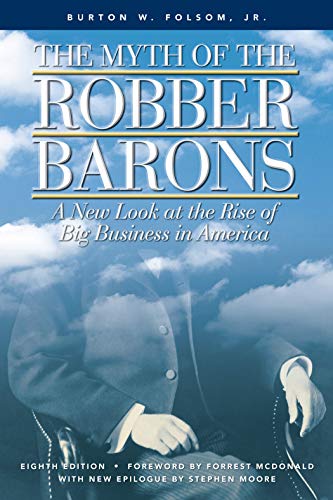
The Myth of the Robber Barons describes the role of key entrepreneurs in the economic growth of the United States from 1850 to 1910. The entrepreneurs studied are Cornelius Vanderbilt, John D. Rockefeller, James J. Hill, Andrew Mellon, Charles Schwab, and the Scranton family. Most historians argue that these men, and others like them, were Robber Barons. The story, however, is more complicated. The author, Burton Folsom, divides the entrepreneurs into two groups market entrepreneurs and political entrepreneurs. The market entrepreneurs, such as Hill, Vanderbilt, and Rockefeller, succeeded by producing a quality product at a competitive price. The political entrepreneurs such as Edward Collins in steamships and in railroads the leaders of the Union Pacific Railroad were men who used the power of government to succeed. They tried to gain subsidies, or in some way use government to stop competitors. The market entrepreneurs helped lead to the rise of the U. S. as a major economic power. By 1910, the U. S. dominated the world in oil, steel, and railroads led by Rockefeller, Schwab (and Carnegie), and Hill. The political entrepreneurs, by contrast, were a drain on the taxpayers and a thorn in the side of the market entrepreneurs. Interestingly, the political entrepreneurs often failed without help from government they could not produce competitive products. The author describes this clash of the market entrepreneurs and the political entrepreneurs. In the Mellon chapter, the author describes how Andrew Mellon an entrepreneur in oil and aluminum became Secretary of Treasury under Coolidge. In office, Mellon was the first American to practice supply-side economics. He supported cuts on income tax rates for all groups. The rate cut on the wealthiest Americans, from 73 percent to 25 percent, freed up investment capital and led to American economic growth during the 1920s. Also, the amount of revenue into the federal treasury increased sharply after tax rates were cut. The Myth of the Robber Barons has separate chapters on Vanderbilt, Hill, Schwab, Mellon, and the Scrantons. The author also has a conclusion, in which he looks at the textbook bias on the subject of Robber Barons and the rise of the U. S. in the late 1800s. This chapter explores three leading college texts in U. S. history and shows how they misread American history and disparage market entrepreneurs instead of the political entrepreneurs. This book is in its seventh edition, and is widely adopted in college and high school classrooms across the U. S.
User’s Reviews
Editorial Reviews: Review Burton Folsom’s The Myth of the Robber Barons constituted one of the first shots in the revolution against liberal theology masquerading as scholarship. More importantly, it was easy to read and tailor made for students. –Larry Schweikart, New York Times bestselling author of A Patriot’s History of the United StatesA masterpiece. It is my favorite single book of economic history. –George Gilder, New York Times bestselling author of Wealth and PovertyTaking on false narratives, Burton Folsom has written a highly educational and insightful account of America’s business history that can also be applied to today’s policy debate. It belongs on every bookshelf. –Michele Bachmann, Congresswoman, Minnesota’s 6th District About the Author Burton W. Folsom, Jr. is the Charles Kline professor of history and management at Hillsdale College in Michigan. He received his Ph. D. from the University of Pittsburgh, and has taught U. S. history at the University of Nebraska, the University of Pittsburgh, Murray State University, and Northwood University. He has also been a senior fellow at the Mackinac Center for Public Policy in Midland, Michigan; and historian in residence at the Center for the American Idea in Houston, Texas. He has written articles for the WALL STREET JOURNAL, THE AMERICAN SPECTATOR, POLICY REVIEW, and HUMAN EVENTS. Professor Folsom’s first book was Urban Capitalists. His later books include Empire Builders, No More Free Markets or Free Beer: The Progressive Era in Nebraska. He has two edited books, The Spirit of Freedom and The Industrial Revolution and Free Trade. His articles have appeared in the Journal of Southern History, Pacific Historical Review, Journal of American Studies, Great Plains Quarterly, The American Spectator, and The Wall Street Journal. He is a columnist on economic history for The Freeman for Ideas on Liberty.
Reviews from Amazon users which were colected at the time this book was published on the website:
⭐Too often the so-called Robber Barons have been portrayed as having only one “side” – the unpleasant/greedy side. The author does a very good job of presenting the “other side” – the benefit the early and efficient capitalists brought to the country and the world of business.
⭐The Myth of the Robber Barons — A New Look at the Rise of Big Business in America, by Burton W, Folsom, Jr., Ph.D.a short Book Report by Ron HousleyWhen I was a child in New Jersey, the Lehigh Valley Railroad practically ran through my back yard. Every day at suppertime a dark red passenger train, powered by one of those ALCO PA diesel locomotives, roared by and I always wondered where it came from, where it was going, and who was on it. Little did I know that Charles Schwab’s Bethlehem Steel produced the rails, that Lehigh was actually part of Pennsylvania, that the railroad in my backyard was a symbol of American industrial history — which I wouldn’t fully learn about for decades to come. Folsom’s book colored in more of the missing pieces for me.Burt Folsom shows us that the industrialization of America was not a “pure” story of individual productivity. Rather, it was a story seriously contaminated by ongoing instances of innovation-stifling government intrusion (think: special privileges, regulations, subsidies, fines, charters, tariffs and miscellaneous obstructionism) at every turn, just a little at first but ever more as the years ticked by. And we learn in this volume to be on the lookout for those never-ending contaminations —— which prevented the story from being one of productive capitalism and turned it into a story of how government coercion always makes things worse and can damage an entire civilization’s understanding of what productivity and industrialization depends upon.Folsom’s little book from 1987, now in its seventh printing, lays out the basic facts of notable American entrepreneurs. And woven into each story we see the same history repeating itself over and over: economic growth stifled by coercive government forcing citizens to misallocate their wealth.The culture at large painted each of the successful industrial pioneers as an object of scorn, as if each had stolen, rather than created, his wealth.Vanderbilt, for instance, uprooted Robert Fulton’s state-granted and state-enforced monopoly of all steamboat traffic in New York; he was instrumental in removing government force from the economic equation; he relentlessly competed against federal aid to other steamboat operators; and when he out-competed even the most heavily subsidized shipping lines, he was vilified and hated for his success.These American producers were likened to the “Robber Barons” of medieval Germany who used force to extort wealth from innocent merchants. “Robber Baron” turned out to be an effective smear, casting paragons of virtue and productivity with the opprobrium ordinarily reserved from rapists and murderers.Those who benefited most from the new comforts afforded by the industrial revolution were the ones who most vehemently denounced the very men who made those comforts possible.It was these envious and vengeful regressives who ultimately rose to prominent numbers in government, in academia and in the press. These were the ones who clamored for federal subsidies and loans (think: Solyndra, today, or railroad land grants, back when); these were the ones who threw up obstacles to economic development (think: ICC, FTC, anti-trust); these were the ones infecting the American culture of freedom with the notion that protecting individual rights was, therefore, the central mistake of our country’s founding (!).So, all during the careers of Vanderbilt, of the Scranton’s, of Rockefeller, of Carnegie and Schwab, of Mellon, there was a cultural counter-current, even as the developing industrial revolution was lifting the masses out of poverty for the first time in human history.Each instance where an industrial hero created new wealth and opportunity where none had existed before, the counter-current grew louder.And what was the counter-current? It was the growing chorus in support of government confiscating this newly created wealth and distributing it to non-producers; in support of disallowing inheritances; in support of throwing up obstacles to business growth; in support of coercively imposing equality of wealth —— never mind the producer who created the wealth in the first place; and never mind the impact on would-be future producers.The counter-current was a resurrection of the Christian morality outlined in The Sermon on the Mount; it was given new energy by 19th century German philosophers; it was smuggled into America by the country’s intellectuals, not the least of which was Woodrow Wilson who had pursued his graduate education in Germany, itself.Never mind that millions of Americans suddenly were lifted out of century’s-old poverty; never mind the new opportunities suddenly available to anyone willing to pursue them; the culture was already under the spell of this “new” (think: old) moral philosophy insisting that our foremost moral duty is to sacrifice ourselves to others — i.e., otherism, or, altruism.Folsom’s book gives us a glimpse into the phenomenon of wealth creation itself. We see that it depends entirely upon the focused effort of individuals.And side by side with stories of wealth creation we see how the wealth destroyer gradually but steadily took command of the culture’s hatred for individual productivity. We see how the bias against individualism has been woven into today’s indoctrination which passes for education.To me, Folsom’s most compelling act was to make solidly concrete the picture supporting an otherwise abstract principle: productivity requires freedom. It is a principle practically lost by today’s culture.
⭐There is a perception that most of the industrialists who developed new ways of solving business problems between 1820 and 1930, enriching themselves in the process, were greedy, unethical and harmful to their customers. This perception is strongly repudiated by Burton Folsom in The Myth of the Robber Barons as he demonstrates how college textbooks and other media have irresponsibly perpetuated erroneous versions of economic history.Dr. Folsom carefully distinguishes between political entrepreneurs, such as Robert Fulton (steamboats) and market entrepreneurs, such as Cornelius Vanderbilt (steamboats and railroads). The political entrepreneurs relied on government subsidies and other preferential treatment to develop new industries in ways that legislators thought would be beneficial, but these political entrepreneurs operated inefficiently and provided inferior quality of service at higher prices than the market entrepreneurs.All the market entrepreneurs in the book are good examples of achieving business success through motivating employees to perform at high levels and providing customers with excellent value. And while most of them donated a lot of money to worthy charities, many of them had imperfect personal lives. Two who seem to have been excellent role models in all facets of their lives are John D. Rockefeller and Andrew Carnegie.I cannot determine why Dr. Folsom chooses to use Charles Schwab instead of Carnegie as the primary market entrepreneur example in the steel industry. Both men seem to epitomize the book’s theme, but there is little information about Carnegie other than that he was a mentor for Schwab who liked the way Schwab took over the business at Carnegie Steel, but not the way Schwab conducted his personal life.The John D. Rockefeller chapter contains an amazing paradox. “He put God first, his family second, and career third. This is the puzzle: how could someone put his career third and wind up with $900 million, which made him the wealthiest man in American history?” As Dr. Folsom elaborates, maybe the solution to the puzzle can be found in Malachi 3:10. And maybe this is a lesson for all of us Christians who choose not to tithe because we think resources are limited.Rockefeller had to overcome many obstacles in order to achieve his goal of being the biggest and best refiner in the world. One of the obstacles was competition with Russian refiners, who had many natural advantages, including proximity to European and Asian markets. Another obstacle was unenlightened U.S. government policies. Rockefeller found it efficient to set up separate Standard Oil corporations in many different states directed in trust by the same board of directors. In 1911, the Supreme Court forced it to break up into separate state companies with separate boards of directors. As Dr. Folsom points out, it was hard to determine how this was a violation of the “restraint of trade” clause in the Sherman Act because of the amount of international competition from the Russians and domestic competition from Gulf Oil and others.Andrew Mellon has been vilified for being a somewhat different type of “robber baron.” His reputation derives from his service as Secretary of State, where he implemented policies to benefit all taxpayers, but particularly those at the lower end of the income spectrum. Mr. Folsom documents that the intent and the results of the dedicated efforts of President Coolidge and Secretary Mellon were for lower income earners to receive the largest benefits proportionally. Also, even though tax rates decreased, tax revenues increased.The author also strongly hints at another fairytale – the Myth of Benevolent Elected Officials who protect the Public from Greedy Monopolistic Entrepreneurs. Completely dispelling this myth is somewhat outside the scope of this work, but there are at least two examples of unenlightened legislation that had unfortunate unintended consequences.1. The Sherman Anti-Trust Act of 1890 was intended to outlaw combinations that restrained trade but had the effect of punishing businesses that achieved economies of scale through consolidation that were passed along to customers in the form of lower rates and better service. This resulted in the dissolution of James J. Hill’s Northern Securities and John D. Rockefeller’s Standard Oil.2. The Hepburn Act of 1906 that made it illegal for railroads to charge different rates to different customers had several negative consequences. One was requiring rates to be published 30 days in advance and made it impossible to change rates to keep up with changing market conditions. Secondly, James J. Hill of the Great Northern Railroad was prevented from extending special rates to Asian importers of cotton and wheat to introduce them to American exporters.
⭐This book tells the truth – and that is what a history book should do. It does not hide the bad things about the businessmen it writes about, Charles Schwab being an adulterer and wildly extravagent, but nor does it hide their achievements.One of the central myths of economic history is that individuals do not matter, that X, Y, Z, economic developement were automatic in some way. This work shows that indiviudals do matter – that people like John D. Rockefeller had ideas and put them into practice, and that other people of their time had neither their ideas not the ability to put them into practice (an incredibly difficult and complex undertaking). That the individual genius of certain people changed the lives of millions of people – and changed them for the better, producing better products at lower prices.The central myth, that men like John D. Rockefeller became rich by “robbing” (or “exploiting”) people, is shown to be just that – a myth. Such people became rich by serving their customers – by producing new products (or higher quality products) and reducing their prices. Whilst (at the same time) paying the highest wages in history and the highest wages of any major nation of the time. There is plenty of violence in American history – such as the armed attacks on J.J. Hill’s Great Northern railroad organized by the rival Union Pacific railroad, or the terrible killings during fighting in strikes that so sickened Andrew Carnegie that he got out of the steel business (selling out to J.P. Morgan and co), but to pretend the violence was about robbing people or this was the way wealth was created is simply false.It is totally true that government subsidized certain businessmen – but they tended to be the businessmen and groups that failed. The competitors of J.J. Hill were all subsidized – and they failed. Vanderbilt was a nasty rude man – but it was his competitors who were subsidized (not him) and they failed, and so on.Burton Folsom rightly divides businessmen into “government entrepreneurs” who concentrated in getting governement subsdies and other support, and “market entrepreneurs” who concentrared on offering their customers the best products at the cheapest prices. And Folsom points out that in American economic history it is the latter group (the market entrepreneurs) who made the difference.This is dealing with the general myths – myths spread by school and college history textbooks. The “organizational” myth (that individual businessmen do not matter – “someone will do it”) and the Marxist myth (wealth is created by “exploiting” people). But their are also explicit lies (not to strong a word) taught about specific businessmen, lies that Folsum exposes and refutes.Perhaps the worst case of smearing is that of Andrew Mellon.Not only was Mellon repeatedly accused of tax fraud (smears from the 1930s to the present day) of which he was innocent. But his political work has also not just been distorted, but has been the victim of downright lies – lies told in the major school and college textbooks.Andrew Mellon was perhaps the only major market entrepreneur to go into politics – so his is the only political life to be examined in this book.In textbook after textbook (written by the supposed guiding lights of the study of American history) Andrew Mellon is smeared. Specifically he is accused (again and again) of shifting the burden of taxation from the rich to the middle class and the poor. Burton Folsom shows that this simply is not true – that not only did Mellon’s reductions in the top rate of income tax in the 1920s mean that the rich paid MORE money to the government (that the money was brought out into the economy – rather than being hidden away to avoid high rates of income tax), but also that Mellon reduced (not increased) the taxation of less wealthy people – taking the poor out of the income tax net totally.This story is important as it moves from interpretation of history (the role of businessmen in American economic history) to specific facts concering a specific individual. Folsom’s chapter on Andrew Mellon – showing that the smearing is so blatent, and the facts are so plain, casts serious doubt on the honesty (not just the abilities) of the historians whose writings have dominated the teaching of American history.
⭐What a pleasure reading the life stories of these industrial titans of the 1800s, early 1900s era. The author gives just the right balance of detail to give the personages depth and also keep the reader fully engaged in the adventure of their rise to fame and business success. It was also so refreshing to have a historical narrative from a pro-market point of view.The author brilliantly tells the bare facts of their life stories and the economic conclusions are self evident to the reader.Highly recommend!
⭐Don’t believe the Left wing hype. Get the facts. This book does that!
⭐Excellent book- explains how business developed in the United States in its early days – very interesting business history and readable
⭐Un livre remarquable qui remet les pendules à l’heure quant aux prétendus capitalistes sauvages américains du XIXème siècle qui doivent leur fortune à leur dons d’entrepreneurs.
⭐
Keywords
Free Download The Myth of the Robber Barons: A New Look at the Rise of Big Business in America in PDF format
The Myth of the Robber Barons: A New Look at the Rise of Big Business in America PDF Free Download
Download The Myth of the Robber Barons: A New Look at the Rise of Big Business in America 2018 PDF Free
The Myth of the Robber Barons: A New Look at the Rise of Big Business in America 2018 PDF Free Download
Download The Myth of the Robber Barons: A New Look at the Rise of Big Business in America PDF
Free Download Ebook The Myth of the Robber Barons: A New Look at the Rise of Big Business in America